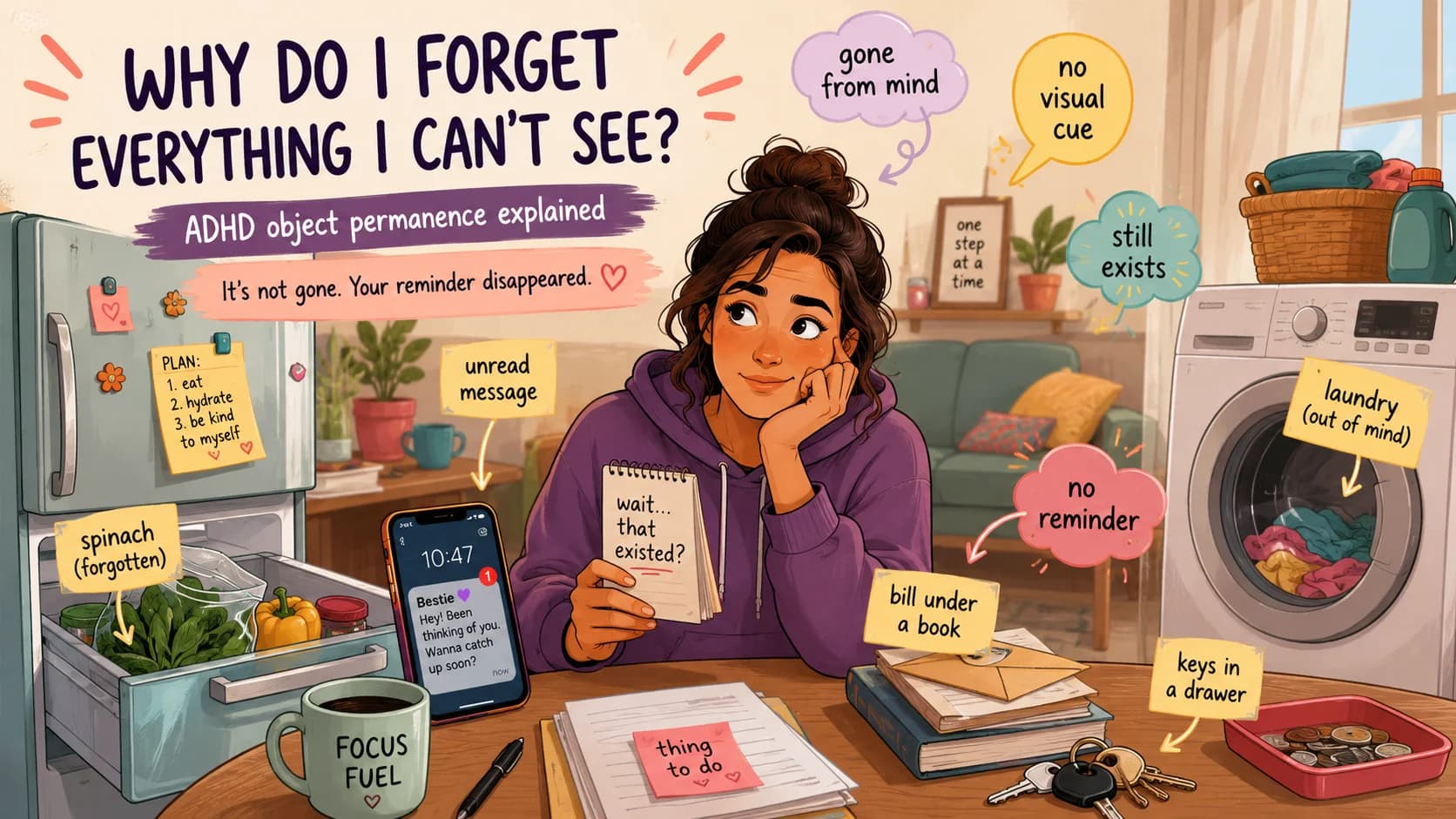
I once found a bag of spinach in my fridge that had quietly turned into soup. I bought it full of good intentions, put it in the drawer, and my brain filed it under "gone forever" the second the drawer closed.
Same week, a friend texted "you okay? haven't heard from you in ages," and I realized I'd loved her the whole time and simply not thought about her once in three weeks. Not busy. Not avoiding her. Just... out of sight, and therefore out of mind.
If your world is full of forgotten leftovers, unanswered messages and laundry you rediscover mid-cycle, you've probably seen the phrase "ADHD object permanence." Here's what it actually means, and how to make the important stuff stop vanishing.
The washer is the classic case, and if it is yours specifically, the ADHD Laundry Rescue Cards have a card for the forgotten wet load that tells you whether to rescue it or rewash it.
Quick answer
Why do I forget things I can't see?
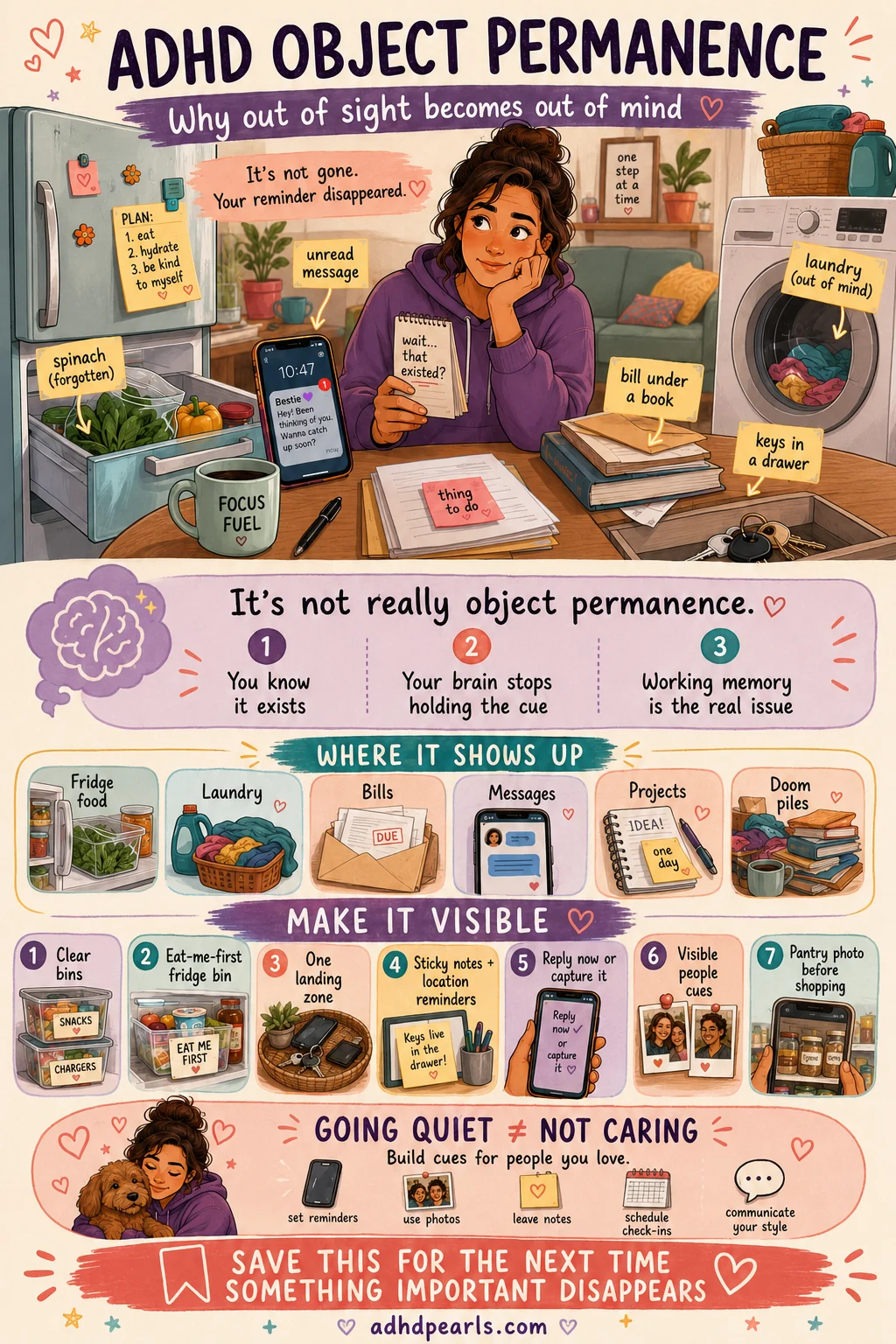
You haven't lost object permanence - you know things still exist when they're hidden. What's happening is a working-memory glitch: without a visual cue, your ADHD brain stops holding the thing in active awareness, so it effectively disappears until something reminds you. The fix isn't more willpower - it's making life visible and letting your environment do the remembering for you.
Key takeaways
📌You have not lost object permanence. You know things exist — it is a working-memory cue problem.
📌Without a visual prompt, the thing stops being held in active awareness and effectively disappears.
📌It applies to people too, and it is not a measure of how much you care about them.
📌Visible storage beats tidy storage. Clear containers and open shelves do the remembering for you.
📌Photograph the cupboard before you shop, and stop buying the fourth of something.
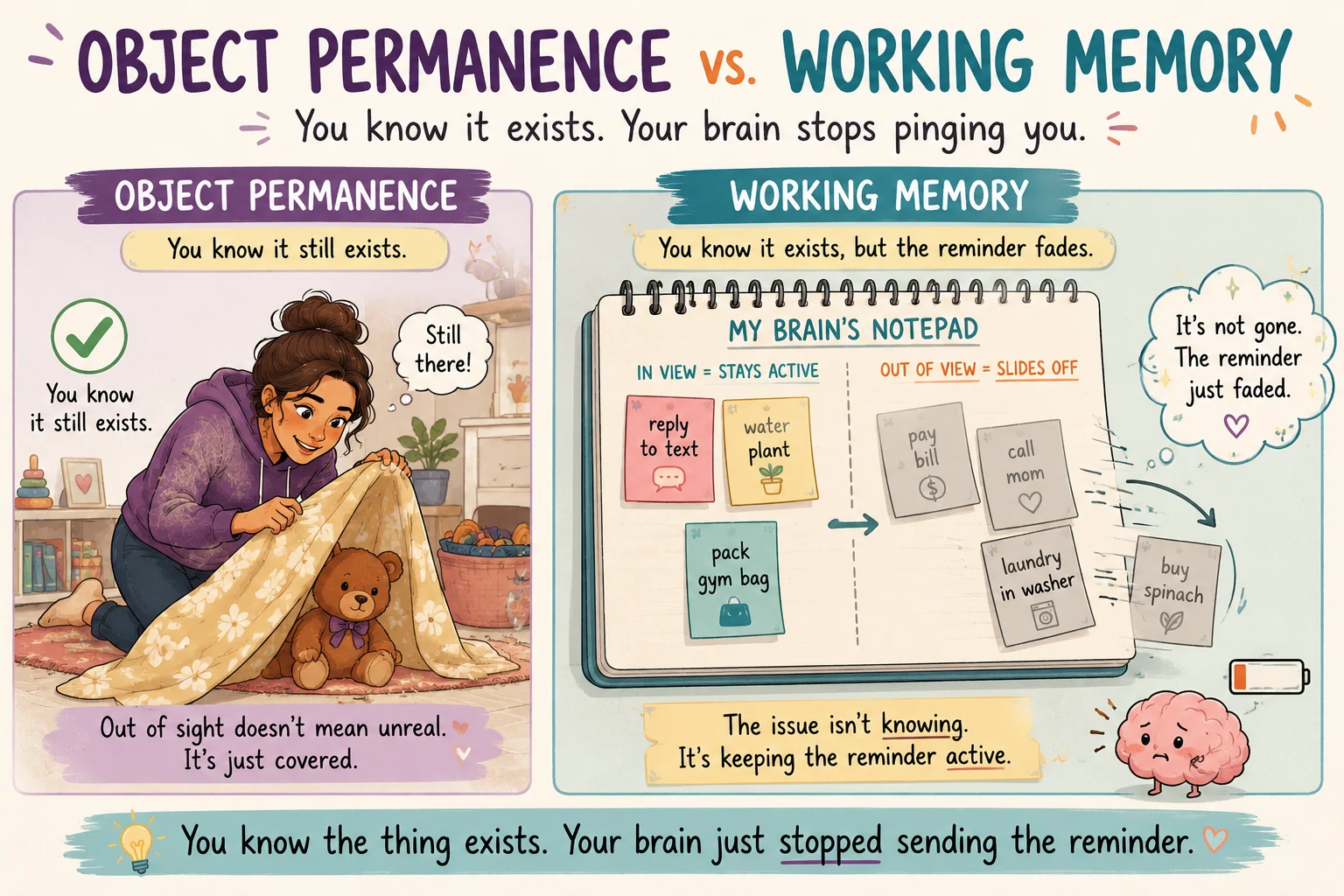
Yes and no, and the "no" part is worth knowing. Object permanence is the skill a baby develops around eight months old: the understanding that a toy hidden under a blanket still exists. You have this. You have never not had it. You know your car is in the parking lot even though you can't see it.
So clinicians don't list "object permanence" as an ADHD symptom, and you'll see that clarification a lot. What people in the ADHD community are really describing is different: things that are out of sight don't stay active in your mind. You know they exist - you just stop thinking about them entirely, as if they've been deleted from your to-do list without your permission.
The nickname stuck because that's exactly what it feels like from the inside. The accurate name is less catchy: working memory.
It's not that the thing stopped existing. It's that my brain stopped reminding me it did.
The problem is not knowing that something exists; it is keeping the reminder active when the visual cue disappears.
From ADHD Pearls
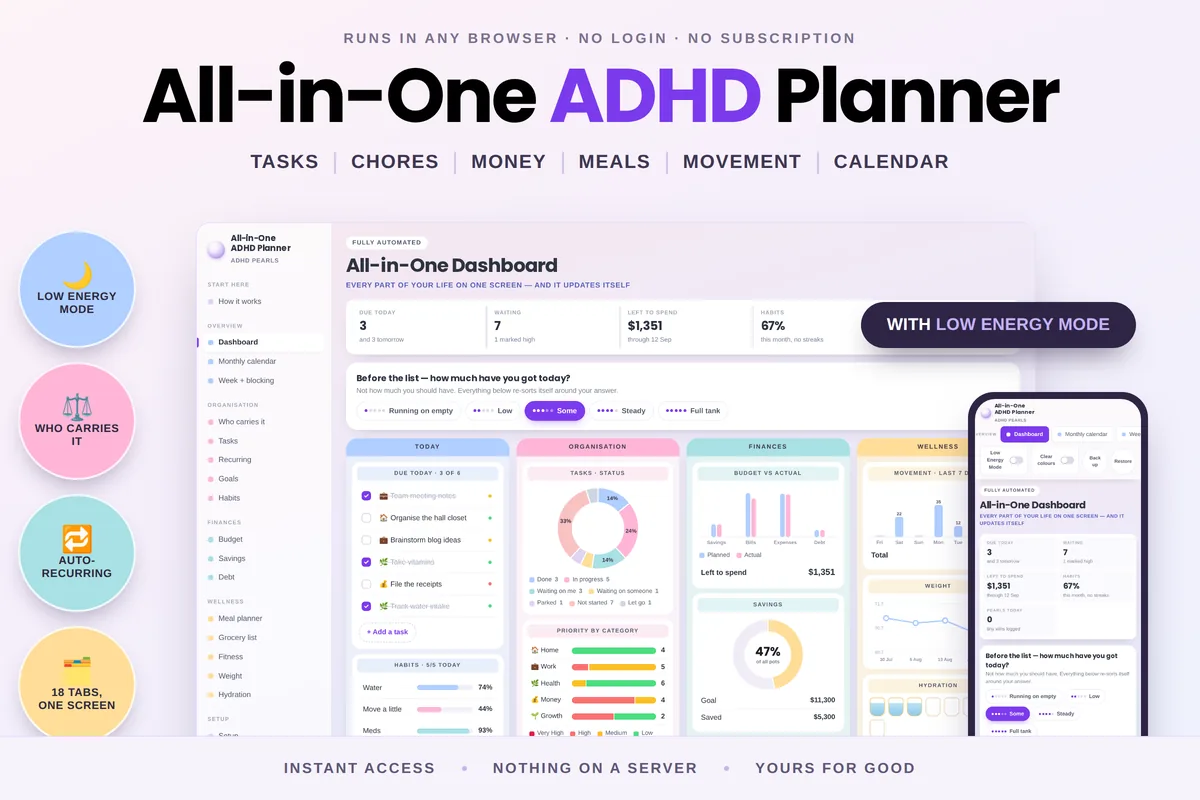
All-in-One ADHD Planner
Eighteen tabs that fill each other in. Say a repeating chore once and the schedule builds itself, and one tab shows who in the house actually carries what.
Opens in a new tab — this article stays where it is.
5 free days, counted only when you use it — just your email, no card. Then $27 once, private to your browser, no login, no subscription.
Why Does My Brain Actually Do This?
The engine underneath is working memory - the brain's short-term notepad that holds small bits of information so you can use them in the moment. In ADHD, that notepad is often underpowered, so anything you're not actively looking at tends to slide off the page.
This isn't a rare quirk. Research suggests working-memory difficulties show up in a majority of people with ADHD - by some estimates in as many as 62 to 85 percent of children studied. It sits right at the center of ADHD's executive-function profile, alongside planning, time and follow-through.
Put those together and you get the "out of sight, out of mind" experience. A visible object is its own reminder - it keeps pinging your attention just by being there. A hidden object has to be remembered from the inside, and that's the exact job an ADHD brain finds hardest. No cue, no thought, no action. It is also why repeating chores are so hard to keep going: a job due on a date has no object to see.
It's the same reason a task feels unreal until the deadline is looming, or "later" quietly becomes "never." If you've read about how ADHD actually shows up in women, this is one of its most exhausting daily forms.
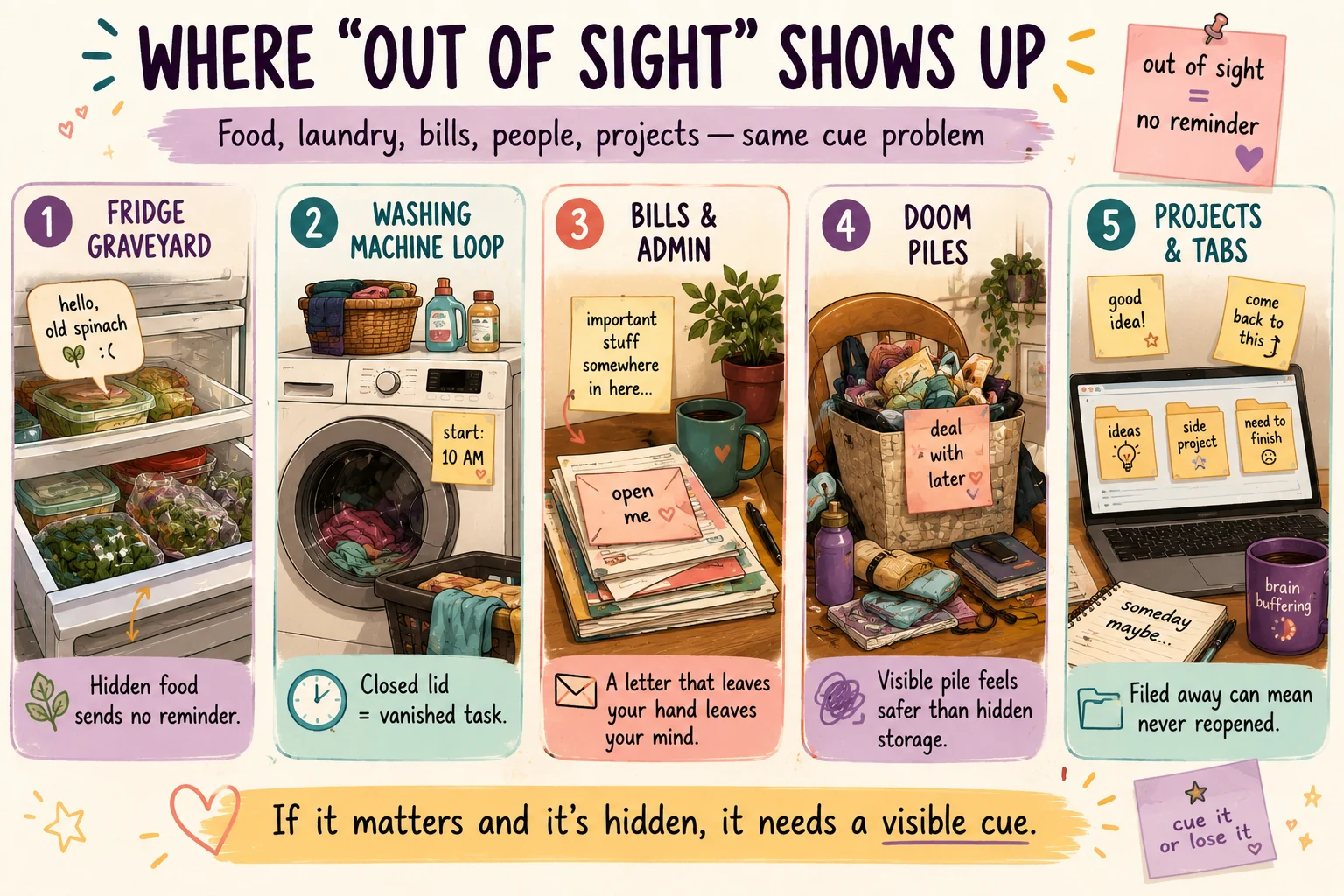
Where "Out of Sight, Out of Mind" Shows Up
Once you know the mechanism, you start spotting it everywhere. A few classics:
The fridge graveyard. Food in opaque drawers rots because hidden food sends no reminder. Same reason you buy a third jar of cumin you already own.
The washing machine loop. Laundry goes in, the lid closes, the clothes cease to exist, and you rediscover them two days later with that particular smell.
Bills and admin. A letter that leaves your hand leaves your mind. This is the beating heart of ADHD life-admin paralysis - not laziness, just invisibility.
Doom piles. Anything you "put away" into a drawer or box is gone. That's why open piles feel safer than tidy cupboards, and how doom piles quietly take over.
Projects and tabs. Filed into a folder = never opened again. The half-finished thing survives only while it's visibly in the way.
If something matters and it is hidden, it needs a visible cue so it does not vanish from active awareness.
Does This Mean I Don't Care About People?
This is the part that hurts, so let's be clear: no. Going quiet is not the same as not caring.
Relationships live in memory, and quiet relationships - the friend who isn't texting you right now, the cousin two cities away - don't generate their own reminders. So you can adore someone and still not think to message them for a month. From the outside it can look like neglect. From the inside it feels like they simply dropped off the edge of your mind, then reappeared with a jolt of guilt.
One person online put it perfectly: "if you don't text me first, I might forget you exist for a month - and I'll feel terrible about it." That's the loop. And the fix isn't loving people harder; it's building visible cues for the people who matter.
The kindest move is honesty. Tell your close people something like: "If I go quiet, it's never personal - a quick text from you helps me resurface." Most people are relieved to have an explanation that isn't "you did something wrong."
How Do I Stop Forgetting Things I Can't See?
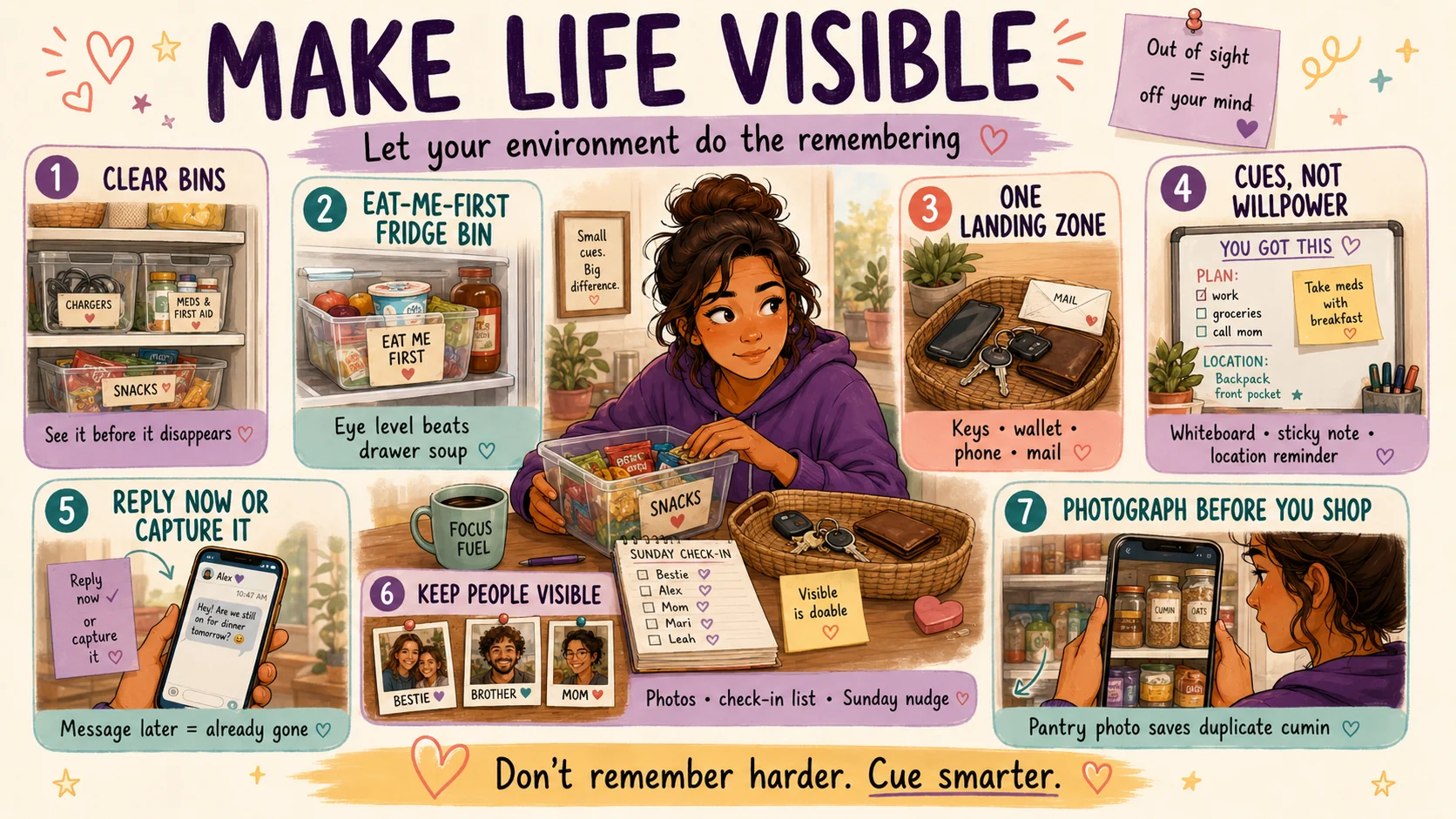
You don't fix this by trying to remember harder - that's asking the broken part to do more work. You fix it by moving the remembering out of your head and into the world. Make things visible, and let your environment carry the load.
1. Make the important stuff visible. Clear bins instead of opaque ones. Open shelves instead of closed cupboards. Glass jars, a fruit bowl on the counter, your gym bag by the door. If it matters, it should be catchable by your eyes.
2. Give the fridge a "face." Clear containers, and an "eat me first" bin at eye level for anything about to turn. You can only eat what you can see.
3. Build one landing zone. A single tray or hook by the door for keys, wallet, phone and incoming mail. One visible home means one place to look instead of a house-wide search.
4. Outsource memory to cues, not willpower. A whiteboard at eye level, sticky notes where you'll actually hit them, and phone reminders tied to a time and a place ("6pm, kitchen: take out the bins"). A reminder with no trigger is just a wish.
5. Reply in the moment, or capture it. The message you save "for later" is already gone. Answer it now, or fire off a reminder before you put the phone down. This is one reason tidy apps and buried folders fail ADHD brains - anything out of view is out of play. The most expensive version of this happens in the kitchen, which is why an ADHD fridge needs an eat-first shelf more than it needs tidy drawers. The largest version lives on your phone, where thousands of screenshots sit in a place you never open.
6. Keep the people you love visible. A short "check in" list, photos where you'll see them, or a gentle recurring nudge to text two people on Sundays. It feels unromantic; it works.
7. Photograph before you shop. A quick snap of the pantry or the cleaning cupboard saves you buying duplicate number four.
8. Buy for visibility, not for tidiness. Clear, front-opening bins instead of matching lidded baskets; open shelves instead of closed cupboards. This is also why a tracking tag is one of the most useful gifts you can give an adult with ADHD — it outsources object permanence to a device that never forgets.
The goal is not to remember harder, but to let your environment do more of the remembering.
This is educational, not medical advice. Object permanence is community shorthand, not a clinical diagnosis, and working-memory struggles can also come from anxiety, sleep deprivation, thyroid issues and more. If forgetfulness is affecting your life, bring it to a qualified professional.
The tiny move: pick one thing that keeps vanishing - the pills, the water bottle, the one bill - and give it a visible home today. Just one. You're not disorganized or cold. Your brain just needs the world to hold the string for you, and now you know how to hand it over.
Save this ADHD object permanence guide for the next time something important disappears from mind.
FAQ: ADHD and Object Permanence
Is object permanence really an ADHD symptom?
Not in the clinical sense. Object permanence - knowing something still exists when you can't see it - is a skill you developed as a baby and never lost, and clinicians don't list it as an ADHD symptom. It's community shorthand for a real experience: tasks and things dropping out of your mind the moment they leave your sight, driven by working-memory and attention differences.
Do people with ADHD lose object permanence like infants?
No. You know your keys still exist in the drawer and your friend still exists across town - you're not confused about reality. What happens is that your brain stops holding an active reminder of them, so they stop coming to mind until something pulls them back into view.
Why do I forget people exist when I don't see them?
Because relationships live in memory, and ADHD working memory doesn't keep quiet things pinned. When someone isn't in front of you or in your feed, your brain doesn't generate the reminder to reach out. It feels like you forgot them, but it's a cueing problem, not a caring problem.
Why do I forget food in the fridge until it goes bad?
Opaque drawers hide the food, and hidden food doesn't send your brain a reminder that it's there. This is also why many people with ADHD buy duplicates of things they already own. Clear containers and an "eat me first" bin at eye level fix a surprising amount of it.
Does ADHD object permanence affect relationships?
Often, yes. You might go quiet for weeks, forget to reply, or accidentally 'ghost' someone you genuinely love, then feel awful about it. Being honest with close people - "if I go quiet, it's never personal, a quick text helps me resurface" - takes the sting out and sets up gentle reminders.
How do I stop forgetting things I can't see?
Make the important things visible and let your environment do the remembering. Use clear storage, open shelves, one landing zone for keys and mail, and reminders tied to a time and place. The rule of thumb: if it matters and it's hidden, it will vanish - so give it a home you can see.
Is it object permanence or working memory?
Working memory is the accurate term. It's the brain's short-term notepad, and in ADHD it's often underpowered, so information you aren't actively looking at slips off the page. "Object permanence" is the nickname people use because that's what the experience feels like from the inside.
Why do I keep buying things I already own?
If an item is stored out of sight, your brain has no active record of it while you're at the store, so it feels like you don't have one. A quick phone photo of your pantry or a running shared list gives you a visible reference to check before you buy.
Can medication help with ADHD object permanence?
ADHD medication can improve working memory and attention for some people, which may make it easier to hold things in mind. It doesn't replace visible systems, though - most people do best combining any treatment with an environment built around cues. Medication decisions should always be made with a qualified clinician.
One tap makes ADHD Pearls a preferred source in your Google account, so our articles surface higher when you search. No signup, and it brings you straight back to this page.
Before you go
All-in-One ADHD Planner
Eighteen tabs that fill each other in. Say a repeating chore once and the schedule builds itself, and one tab shows who in the house actually carries what.
For the woman who sets up the perfect system on Sunday and abandons it by Tuesday.
One short letter, every week. Real talk about ADHD, task paralysis, and the tiny wins that actually move the needle for a brain like yours. No shame. No hustle culture.