Someone once told me to go for a walk when I felt overwhelmed. Good advice. I have used it many times and it works.
It did not work the evening I was sitting on the floor of my hallway, unable to decide whether to stand up. I remember thinking about the walk. I remember understanding that it would probably help. And I remember being about as capable of putting on shoes as I was of filing a tax return.
For a long time I read that as proof that regulation strategies do not work on me. What was actually true is duller and more useful: the advice was fine, and I was two levels below the level it was written for.
Once I started sorting my bad states into levels instead of treating them as one big undifferentiated "overwhelmed", the whole thing got easier. Not because I found better strategies. Because I stopped reaching for the wrong-sized one.
Quick answer
What should I do when I am overwhelmed with ADHD?
Work out how much capacity you have left first, then pick a tool that fits it. Mild: move your body or close the loop that is nagging you. Moderate: empty your head onto paper and shrink the world to one timed thing. Shutdown: stop trying to function and cut input. Using a mild-overwhelm tool during shutdown is why help sometimes makes things worse.
Key takeaways
📌Match the tool to the capacity you have left, not to the size of the situation.
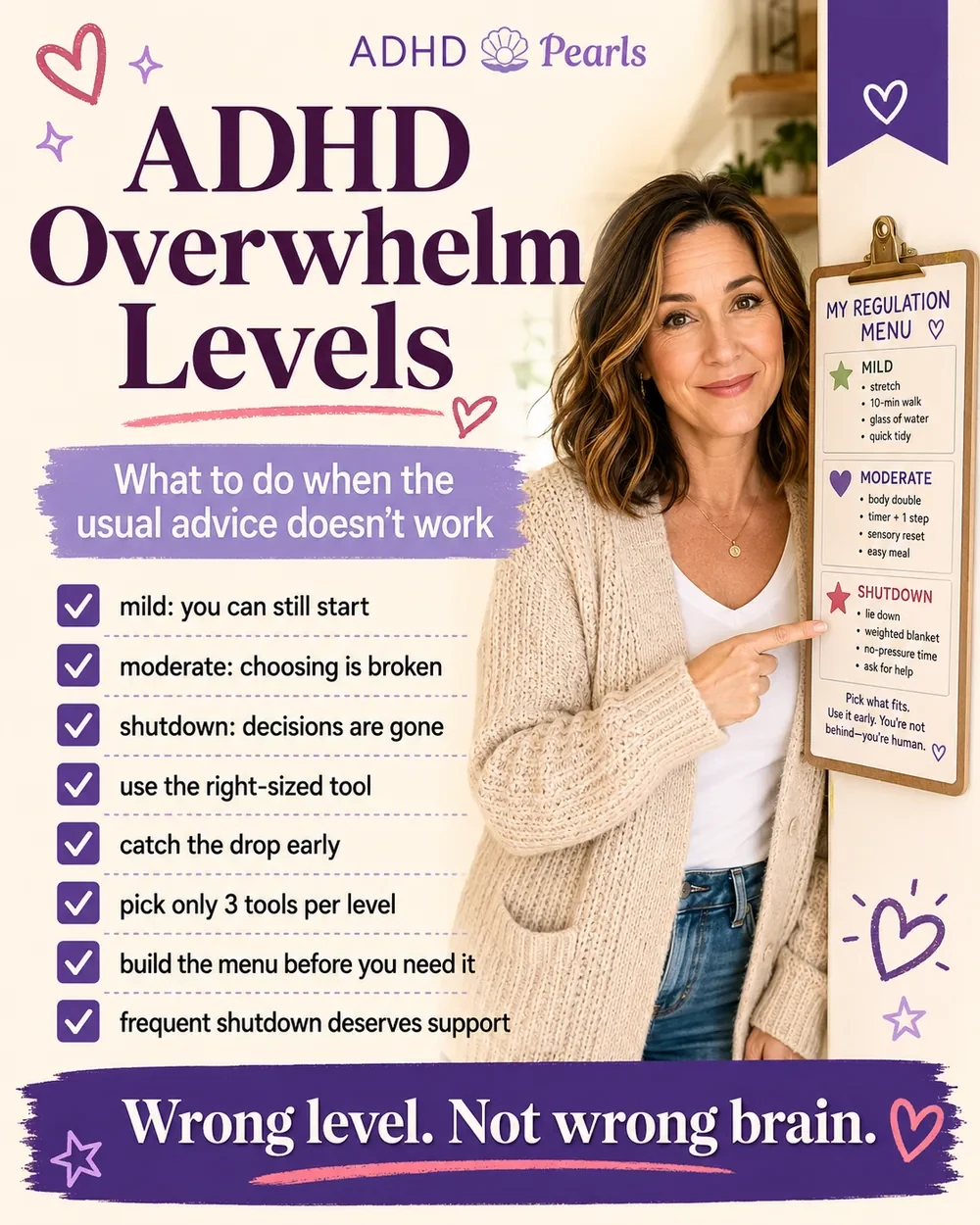
📌Mild: move, or close the loop that is nagging. Moderate: empty your head, shrink to one timed thing. Shutdown: cut input.
📌Using a mild-overwhelm tool during shutdown is why well-meant help sometimes makes things worse.
📌Learn your own signs of dropping a level. They show up before you notice the drop.
📌Build your menu before you need it. Nobody designs one mid-shutdown.
Almost every list of coping strategies is written as though overwhelm is one thing. It is not. It is a range, and the amount of executive function you have left at each end is wildly different.
At the top of the range you can still think, plan and initiate. You are irritable and slightly off, but the machinery works. Almost any strategy will work here, which is why the people writing the lists tend to be writing from here.
At the bottom, initiating anything at all is the thing that has broken. Advice that requires you to decide, plan or begin is not slightly harder. It is unavailable.
So a strategy that fails is usually not the wrong idea. It is the wrong size. And because we experience it as personal failure rather than a mismatch, we tend to throw the strategy away permanently, which is how people end up convinced that nothing works for them.
A strategy that failed at shutdown is not a bad strategy. It is a strategy you tried two levels too late.
There is a reason this hits ADHD brains harder. Emotional dysregulation is now widely treated as a core feature of adult ADHD rather than a side effect - a meta-analysis of 13 studies covering 2,535 adults found substantially higher levels of emotional dysregulation in adults with ADHD than in controls, and estimates suggest it affects somewhere between 30 and 70 percent of us. The intensity arrives faster and stays longer, so the window between "slightly off" and "cannot function" is shorter than most advice assumes.
From ADHD Pearls
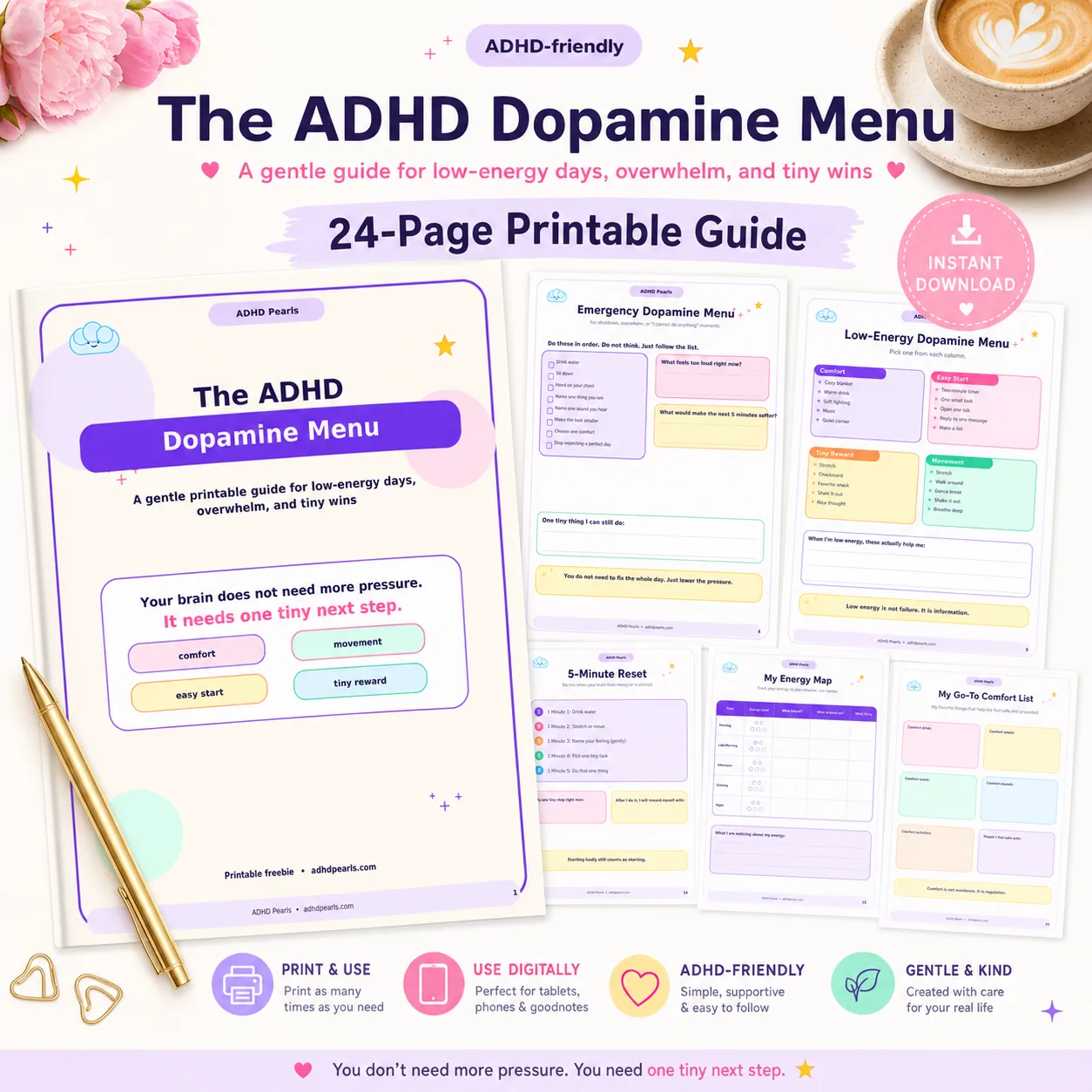
Free Dopamine Menu
24 tiny activities for low-energy, low-capacity days.
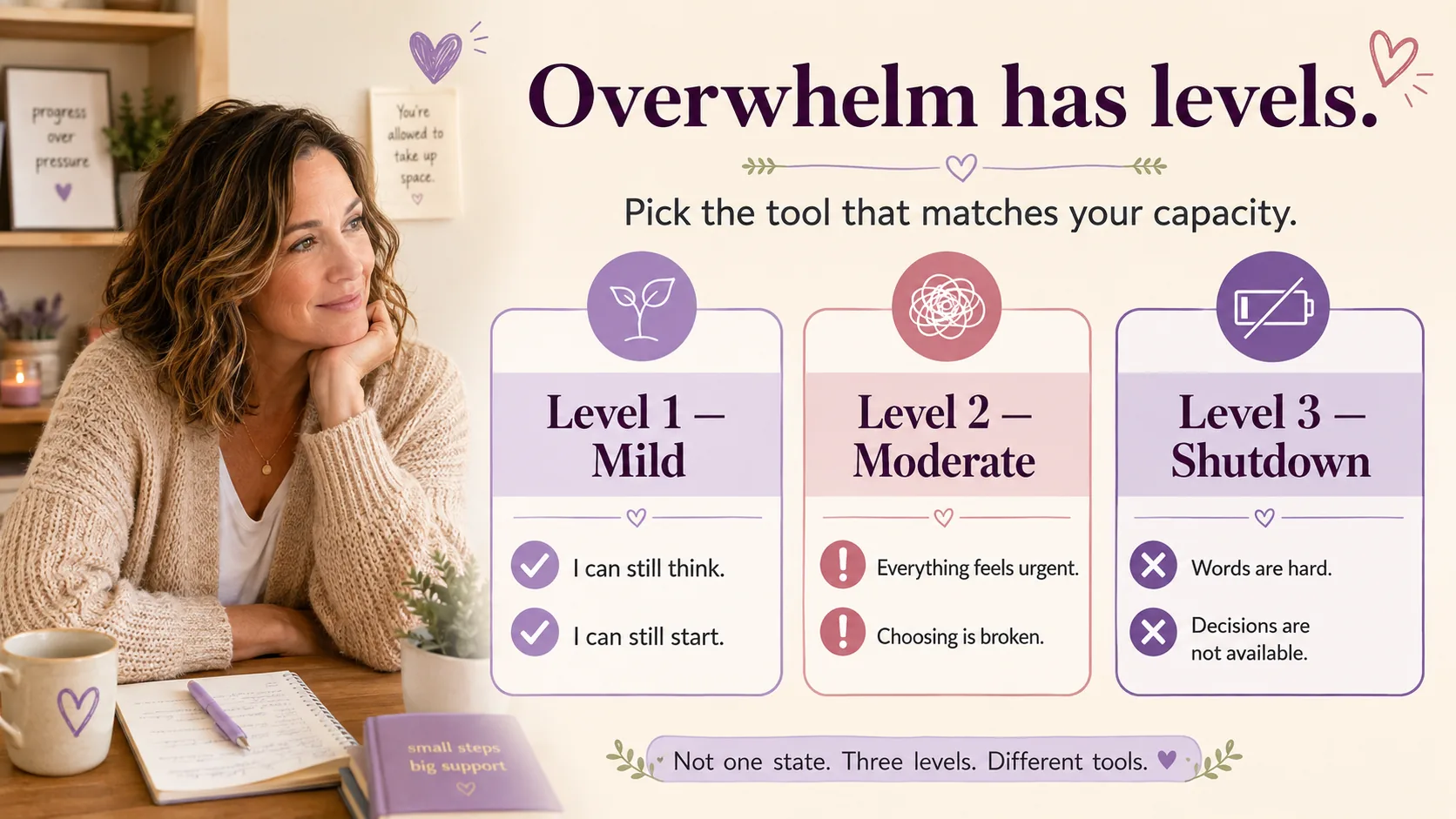
Three is enough. I have tried finer-grained versions and I could never use them, because assessing yourself accurately is itself a task that needs capacity.
Level 1 - Mild. I can still think, something is just off.
Irritable. Restless. Reading the same sentence three times. Snapping at something that does not deserve it. Opening and closing the same app.
Crucially: you can still start things. That is the defining feature, not how bad you feel.
Level 2 - Moderate. Scattered, and everything feels urgent.
Thoughts will not stay put. You start four things and finish none. The mental list is loud and unsortable, and everything on it feels equally and immediately necessary, which is a reliable sign that the sorting function has gone.
You can still act, but only if the acting is decided for you. Choosing is the part that has broken.
Level 3 - Shutdown. I cannot think, I need to get through this.
Words are hard. Decisions are not available. You may feel flat rather than distressed, which is why this is so often mistaken for laziness or a mood - including by the person in it.
Mine is quiet. I go vague and slightly slow, and for years everyone around me including me read it as tiredness. If you want the fuller picture of how this differs from a meltdown, and what to do when the trigger is specifically sensory, that is the first aid protocol for sensory overload.
This is educational and personal, not medical advice. Persistent overwhelm, flatness and shutdown also appear in depression, anxiety, burnout, trauma and perimenopause. If this is frequent or getting worse, please take it to a doctor rather than sorting it into levels on your own.
Overwhelm is not one state. The right tool depends on how much capacity is still available.
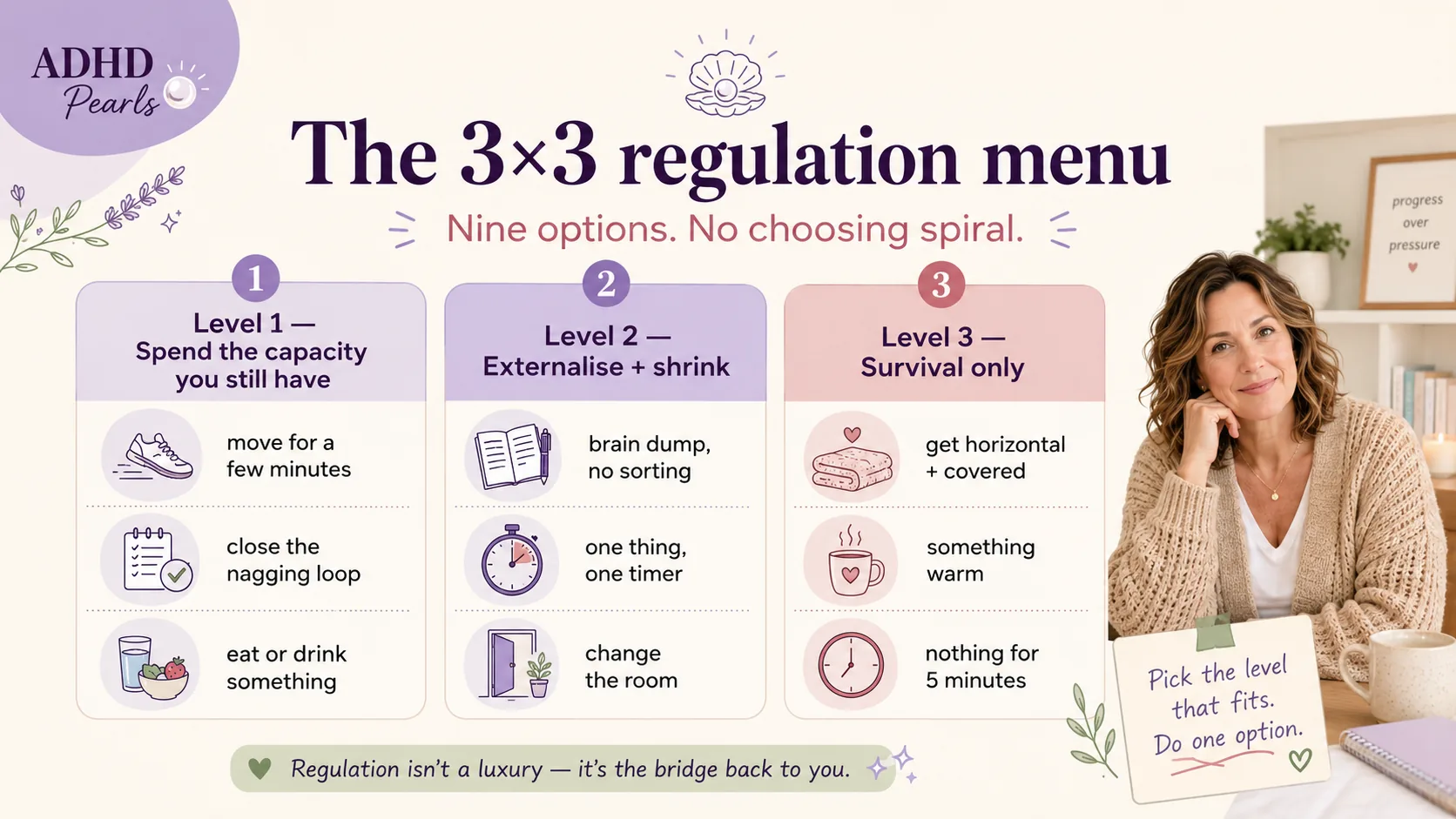
The Menu: 3 Things Per Level
Three per level. Nine total. Any more and you are choosing, which defeats the point.
Level 1: spend the capacity you still have
At mild, you can act - so act, before it costs more.
Move your body for a few minutes. Stairs, the end of the street, anything. There is decent evidence behind this: a study of adults with ADHD found that a bout of moderate aerobic exercise measurably improved attention and processing speed afterwards. That study used thirty minutes of cycling, so I will not pretend two minutes on the stairs is the same intervention - but it is the version I can actually do at 4pm, and it reliably moves me back up a level.
Close the loop that is nagging. Name the specific thing quietly draining you. Then either do it, if it takes two minutes, or write it down. Unfinished things cost attention continuously, and at mild level you still have the ability to pay them off cheaply.
Eat and drink something. Unglamorous and disproportionately effective. I have talked myself out of a great many "emotional" states with a glass of water and a piece of toast at half past four.
Level 2: externalise and shrink
At moderate, choosing is what broke. So remove choosing.
Brain dump, no sorting. Everything out of your head and onto paper, in whatever order it arrives. Do not organise it, do not prioritise it, do not make it a system. The relief comes from getting it out, not from the list being good.
One thing, one timer. Pick anything from the dump - genuinely anything, it does not have to be the important one - and set fifteen minutes. The point is to shrink the world to a size your brain can currently hold.
Change the room. Leave the space you are in, or lower what it is doing to you - light down, sound off, a door closed. At this level you do not have the capacity to filter a busy room and think at the same time.
Level 3: survival only, no decisions
At shutdown there is nothing to spend. The only reasonable goals are rest, warmth and food.
Get horizontal and covered. Bed, sofa, floor. A blanket even if you are not cold - weight and enclosure help most people, and it removes the ongoing low-level work of holding yourself upright.
Something warm, in the easiest possible form. Tea, soup from a tin, toast. This is not the moment for a nutritious plan. Whatever requires the fewest steps between you and calories is the correct answer.
Nothing, deliberately, for a set time. No phone, no plan, no working out what went wrong. And do not mistake scrolling for this - it is more input, not less, which is the distinction in fake rest versus real rest.
If your day has been low from the start rather than crashing suddenly, the maths is slightly different and low-energy days covers it properly.
Three tools per level is enough. More choices can become another task.
Noticing You Are Dropping a Level
The whole thing only works if you catch the fall. Which is hard, because the ability to notice is itself one of the things going offline.
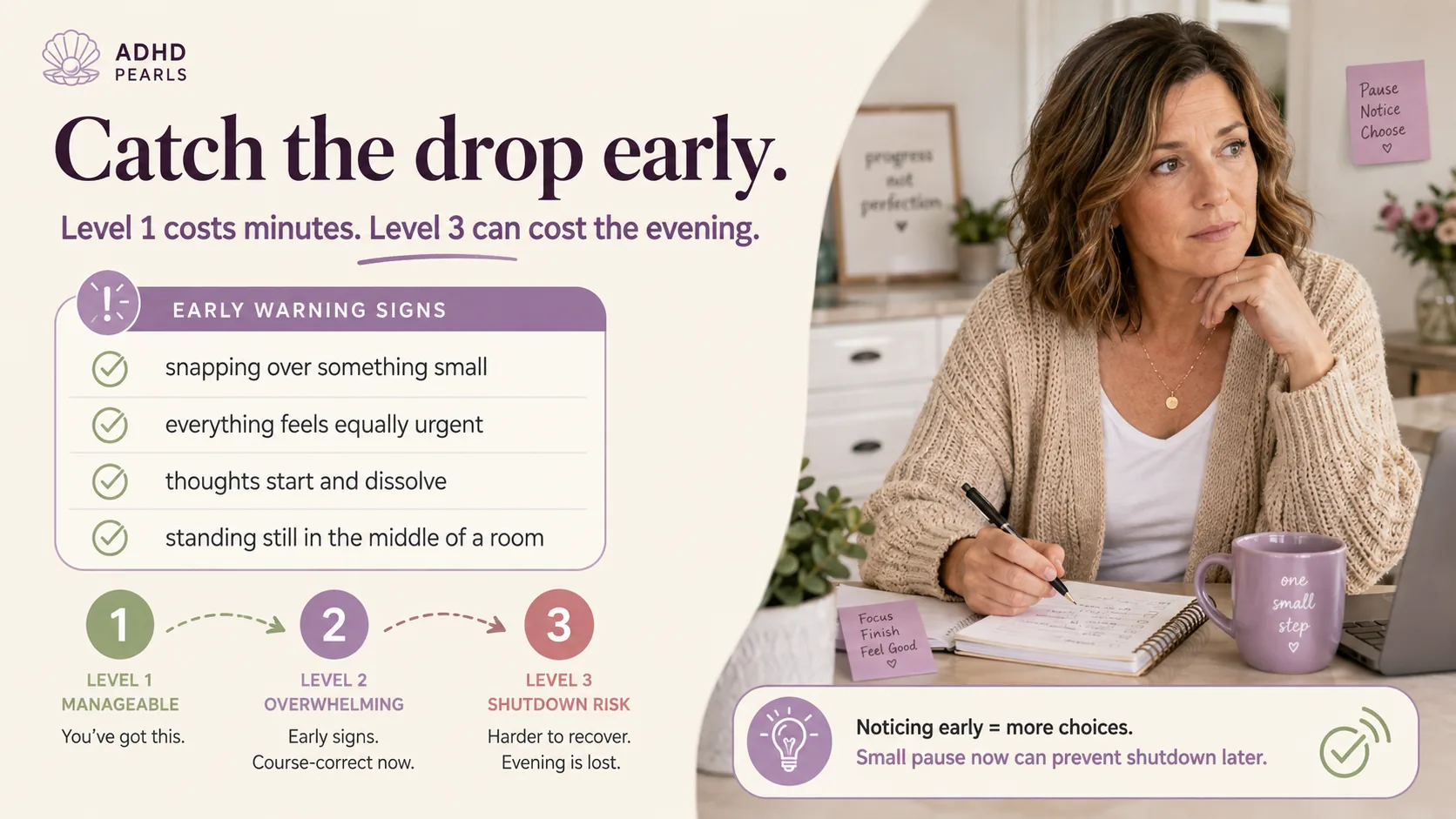
The signals I have learned to trust, in the order they usually arrive:
I get short with someone over something small. Almost always my first sign, and almost always about twenty minutes before I would otherwise have noticed anything.
Everything on the list becomes equally urgent. When I cannot tell what matters more, the sorting function has already gone.
I stop finishing sentences in my head. Thoughts start and dissolve.
I stand still in the middle of a room. Physically stopped, holding something, not going anywhere. That one means I am nearly at level three.
Pick your own two. Not nine - two, the earliest ones you actually recognise. The goal is to intervene at level one, where it costs four minutes, instead of level three, where it costs the evening.
Catching the drop early gives you more options. Waiting until shutdown makes every tool harder.
Using the Wrong Level's Tool
It goes wrong in both directions, and both are worth naming.
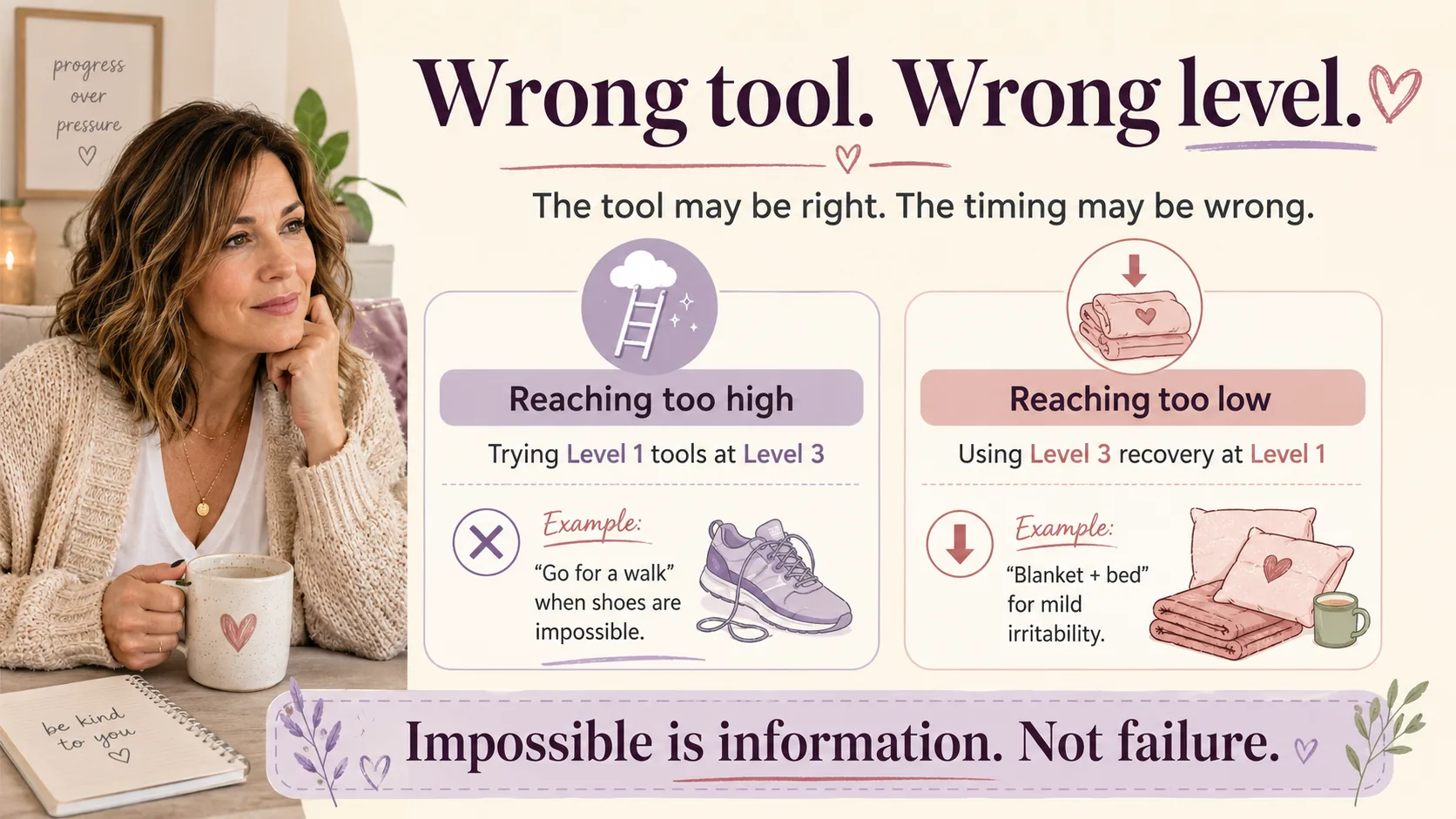
Reaching too high. Trying a level 1 tool at level 3. Attempting to go for a walk, do a brain dump or tackle the important task when there is nothing left to spend. It does not work, and then you conclude something about yourself rather than about the timing.
Reaching too low. Going straight to bed and a blanket over mild irritability. Occasionally that is exactly right. Mostly it turns a twenty-minute wobble into a lost afternoon, and the guilt afterwards does more damage than the original state.
I get this wrong regularly. The fix that helped most was not better judgement, it was giving myself permission to guess and adjust - try the level you think you are at, and if the tool feels impossible, you are lower than you thought. That is information, not failure.
If a tool feels impossible, that is information about your level. It is not proof that you failed.
Build Yours Before You Need It
Mine works because it was written on a good afternoon, not in the hallway.
Take ten minutes when you are fine. Write three levels. Under each, three things that have genuinely worked for you at that level - not things that sound wise. Then put it somewhere you will physically see it: the fridge, the back of a door, the inside of a cupboard you open daily.
Two rules that made mine usable. Nothing that requires ordering anything, and nothing that requires another person to be available - because both introduce a decision and a dependency at exactly the wrong moment.
If you want a ready-made starting point rather than a blank page, the dopamine menu is the same idea sorted by type of activity instead of by level, and there is a longer explanation of how to use one in how a dopamine menu works.
One Tiny Move
Do not build the whole menu today. Write one line.
Think of the last time you were properly overwhelmed, and write down the single thing that helped - and which level you were at when it helped. One entry, on a sticky note, on the fridge.
That is the hardest square filled in, because it is the only one you cannot get from an article. Everything else you can borrow from mine.
Save this for the next time the usual advice does not work and you need to match the tool to your actual capacity.
Pin this ADHD overwhelm levels guide for the next time you need a tool that fits the state you are actually in.
FAQ: ADHD Overwhelm Levels
What do I do when I am overwhelmed with ADHD?
First work out how much capacity you have left, then pick a tool that fits it. At mild overwhelm you can still act, so move your body or close the loop that is nagging you. At moderate you cannot hold thoughts, so get everything out of your head onto paper and shrink the world to one timed thing. At full shutdown you have no executive function left, so the only jobs are rest, warmth and food. Matching the level matters more than the specific action.
Why does regulation advice never work for me?
Usually because it was written for a different level than the one you are at. Go for a run is reasonable advice at mild overwhelm and completely impossible at shutdown. When a strategy fails, it is often the wrong size rather than the wrong idea, and it is worth trying the same tool again when you have more capacity.
What are the signs of ADHD overwhelm before shutdown?
Common early signs are re-reading the same sentence, snapping at small things, opening and closing the same app, feeling like everything is equally urgent, and physically standing still in the middle of a room. These arrive before the fog does, and catching them is the whole point of knowing your levels.
Is ADHD overwhelm the same as emotional dysregulation?
They are related but not identical. Emotional dysregulation is the difficulty regulating the intensity and duration of emotions, and research suggests it affects roughly 30 to 70 percent of adults with ADHD. Overwhelm is the state of having more input and demand than capacity. Overwhelm makes dysregulation much more likely, because the resource you would use to steady yourself has already been spent.
How do I know if I am in ADHD shutdown?
The clearest marker is that thinking itself has stopped being available. Words are hard, decisions are impossible, you may feel flat rather than upset, and you can look completely fine from the outside. If you are able to read this and weigh it up, you are probably not in full shutdown yet, which means you still have the window to act.
How long does ADHD overwhelm last?
Mild overwhelm can lift in minutes if you catch it. Moderate usually needs an hour or two of reduced demand. A full shutdown often takes the rest of the day, and the flat feeling afterwards is recovery rather than laziness. Caught early it is a small event; ignored, it takes the evening.
Why can I not just push through?
Because pushing through spends capacity you do not have, and the debt gets collected later with interest. Pushing through mild overwhelm is often fine. Pushing through moderate usually turns it into shutdown. Pushing through shutdown mostly produces a longer shutdown.
What should I do the day after a shutdown?
Reduce demands rather than making up for lost time. The instinct to compensate is strong and it is how a bad evening becomes a bad week. Pick one thing that needs doing, do that, and treat everything else as optional for one day.
Does a regulation menu actually help, or is it another list I will ignore?
It helps for the same reason a fire drill helps — it removes the need to decide anything at the moment you are least able to decide. Keep it to nine items, keep it visible, and accept that you will only ever use three or four of them regularly.
One tap makes ADHD Pearls a preferred source in your Google account, so our articles surface higher when you search. No signup, and it brings you straight back to this page.
Before you go
Free Dopamine Menu
24 tiny activities for low-energy, low-capacity days.
For the woman who sets up the perfect system on Sunday and abandons it by Tuesday.
One short letter, every week. Real talk about ADHD, task paralysis, and the tiny wins that actually move the needle for a brain like yours. No shame. No hustle culture.