It was 5:40 on a Tuesday and my partner, standing in front of the open fridge, asked the question with total innocence: “What’s for dinner?”
I knew the answer. I also knew we had two eggs, not six, that the spinach had until Thursday, that the tortillas were in the cupboard behind the flour, and that someone had finished the milk and put the empty carton back. I knew all of this the way you know the lyrics to a song you hate.
He did not know any of it. Not because he is careless. Because the whole kitchen lived in one head, and it was mine.
Quick answer
Why am I the only one who knows what’s for dinner?
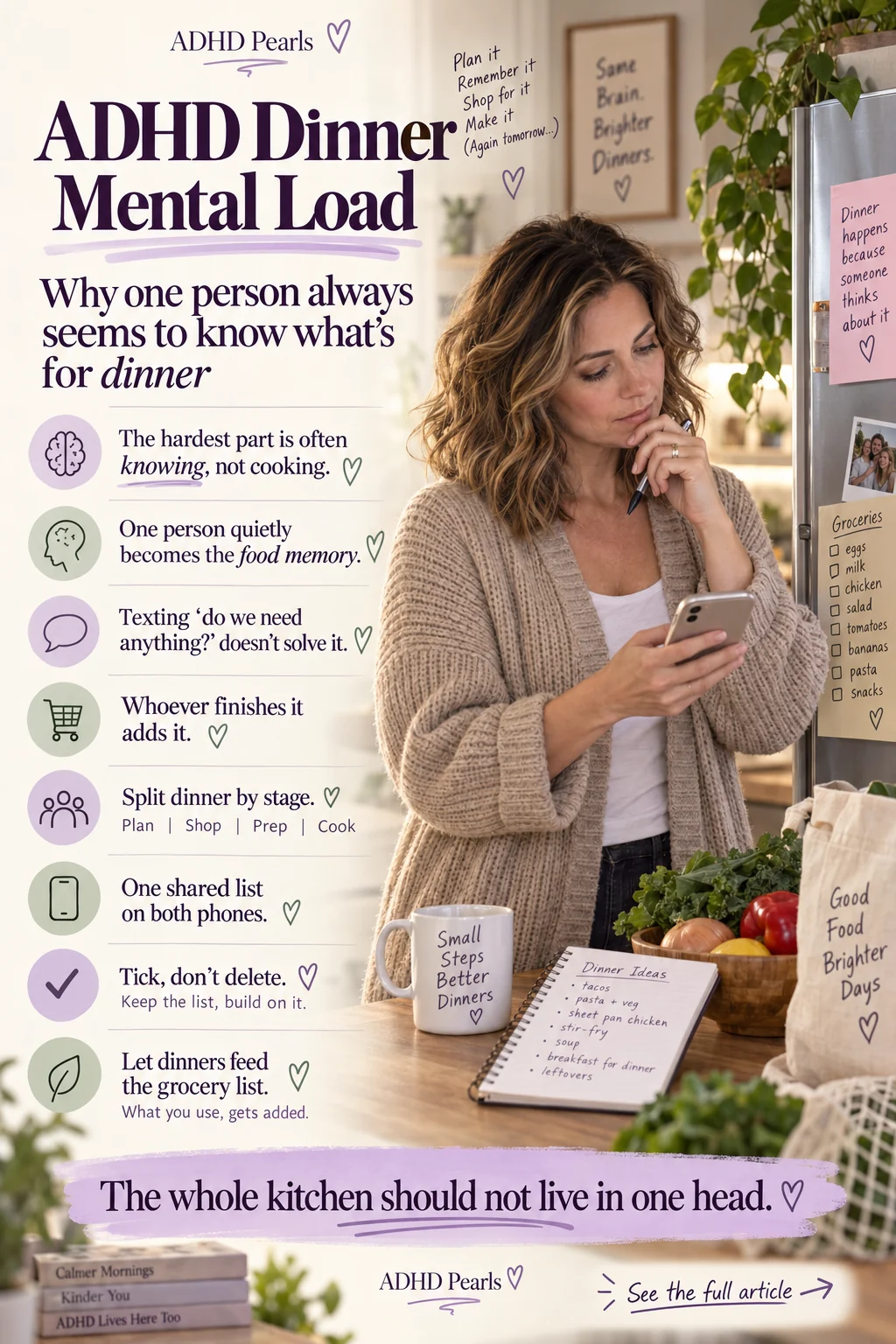
Usually because one person quietly became the household’s food memory: what is in the fridge, what ran out, what gets eaten this week. That job is invisible, repeats every single day, and is hard to share while it lives in one head. It gets lighter when the list lives in one shared place and each stage of dinner has an owner.
Key takeaways
📌The hardest part of dinner is rarely the cooking. It is knowing, every day, what the kitchen needs.
📌A list that lives in one person’s head cannot be shared, however willing the other person is.
📌“Do we need anything?” by text is a request for a memory dump, not a shopping list.
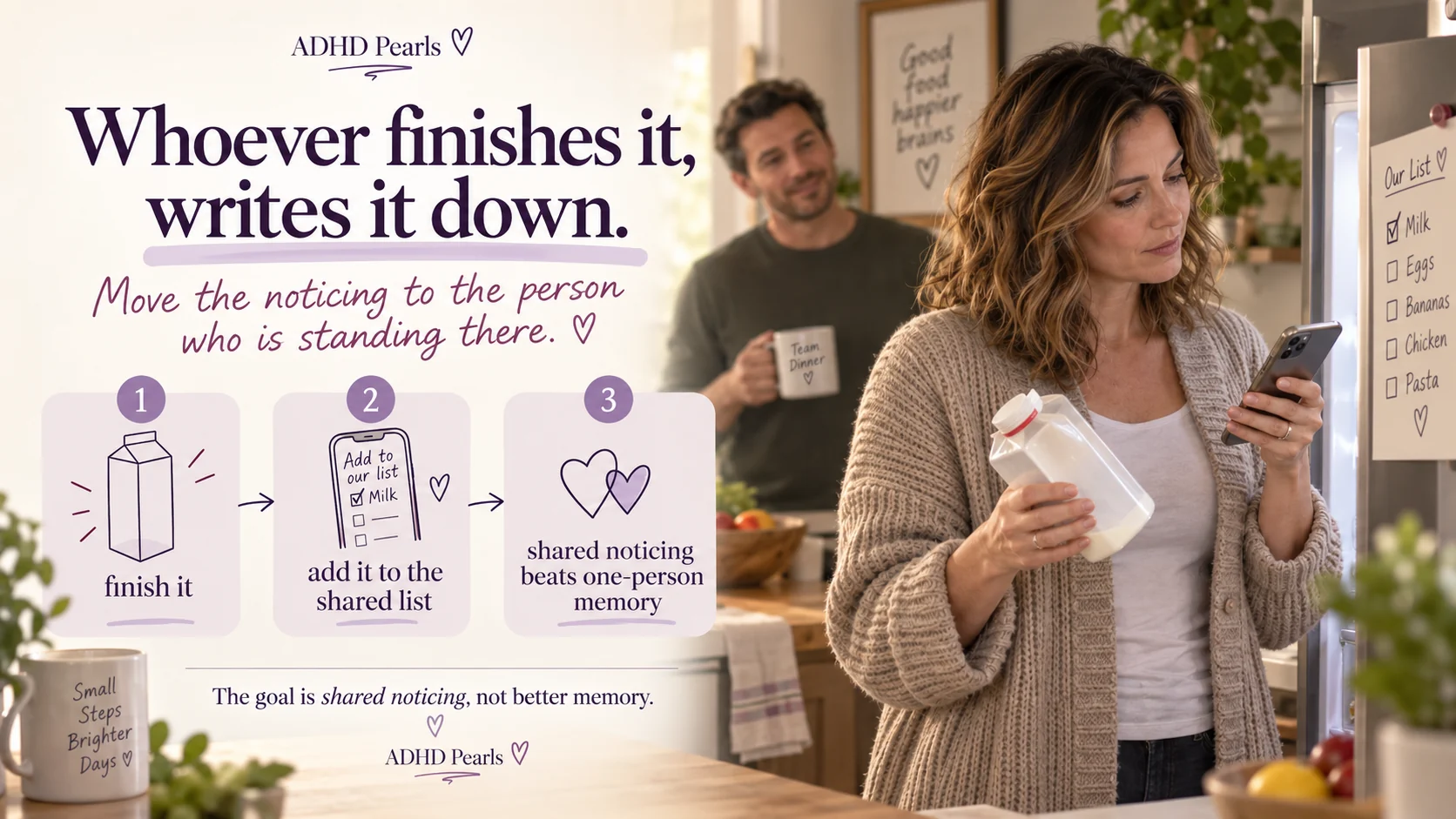
📌One rule fixes most of it: whoever finishes something writes it down, in the one place you both use.
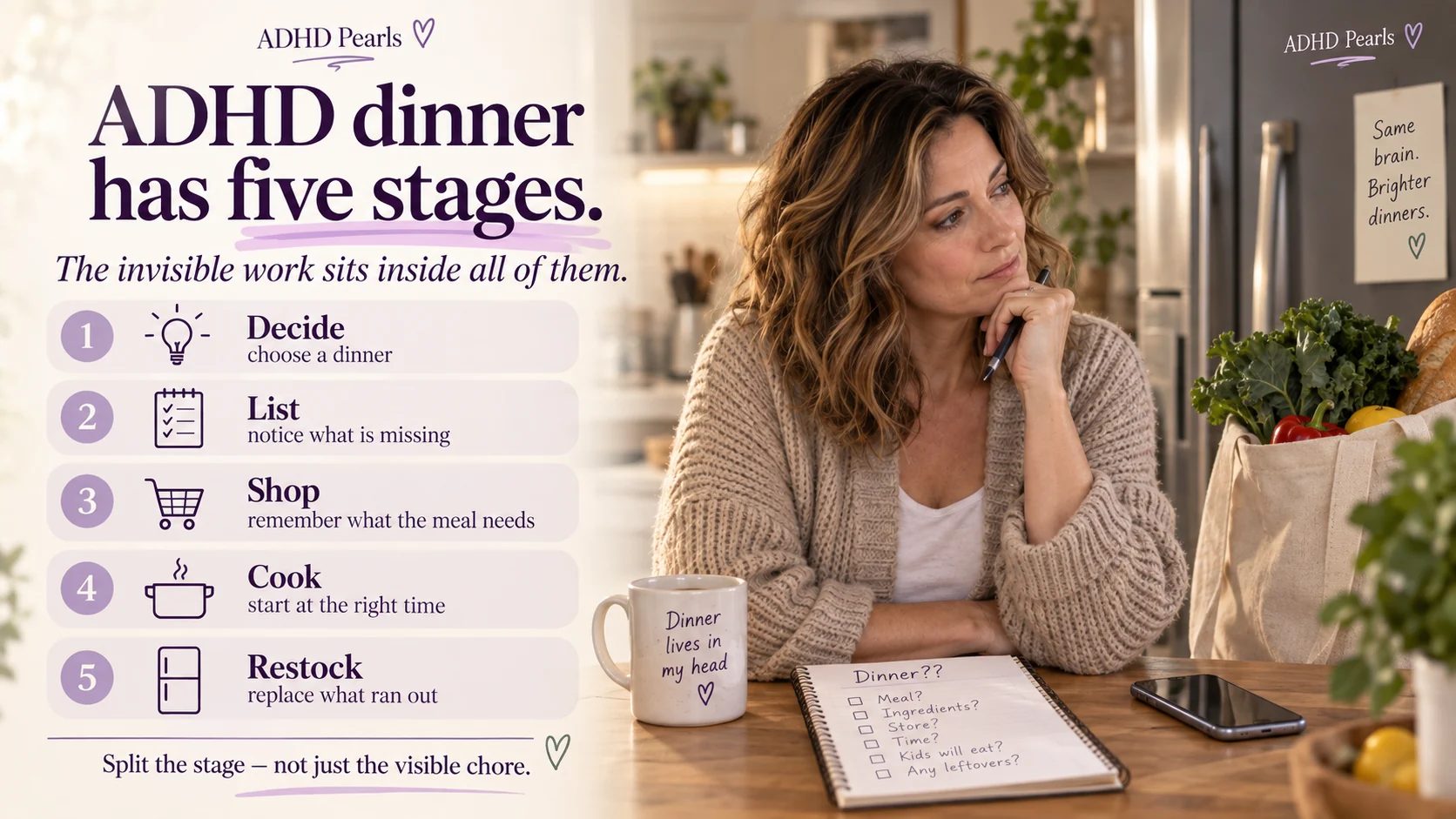
📌Split dinner by stage, not by favor, so the deciding and the listing are not always the same person’s job.
Nobody in our house ever decided that I was in charge of food. It happened the way a drawer fills with batteries. I noticed we were out of rice once, then twice, and at some point noticing became my job without anyone applying for it.
Sociologists have a clean name for this. In interviews with 35 couples, Allison Daminger described household cognitive labor as four steps: anticipating needs, identifying options, deciding, and monitoring what happens next. The striking finding was that the deciding was shared fairly evenly. The anticipating and the monitoring were not. I went through all four parts, and the two that ADHD makes hardest, in ADHD and the mental load.
Dinner is that pattern in its purest form, because it never stops repeating. A dentist appointment happens twice a year. “What are we eating?” happens roughly 365 times, plus the side quest of what we need to buy to make it possible.
Planning dinner is the only chore that is finished before anyone notices it started. By the time someone is hungry, the invisible part is already done.
It shows up in surveys too. In the Armour Mealtime Pressure Index, a January 2026 survey of 2,000 US parents, 39% said planning and preparing dinner takes more of their time than actually sitting down to eat it. Only 23% said the eating took longest. The meal is the short part.
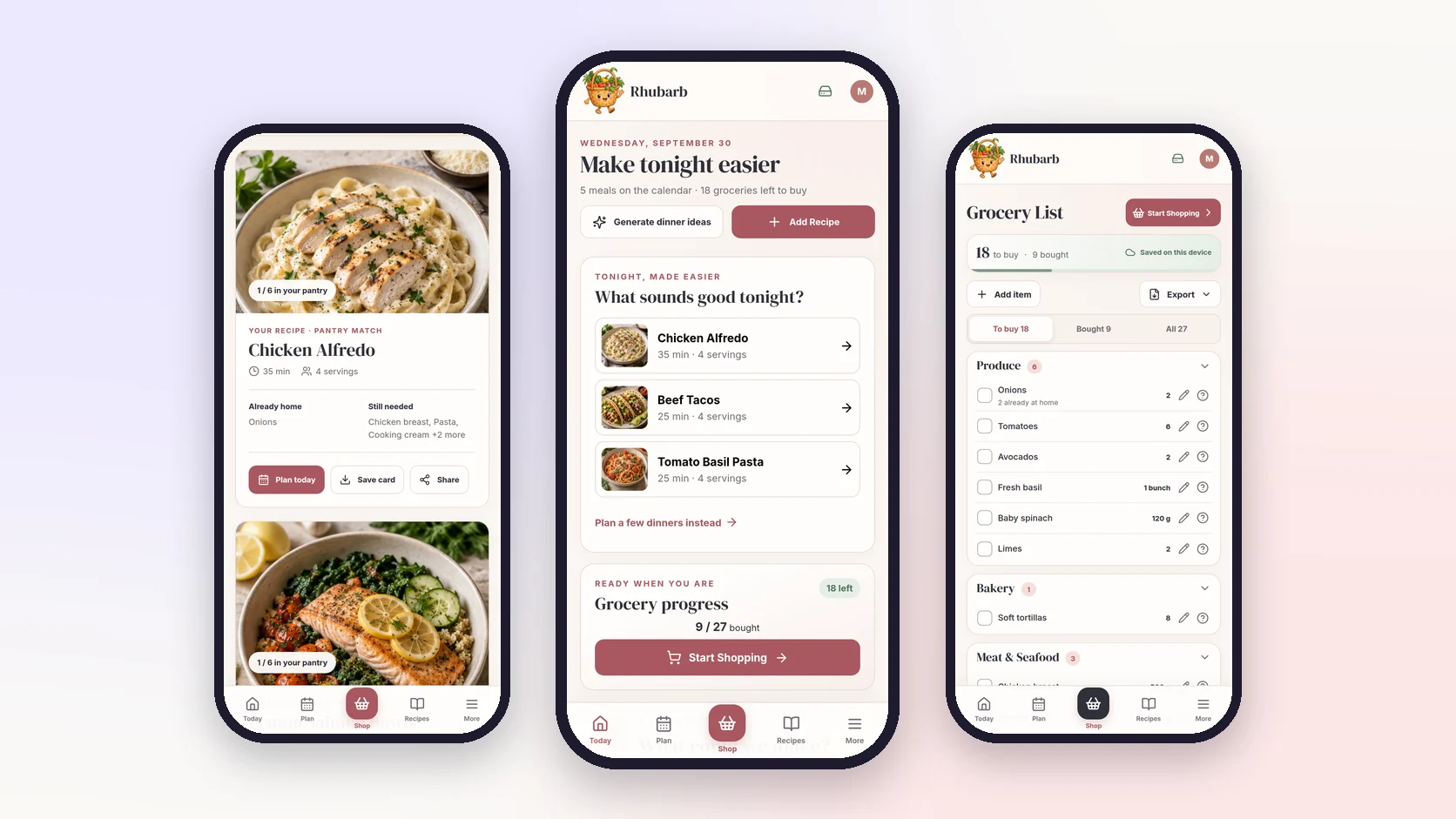
For a long time I thought the answer was a better system for me. A prettier planner, a sharper memory, a Sunday ritual. None of it helped, because the problem was not how well I held the list. It was that nobody else could get into it. When I went looking for something that would let two people see and change the same food list from two phones, everything I found either wanted a full seven-day plan first or was a plain list with no idea what we were cooking. So we built one where the dinners you pick fill the list, and whoever is in the shop sees the change. It did not make my partner psychic. It did stop the 5:40 question, which was the one that was quietly wearing me out.
From ADHD Pearls
Meal Planner App — for people who hate meal planning
Pick a few dinners without choosing the days. The grocery list builds itself, grouped by aisle, minus what is already at home — and your household sees the same list.
$17 once — web app for phone and laptop, shared with your household, no subscription.
The Fridge Inventory Lives in One Head 🧠
Here is the part that took me embarrassingly long to see. My partner was not refusing to help. He could not help, because the information he needed was stored somewhere he had no access to: behind my eyes.
Ask most households who knows how many eggs are left and the answer is a person, not a place. That person is the list. And a person is a terrible list, because they forget, they get tired, and they are not in the supermarket when someone else is.
The cost is not only mental. A UK survey run by YouGov for Tesco found that 92% of shoppers do not always know what is in their kitchen before they shop, and 68% had bought duplicates without realizing it. I once found six cans of chopped tomatoes in our cupboard. Nobody in our house could explain the sixth. We still do not talk about it.
In the US, researchers at Penn State estimated from USDA data on about 4,000 households that the average home wastes 31.9% of the food it buys, worth about $1,866 a year. One of the things associated with lower waste was simple: households that used a shopping list. Not a clever one. Just one.
If your fridge problem is more about food vanishing at the back than about who knows what is in it, the ADHD fridge reset goes after the visibility side.
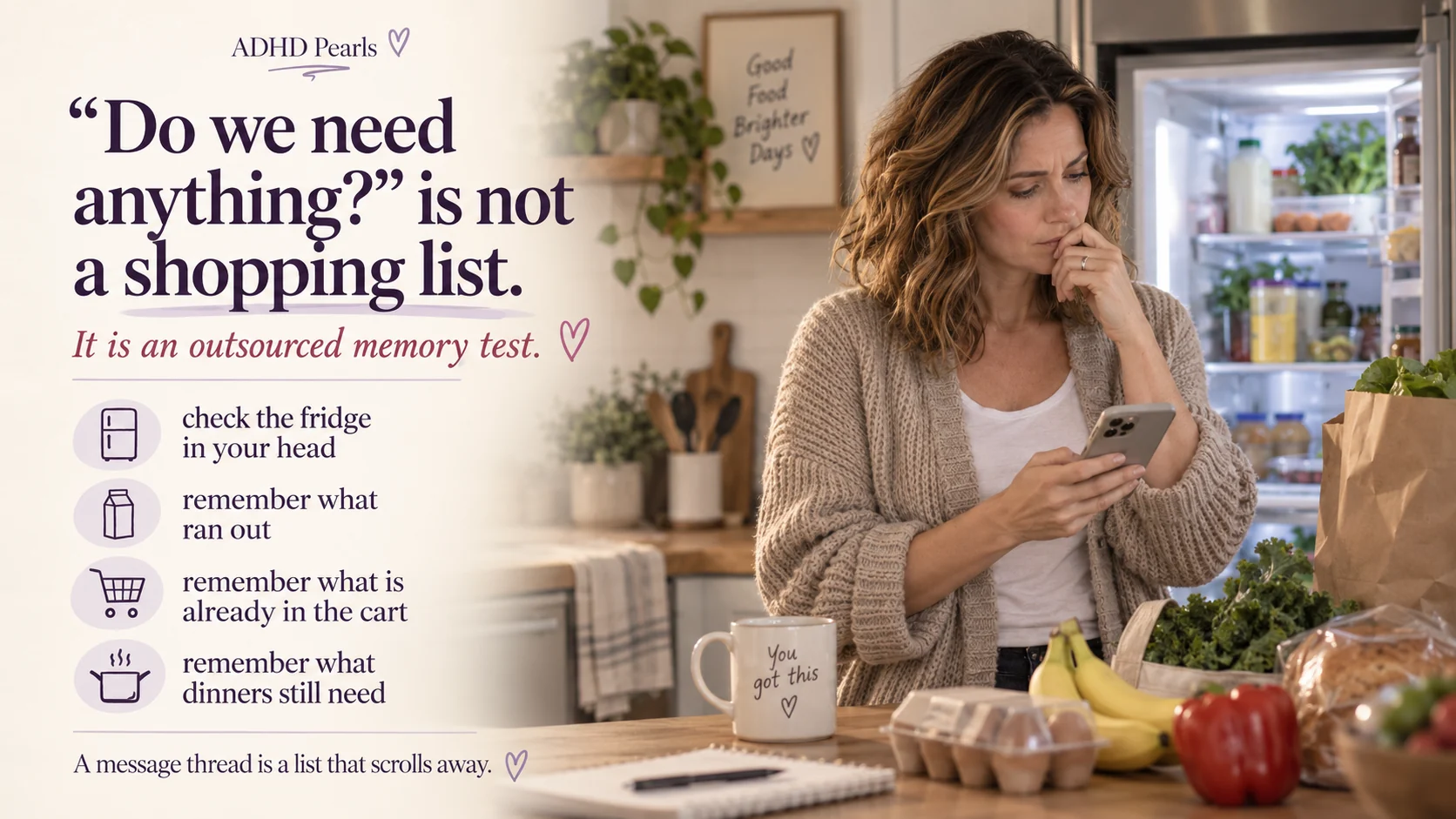
“Do We Need Anything?” Is Not a Shopping List 📱
You know the text. It arrives at 6:10 from the parking lot. “At the store, do we need anything?”
A helpful-looking text can still leave the whole inventory job with the person who was already carrying it.
It sounds helpful. It is actually a request for me to stop what I am doing, open the fridge in my mind, run an inventory from memory, and type it out with my thumbs while dinner burns. “Do we need anything?” is not a shopping list. It is an outsourced memory test, and I fail it every time.
The reverse version is just as familiar. Someone comes back from the shop, the bags are on the counter, and the other person says, “Oh, I needed something.” The thing they needed was never written down, because they finished it three days ago and put the empty jar back.
Texting fails for a boring structural reason. A message thread is a list that scrolls away. The request from Monday is buried under a meme by Wednesday, and nobody can tick anything off, so nobody knows what already got bought.
•It depends on one person’s memory at the worst possible moment.
•It cannot tell you what is already in the cart.
•It has no idea what you are cooking this week, so it never includes the one ingredient that matters.
•It resets every trip, so you rebuild the same list from zero.
Rule One: Whoever Finishes It, Writes It Down 🥚
If you take one thing from this article, take this. Whoever uses the last of something adds it to the list right then, in the one place you both use. Not later. Not in a text. Not by leaving the empty box in the cupboard as a kind of passive-aggressive art installation.
The point is not a better memory. It is moving the noticing to whoever is there when something runs out.
I resisted this rule because it sounded too simple to matter. It turned out to be the most important change we made, because it moves the job of noticing from one person to whoever is standing there. The monitoring gets shared without a single conversation about fairness.
Three details make it work:
•One place only. A list on the fridge and a list in a notes app and a list in your head is three lists and zero lists.
•Within reach of the moment. If adding an item takes more than about ten seconds, it will not happen while you are holding the empty carton.
•No judgment for the last egg. The rule is about writing it down, not about who ate it. Keep it that way or it dies within a week.
The first week we tried it, my partner added “eggs” four times. We did not need eighteen eggs. But I had not thought about eggs once, and that was the whole point.
Split Dinner by Stage, Not by Favor 🍳
“Just tell me what to do and I’ll do it” is kindly meant and quietly exhausting, because it leaves the telling with you. The fix for dinner specifically is to stop splitting tasks and start splitting stages, so each stage has an owner who does the thinking for it too.
Sharing the visible chore is not the same as sharing the thinking that makes it possible.
This is the table we taped inside a cupboard door. It is not a rulebook. It is a way to see where the invisible part actually sits.
Stage of dinner
The visible part
The invisible part
Decide
Picking a few dinners for the week
Remembering who hates mushrooms and what is about to go off
List
Writing the grocery list
Checking what is already at home so nothing gets bought twice
Shop
Going to the store
Choosing substitutes when the thing on the list is not there
Cook
Making the meal
Starting at the right time so dinner is not at 9 p.m.
Restock
Putting shopping away
Noticing what ran out and getting it onto next week’s list
Once we wrote it out, the imbalance was obvious in about four seconds. My partner cooked most nights and cleaned up every night, and said, reasonably, that he did plenty. He did. He did the visible column. I did the invisible one, all five rows.
What changed things was handing over whole rows, not chores inside them. He took “list” completely, including checking the cupboard. I kept “decide,” because I actually enjoy picking dinners when I do not also have to be the pantry.
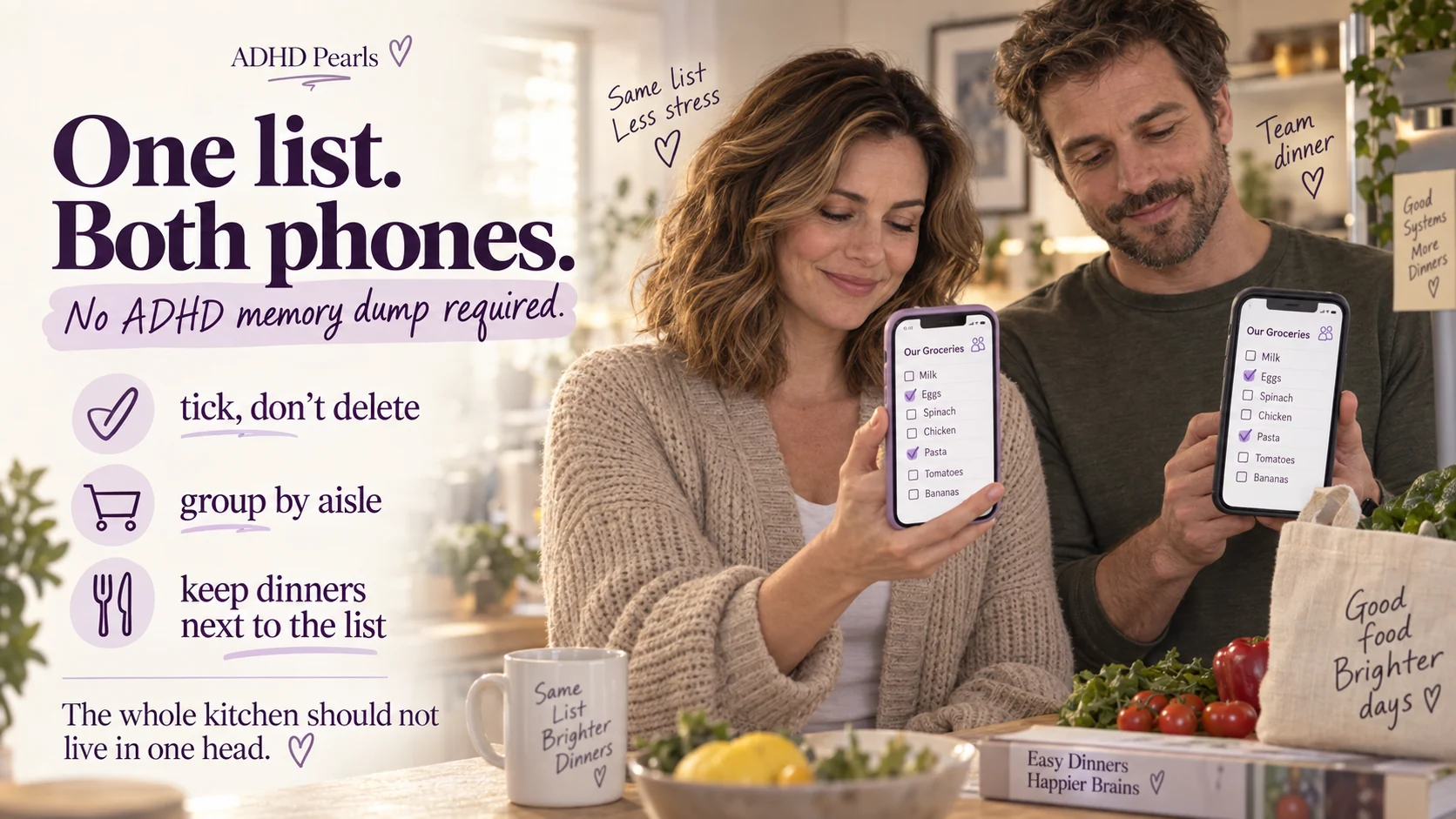
The rule and the rows only work if the list is somewhere both of you can reach at the moment you need it. For most couples that means your phones, because that is what is in your hand in the kitchen and in the aisle.
A list is only shared when both people can see, update and use the same version.
You do not need anything fancy to start. A shared note or a shared list in any app you both already have will beat texting on the first day. What matters is how you use it:
•Tick, don’t delete, in the store. A ticked item tells the other person it is already in the cart.
•Keep the dinners next to the list. A list that knows you are making tacos on Thursday will not forget the tortillas.
•Give it one name. “The list.” Not “my list” and “your list.” Ownership of the list is exactly what you are trying to share.
The limit of a plain shared list is that someone still has to turn “we’re having pasta and fajitas” into “onions, two peppers, a tin of tomatoes,” and that someone is usually the person who was already carrying everything. The real relief comes when the dinners write the list, not the person.
When You’re the One With ADHD (Or Both of You Are)
Everything above assumes one person is carrying the list. Sometimes the honest version is the reverse: you are the one who finishes the milk and forgets to say so, and your partner is the one quietly keeping track.
One commenter in an r/ADHD thread described meal planning as “a stack of everything ADHD makes hard,” and that is accurate. Noticing, remembering and following up all lean on working memory, which is exactly the part ADHD tends to make unreliable. It is not a character flaw. It is also not an excuse to leave the list to someone else forever.
What helps, if the forgetting is on your side:
•Take the stage that suits your brain. Plenty of people with ADHD are great at the shop itself or at cooking on the night. Own that row completely.
•Make adding an item a one-step action. The list open on your home screen, not three taps deep.
•Put the empty-box habit on the list itself. Yes, really. “Empty box goes in the bin, item goes on the list.”
And if you both have ADHD, lower the bar on purpose. A shared list with half the things on it still beats two perfect lists in two heads. For the nights when nobody has anything left, keep a few low-energy dinners that need no planning at all.
Save this for the next time someone asks what’s for dinner at 5:40.
FAQ: Dinner, the Mental Load and Sharing the List
Why am I the only one who knows what’s for dinner?
Usually because one person gradually became the household’s food memory, knowing what is in the fridge, what ran out and what gets eaten this week. Nobody assigns it. It builds up through small moments of noticing, and because it lives in one head, nobody else can pick it up even when they want to.
Is planning dinner part of the mental load?
Yes. Research on household cognitive labor describes anticipating needs, identifying options, deciding and monitoring. Dinner involves all four, every day, which is why it can feel heavier than chores that look bigger but happen less often.
How do I get my partner to help with meal planning?
Hand over a whole stage rather than individual tasks. If your partner owns the grocery list completely, including checking what is at home, the thinking moves with the job. Asking for help with tasks keeps the planning, and the telling, with you.
What’s the best way to share a grocery list with my partner?
Use one shared list on both phones instead of texts. Agree that whoever finishes something adds it straight away, tick items rather than deleting them in the store, and group the list by aisle. A list that updates for both of you removes the “do we need anything?” message entirely.
How do we stop buying things we already have?
Check the fridge and cupboard before writing the list, not from memory in the store, and keep one list in one place. Duplicates are mostly a visibility problem. When two people shop from two separate mental lists, buying the same thing twice is almost guaranteed.
What if I’m the one with ADHD who keeps forgetting to add things?
Make adding an item as close to zero effort as possible, like a list pinned to your home screen, and take ownership of a stage that suits you, such as shopping or cooking. Forgetting is common with ADHD, and the fix is a system with fewer steps, not more willpower.
Should couples split the cooking or the planning?
Splitting only the cooking often leaves the planning with one person, and the planning is the part that repeats daily and stays invisible. It usually works better to split by stage, such as deciding, listing, shopping, cooking and restocking, so each person owns the thinking for their stage.
Do meal planning apps actually help couples?
They help when both people use the same list and it updates live, and when the dinners you choose feed the grocery list automatically. They do not help if one person still has to translate recipes into a list by hand, because that keeps the invisible work with the same person.
Sources I leaned on while writing this
Daminger, A. (2019).The cognitive dimension of household labor.American Sociological Review, 84(4), 609–633. In-depth interviews with 70 people in 35 couples. Describes anticipating, identifying, deciding and monitoring, and found anticipating and monitoring fell more on women while deciding was more evenly shared.
Yu, Y., & Jaenicke, E. C. (2020).Estimating food waste as household production inefficiency.American Journal of Agricultural Economics, 102(2), 525–547 (Penn State summary). About 4,000 US households from the USDA FoodAPS survey; average household waste of 31.9% of acquired food, about $1,866 a year. Households using a shopping list wasted less.
Tesco / YouGov (2022).92% of shoppers don’t always know what’s in their kitchen. Reported by Circular Online. UK adults; 68% had unknowingly bought duplicates. Commissioned by a retailer, so treat it as an indication rather than a study.
Armour Meats (2026).Armour Mealtime Pressure Index. Survey of 2,000 US parents with children under 18, fielded January 2026; 49% named dinner the most stressful meal and 39% said planning and preparing takes longer than eating. Industry-commissioned survey.
r/ADHD community.“Cooking with ADHD???” A discussion thread where people with ADHD describe why planning meals and shopping lists are hard. Lived experience, not research.
We still have too many eggs some weeks. Nobody has found a seventh can of tomatoes, which I am choosing to count as progress.
What actually changed was not my memory. It was that the list stopped living in it. We built a small meal planner app for exactly that: you pick a few dinners, their ingredients land on one grocery list grouped by aisle, and it updates on both phones, so whoever is in the shop sees what the other person just added. It does not decide dinner for you, and someone still has to pick the tacos. But the 5:40 question has mostly gone quiet, and that turned out to be the part I needed back.
Found this helpful? Share it with someone who gets stuck too.
One tap makes ADHD Pearls a preferred source in your Google account, so our articles surface higher when you search. No signup, and it brings you straight back to this page.
Before you go
Meal Planner App — for people who hate meal planning
Pick a few dinners without choosing the days. The grocery list builds itself, grouped by aisle, minus what is already at home — and your household sees the same list.
For the woman who sets up the perfect system on Sunday and abandons it by Tuesday.
One short letter, every week. Real talk about ADHD, task paralysis, and the tiny wins that actually move the needle for a brain like yours. No shame. No hustle culture.