I bought the same bag of spinach three weeks running. Each time with genuine intent, each time discovering the previous bag only when it had turned into something I had to carry to the bin at arm's length.
The spinach was never the problem. The problem was that it lived in a drawer, behind a panel, at the bottom of a cold cupboard I opened four times a day without ever once looking down.
Quick answer
How do you stop food going bad in the fridge with ADHD?
Move the things that expire fastest out of the drawers and onto the shelf at eye level, in one clearly designated eat-first spot. Most food is not forgotten because you do not care. It is forgotten because it is hidden, and a fridge you cannot see into is a fridge that quietly throws your money away.
Key takeaways
📌Crisper drawers keep produce fresher and make you forget it exists. For many ADHD brains that trade is a bad one.
📌One eat-first zone at eye level does more than any full reorganization.
📌Buying the same thing twice is a visibility problem, not a memory failing you can fix by trying harder.
📌Label leftovers with the day you made them, not a guess at when they expire.
📌Ten minutes before you shop beats an hour of deep cleaning after everything has gone.
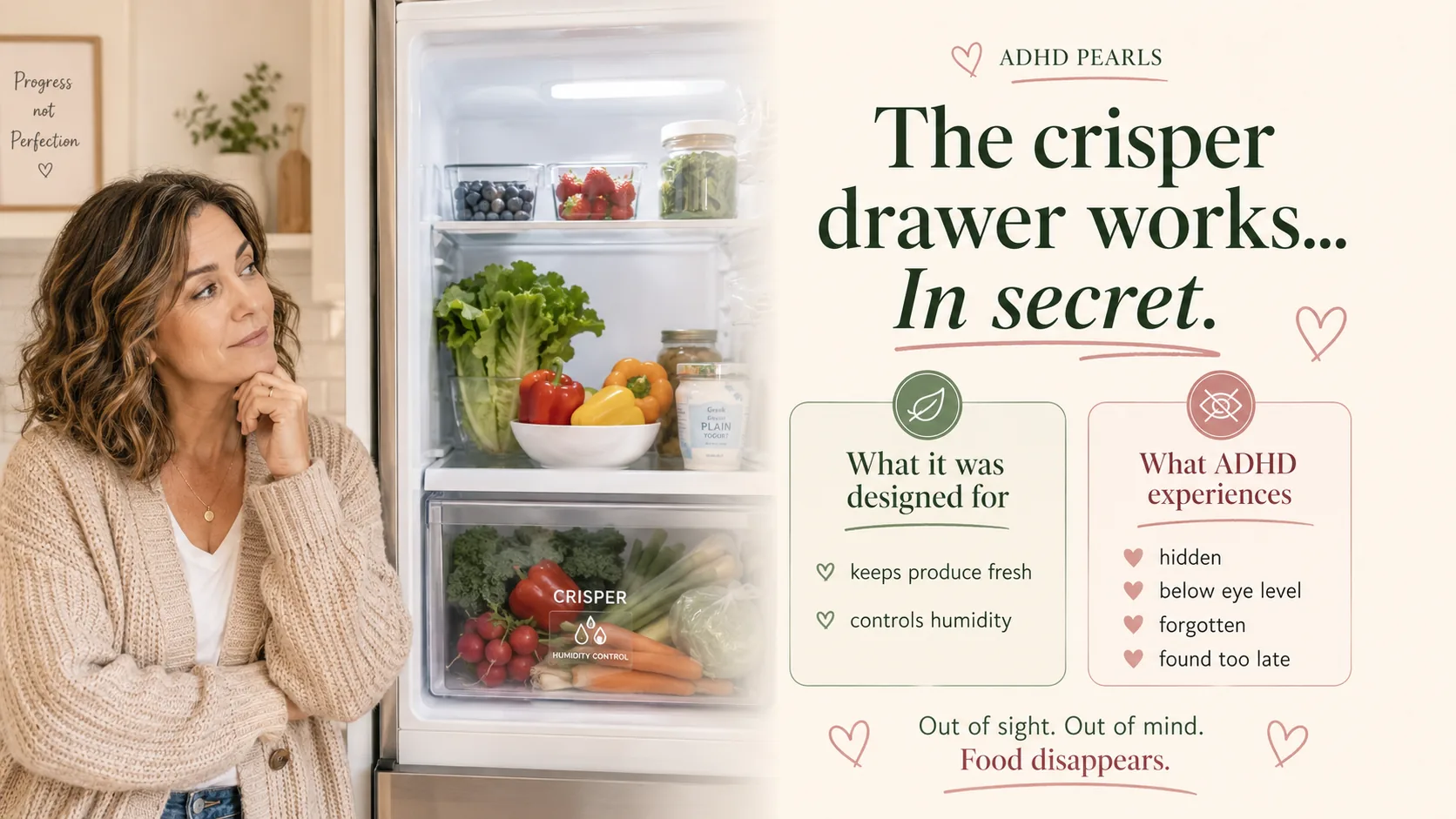
Crisper drawers work. They hold humidity, and produce genuinely lasts longer in them. That is the entire design brief and they meet it.
The trouble is that they meet it inside an opaque box, below your line of sight, behind a panel you have to pull. For a brain that runs heavily on what it can currently see, that is not storage. That is a slow-motion disposal unit with a nice seal on it.
The ADHD community calls this object permanence, which is borrowed from developmental psychology and used loosely - what is really going on is working memory and attention, not a failure to understand that objects continue to exist. I unpacked the mechanism properly in why you forget everything you cannot see. The practical version is short: out of sight is out of mind, and a drawer is very good at out of sight.
Your crisper drawer is doing exactly what it was designed to do. It is keeping vegetables fresh, in secret, until they are not.
The crisper drawer may work for freshness, but for ADHD visibility it becomes a black box.
You buy it twice
The second half of the pattern. Standing in a shop with no reliable internal picture of what is at home, you buy the thing you might need. It is a completely rational response to missing information.
Then you get home and find the first one, and the shame arrives on schedule, and the whole thing gets filed as evidence that you are wasteful. It is not wastefulness. It is a visibility gap being solved with money, which is one of the quieter forms of the ADHD tax.
The fridge asks for a decision at your worst hour
Opening the fridge at 6pm is not a small act. It is an open-ended question - what could I make from this? - asked at the exact hour your capacity is lowest. Faced with raw ingredients and no obvious answer, most of us close the door and order something.
The food was there. The recipe was not, and neither was the executive function to invent one.
From ADHD Pearls
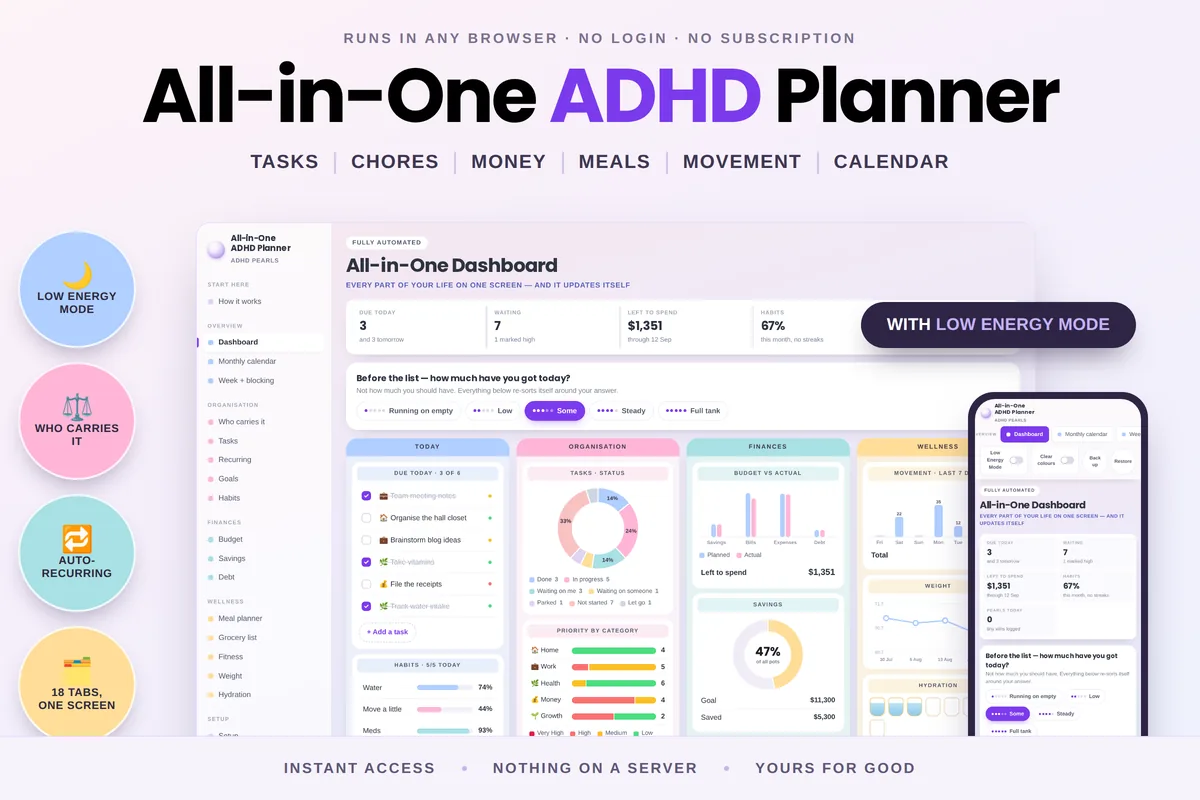
All-in-One ADHD Planner
Eighteen tabs that fill each other in. Say a repeating chore once and the schedule builds itself, and one tab shows who in the house actually carries what.
$27 once — private to your browser, no login, no subscription.
What It Is Actually Costing You
Worth knowing the size of this, because it is easy to dismiss as a bag of spinach.
The EPA estimates food waste costs the average American consumer around $728 a year, roughly $14 a week, and about $2,900 a year for a household of four - close to 11 percent of what they spend on food. The USDA puts it more bluntly: over a third of the food available in the United States is never eaten, and households account for a large share of that.
These are figures for everyone, not for people with ADHD. Nobody has run that study. But the mechanism the general numbers describe - food bought, stored out of sight, forgotten, binned - is exactly the mechanism ADHD makes more reliable. If the average household is losing that much, a household where things genuinely vanish when a drawer closes is unlikely to be doing better.
The Eat-First Zone
If you do one thing from this article, do this one.
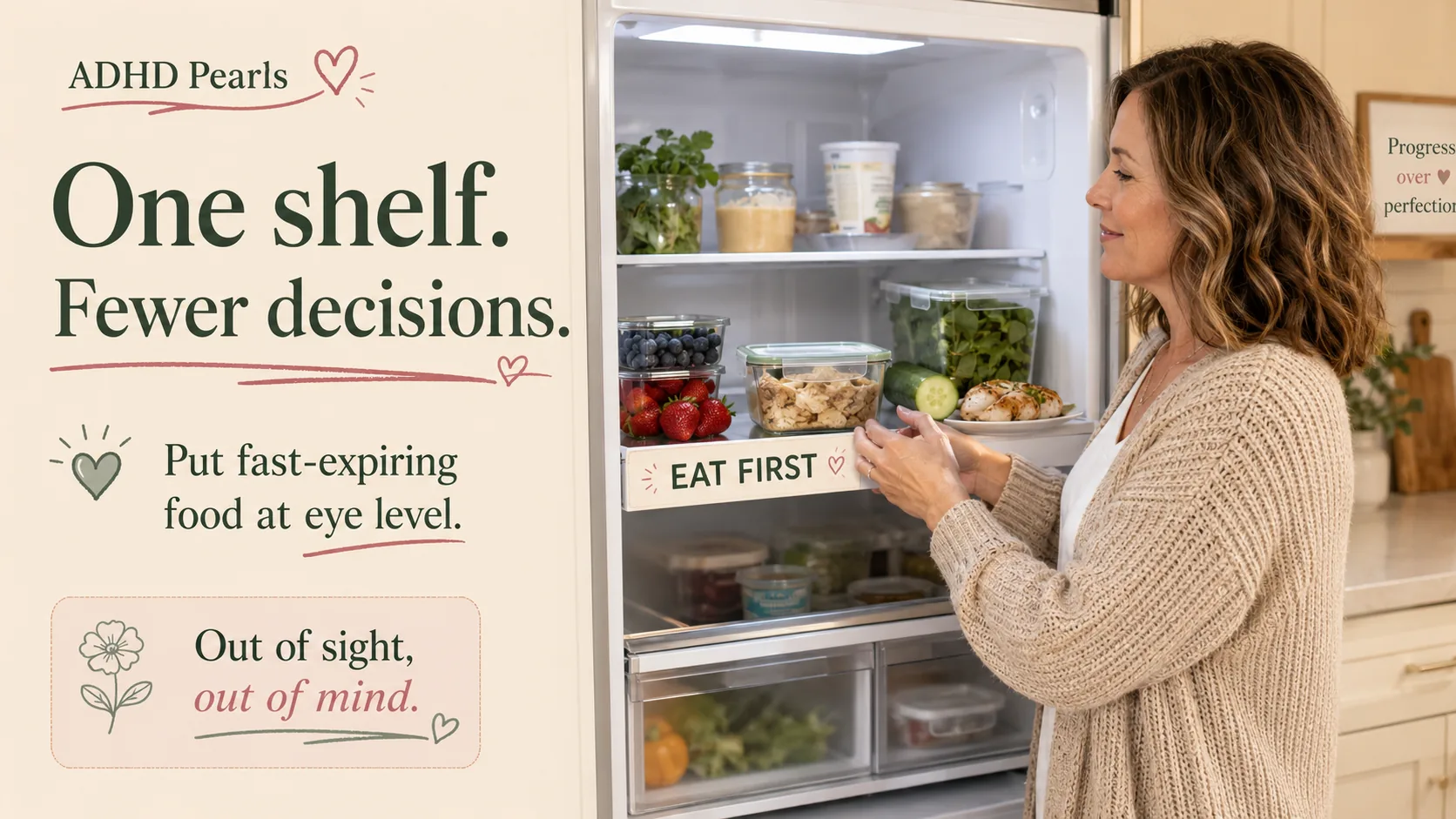
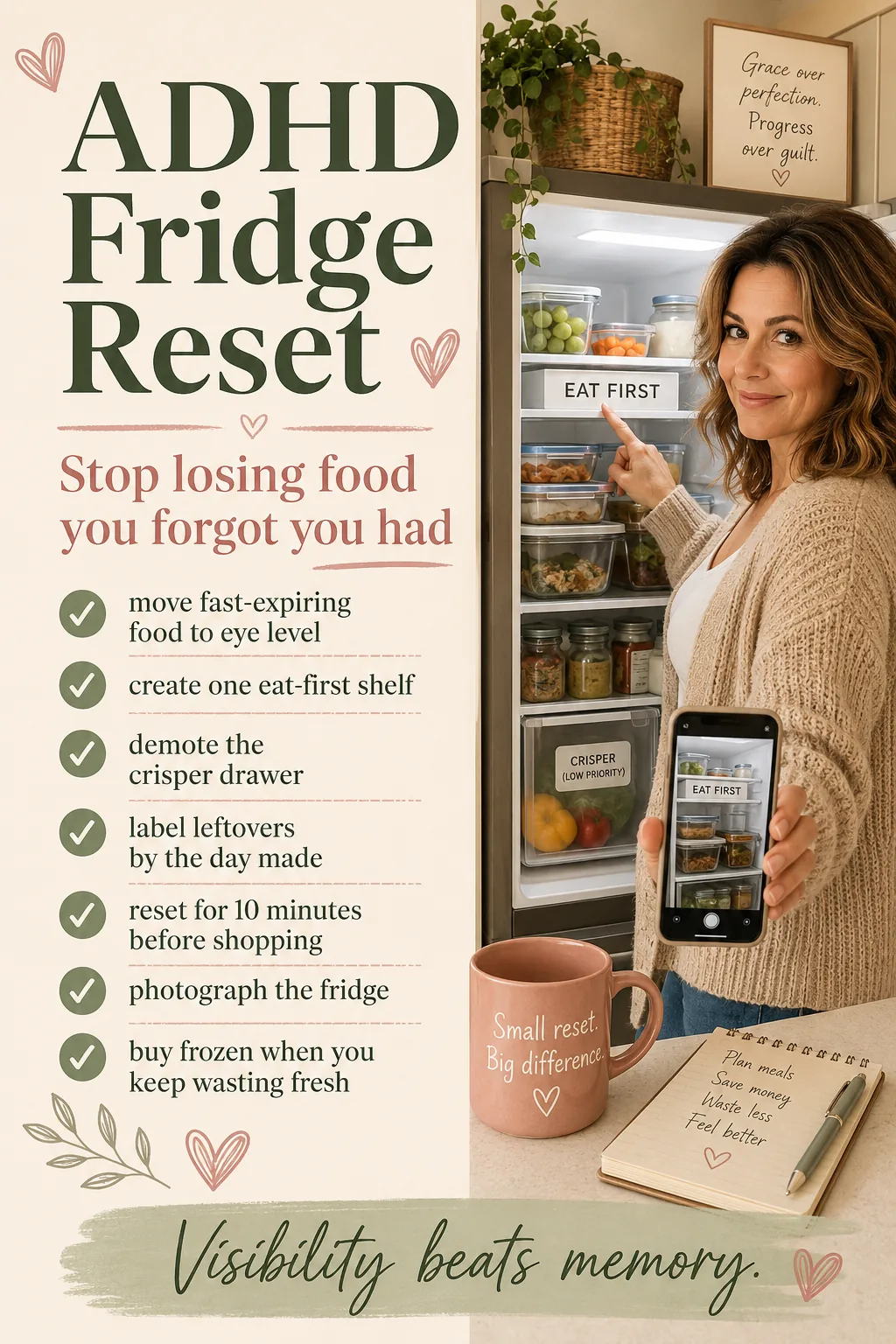
Pick a single shelf, at eye level, and make it the eat-first zone. Anything that will go off in the next few days lives there and nowhere else. Open berries. The half cucumber. Leftovers. The chicken that needs using tonight.
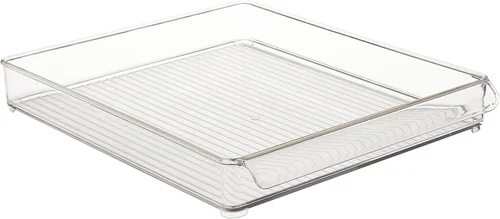
That is it. That is the system. No labelling machine, no matching containers, no fridge that looks like a shop. If you want the shelf to be unmistakable, one clear open tray does the job on its own - it marks the zone, pulls out like a drawer, and stops the eat-first pile drifting to the back.The one clear tray I use →Affiliate link — as an Amazon Associate we may earn from qualifying purchases.
One visible shelf is easier to use than trying to mentally track the whole fridge.
Why it works: it converts an open-ended question into a closed one. Instead of what could I make with all of this, the fridge now asks what needs eating from this shelf. One shelf, a handful of items, and a decision your brain can actually make at 6pm.
What to do with the drawers: demote them. Put things in there that keep for weeks and that you go looking for on purpose - drinks, condiments, butter, the block of cheese. Long shelf life, low urgency, no tragedy if you forget them for a fortnight.
Yes, produce technically lasts longer in the crisper. Produce you can see and eat beats produce that stays crisp until you throw it away.
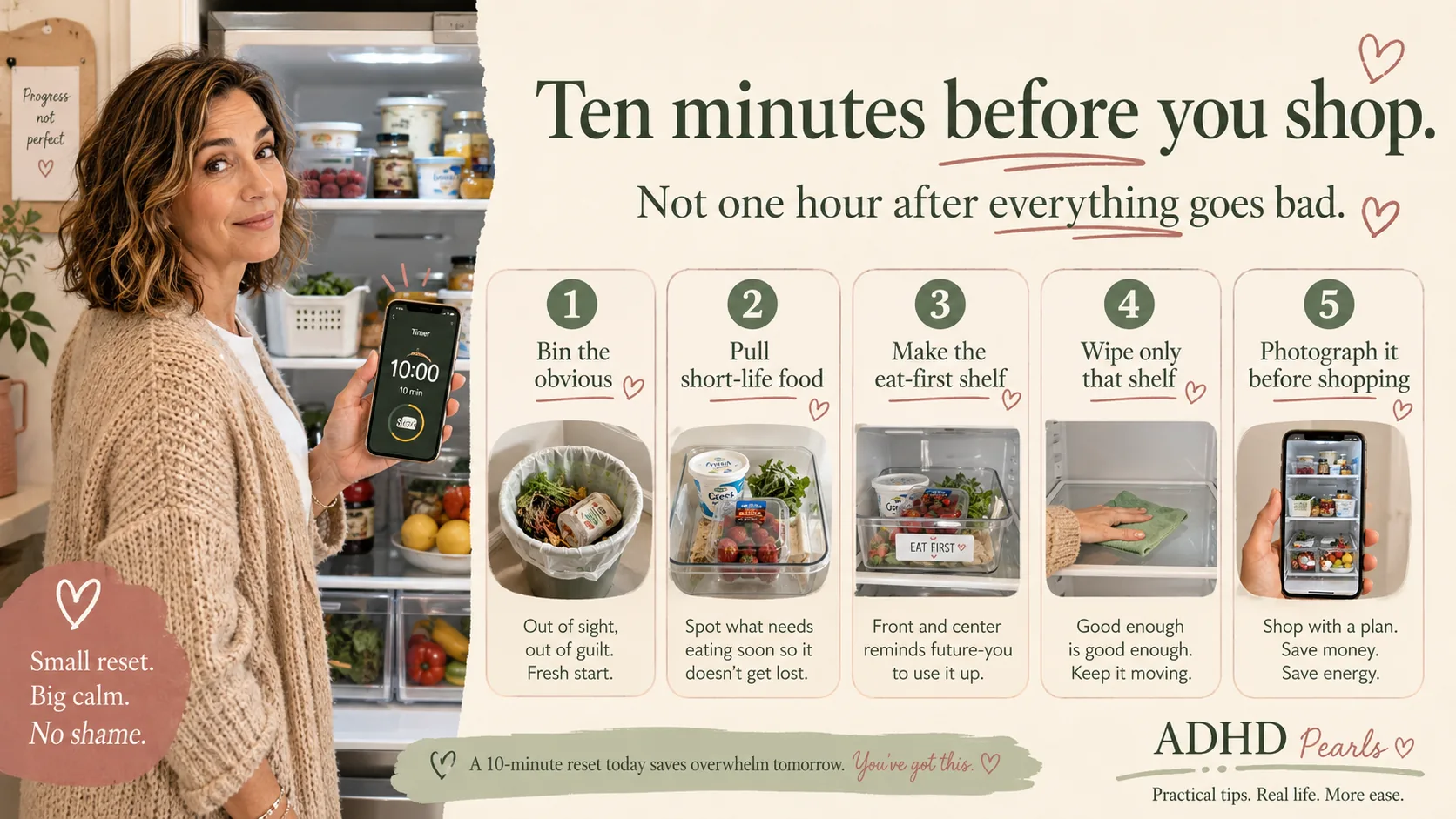
The Ten-Minute Fridge Reset
Do this the day before you shop, not on some future Saturday when you feel organized. Ten minutes, timer on.
Bin the obvious. Anything visibly gone. Do not open it, do not investigate, do not smell it. This step is not a decision, which is why it is first.
Pull anything with a short life left. Sweep the shelves and drawers, and put everything that needs eating this week onto one surface.
That is your eat-first shelf. Everything from step two goes back on it, at eye level. Nothing else is allowed there.
Wipe only what you just emptied. Not the whole fridge. The shelf you cleared, thirty seconds, done.
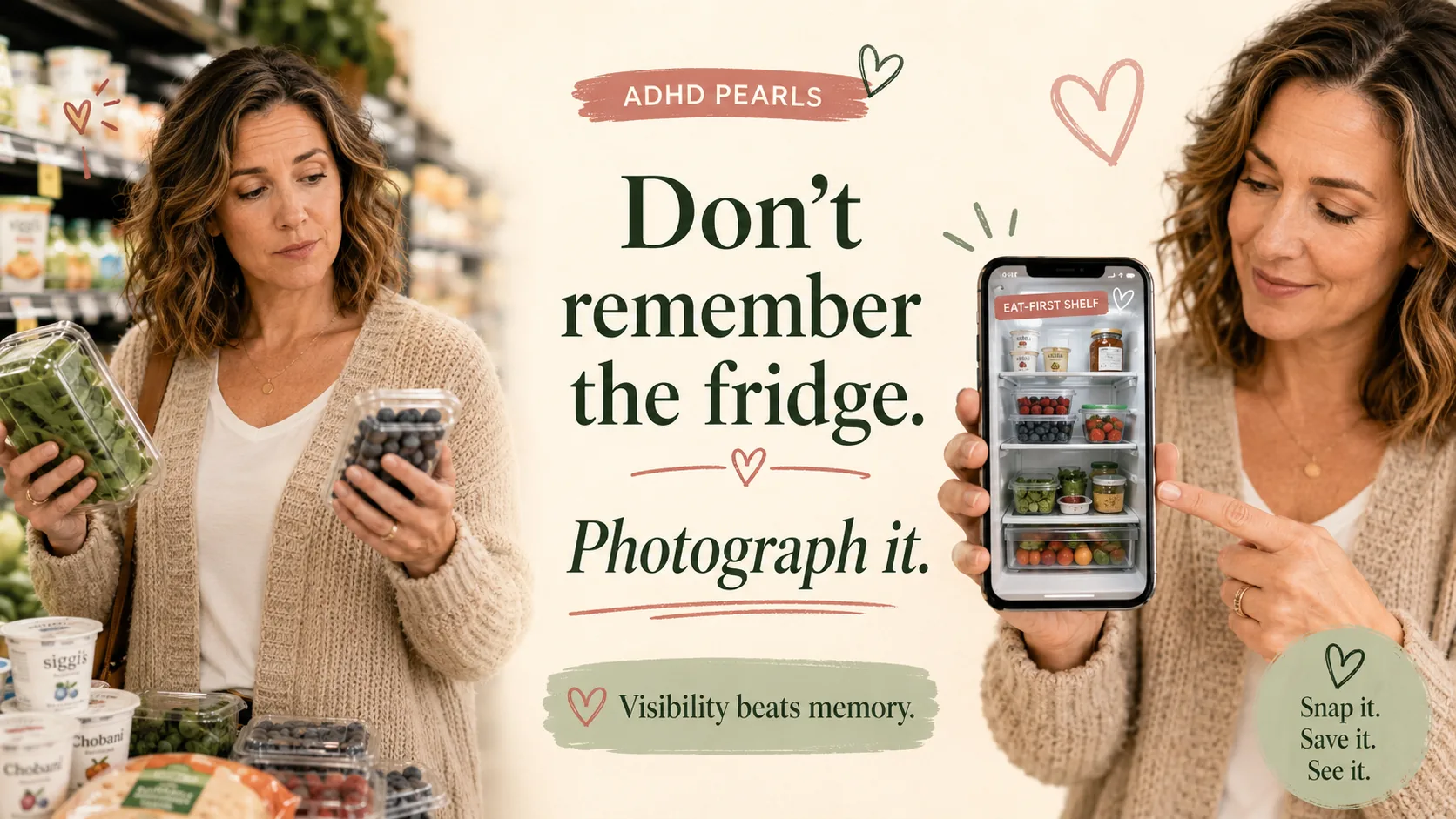
Photograph it. Open the door, take one photo. That is your shopping list, and it is more accurate than the list you would have written.
A small reset before shopping stops the same food being bought again and forgotten again.
Step five is the one people skip and the one that stops the buying-it-twice loop. You are not trying to remember what you own. You are carrying a picture of it.
Shopping So It Does Not Repeat
A reset only holds if the next shop does not immediately refill the fridge with things you will not see.
Buy for the eat-first shelf, not for a fantasy week. Fresh produce for two or three days, not seven. The week-seven version of you is not going to make that soup.
Prep at the point of unpacking or not at all. Wash and cut the berries when you get home, while the bag is already in your hand. Anything you postpone to later competes with everything else later contains.
Buy some of it frozen on purpose. Frozen spinach does not rot at you. For anything you buy repeatedly and waste repeatedly, the frozen version removes the deadline entirely.
Check the photo before you add anything to the trolley. Ten seconds, and it is the difference between three bags of spinach and one.
Do not rely on memory in the shop. A fridge photo gives your brain a visible inventory.
What goes on that shelf and what you actually make from it are two different problems. This article is about seeing the food. If the harder part is deciding what to cook with it, that is covered in ADHD meal planning for people who hate meal planning, and for the evenings when cooking is off the table entirely there are low-energy ADHD meals.
When the Fridge Has Gone Feral
Sometimes there is no system to restore. There is a container at the back that has been there since a season you can no longer name, and opening the door has become genuinely unpleasant.
Three rules for this version:
Do not identify anything. If you cannot tell what it is, it goes, container and all if the container is not worth the encounter. Curiosity is not required and will slow you down.
Bin bag first, shelf second. Removing things is one decision repeated; sorting is a new decision every time. Empty first, arrange later, and later can be a different day.
Set a timer and stop when it rings. Half a fridge done is not half a failure. It is a shelf you can now use, and the rest is still there tomorrow. Matching the job to the capacity you actually have is the same principle as on any low-energy day.
This article is educational and is not medical or food-safety advice. When you are unsure whether something is still safe to eat, follow official food-safety guidance rather than guessing - and if food regularly runs out before the end of the month, local food support exists and is worth using without embarrassment.
FAQ: ADHD and the Fridge
Why do I keep forgetting food in the fridge?
Because most fridges store food where you cannot see it, and ADHD relies heavily on visual prompting. Drawers, opaque containers and the back of deep shelves all remove an item from view, and for many people that is functionally the same as removing it from existence. The fix is visibility rather than a better memory.
Should I stop using the crisper drawers?
Not entirely, but consider demoting them. They keep produce fresher, which is useless if the produce is forgotten. Move fast-spoiling items to an eye-level shelf and use the drawers for long-life things you go looking for deliberately, like drinks, butter and condiments.
What is an eat-first zone?
One designated shelf at eye level that holds only the things that need eating in the next few days. It works because it turns an overwhelming open question - what can I make from all this - into a small closed one about a handful of items in a single spot.
Why do I keep buying food I already have?
Because you are shopping without a reliable mental picture of what is at home, which makes buying it a sensible bet rather than carelessness. Taking a photo of the open fridge before you shop solves it faster than trying to remember, and it costs about ten seconds.
How should I label leftovers?
Write the day you made it, not a guess at when it will go off. A date you can verify is more useful than an estimate you will not trust, and it removes the standing-there-deciding step later. Masking tape and a marker are enough.
How often should I reset the fridge?
Once a week, attached to the shop rather than to a day of the week. Ten minutes the day before you buy food does more than an hour of deep cleaning at a random point, because it feeds directly into what you buy next.
Is a messy fridge a sign of ADHD?
No. Plenty of people with tidy fridges have ADHD and plenty of people without ADHD have chaotic ones. What is more telling than mess is the pattern: repeatedly buying duplicates, finding food you had no memory of, and avoiding opening the door at all.
Does freezing things actually help?
Considerably, because it removes the deadline. Anything you buy often and waste often is a good candidate for the frozen version, particularly leafy greens, berries and herbs. Freezing leftovers in single portions also turns them into a low-effort meal rather than a project.
What if the fridge is already too bad to face?
Start with a bin bag and no identification. Anything unrecognisable goes, container included if that is easier. Set a ten-minute timer, stop when it rings, and treat a single usable shelf as a complete result.
Save this for the next time your fridge keeps hiding food from your brain.
Pin this ADHD fridge reset for the next grocery day.
I still buy spinach. It now sits on the middle shelf, at eye level, directly in front of my face, radiating obligation. I eat considerably more spinach than I used to, and I have stopped meeting it as a stranger.
Found this helpful? Share it with someone who gets stuck too.
One tap makes ADHD Pearls a preferred source in your Google account, so our articles surface higher when you search. No signup, and it brings you straight back to this page.
Before you go
All-in-One ADHD Planner
Eighteen tabs that fill each other in. Say a repeating chore once and the schedule builds itself, and one tab shows who in the house actually carries what.
For the woman who sets up the perfect system on Sunday and abandons it by Tuesday.
One short letter, every week. Real talk about ADHD, task paralysis, and the tiny wins that actually move the needle for a brain like yours. No shame. No hustle culture.