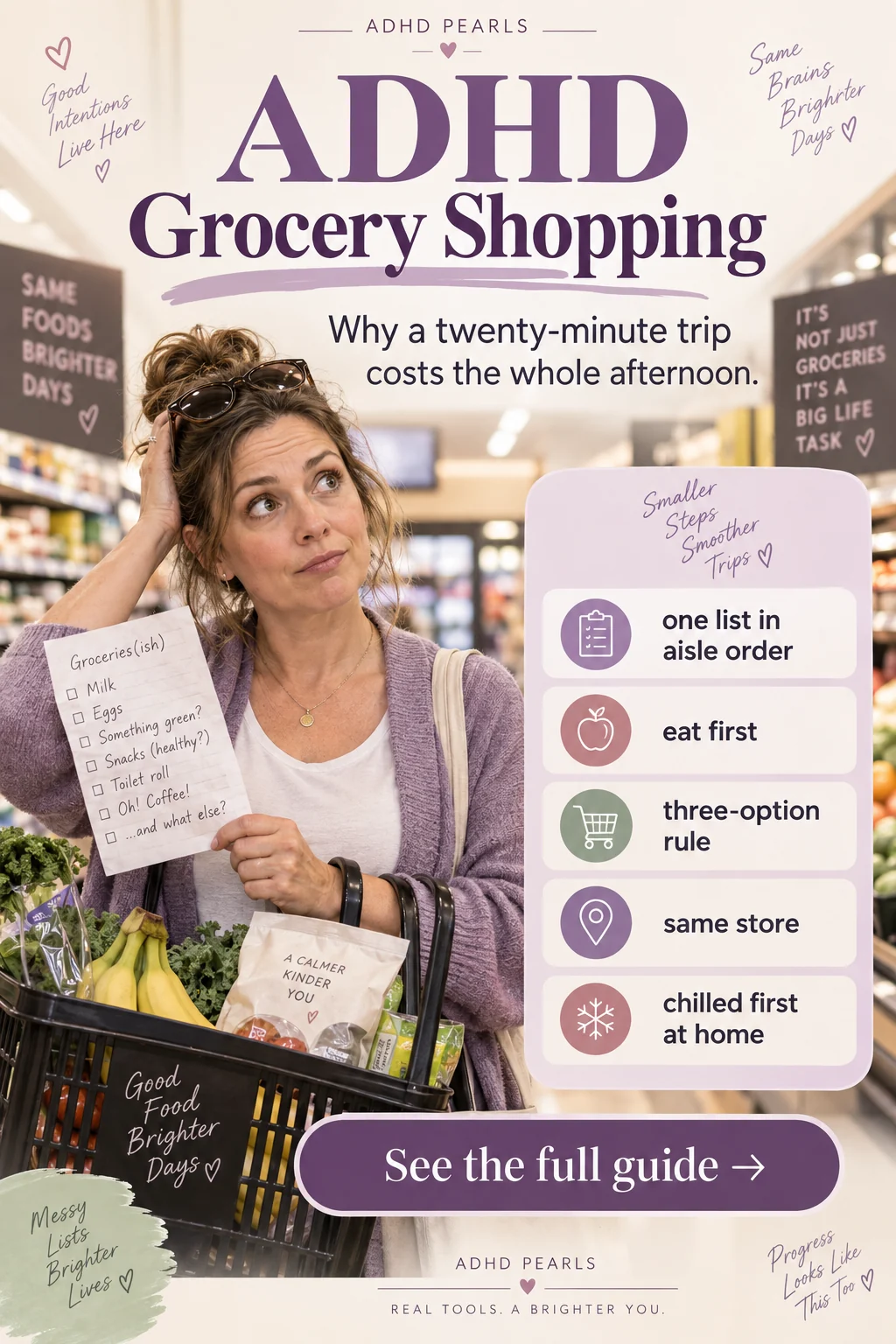
I went in for chicken. I came out with three kinds of crackers, a candle, a bag of salad already contemplating its own death, and no chicken.
The trip took twenty-two minutes. The afternoon it ate was closer to three hours, because after the shop I sat in the car for a while, then came home and left the bags in the hall, and then it was five o’clock and there was still nothing to cook.
For years I thought this was a discipline problem. It is not. A supermarket trip is six executive-function tasks wearing one coat, and it is staged inside a building designed by people whose entire job is to interrupt your plan.
Quick answer
Why is grocery shopping so hard with ADHD?
Because it is not one task. A single trip stacks planning, working memory, sequencing, decision-making and sensory tolerance into about forty minutes, inside a building holding tens of thousands of products arranged to break your concentration. The fix is not more willpower at the shelf. It is doing the deciding before you walk in.
Key takeaways
📌A shop costs far more than the twenty minutes it takes, because it is six separate tasks stacked into one errand.
📌The problem is rarely the number of products. It is that they are not sorted in the order you actually walk.
📌A list written in aisle order does more work than any amount of resolve in front of the shelf.
📌Hunger changes what goes in the cart, and research suggests it is not only the food aisles it affects.
📌The trip is not finished at the till. Unpacking is the part that decides whether any of it gets eaten.
Count what a shop actually asks of you. Decide what you need. Work out what is already at home. Get yourself there. Navigate. Choose between near-identical things. Keep a running total. Queue. Pay. Carry. Put away. Ten separate demands, none of which is hard on its own, all of which draw from the same small reservoir. 🛒
Then there is the building. The Food Industry Association put the average American supermarket at 33,248 items across 42,272 square feet in 2025. That is an unsorted list of thirty-three thousand things, and you are meant to find eleven of them while music plays and a stranger blocks the yogurt.
The thing the internet gets slightly wrong
You will read everywhere that too much choice paralyzes an ADHD brain. It sounds right. The evidence is shakier than the confidence suggests.
A meta-analysis of 63 conditions from 50 experiments, with just over five thousand participants, found the average effect of large assortments on choice to be essentially zero. More options, on average, did not reliably make people freeze.
But the same analysis found conditions under which big assortments did become hard: when the options were not categorized, when people were under time pressure, when the products were unfamiliar, and when the trade-offs between them were awkward.
Read that list again. It is a description of a supermarket on a Tuesday after work — and every single item on it is something you can change.
This is better news than the paralysis story, because “there are too many products” leaves you nothing to do, while “these products are uncategorized and I am in a hurry and I have never bought this before” hands you three levers. The rest of this article is those three levers.
The shop that finally stopped defeating me was not the one where I tried harder. It was the one where the deciding had already happened somewhere else, at a table, in a chair, with a cup of tea. The trouble was that the deciding kept living in four places at once — a note on my phone, the back of an envelope, a half-memory of the fridge, and whatever occurred to me in the bread aisle.
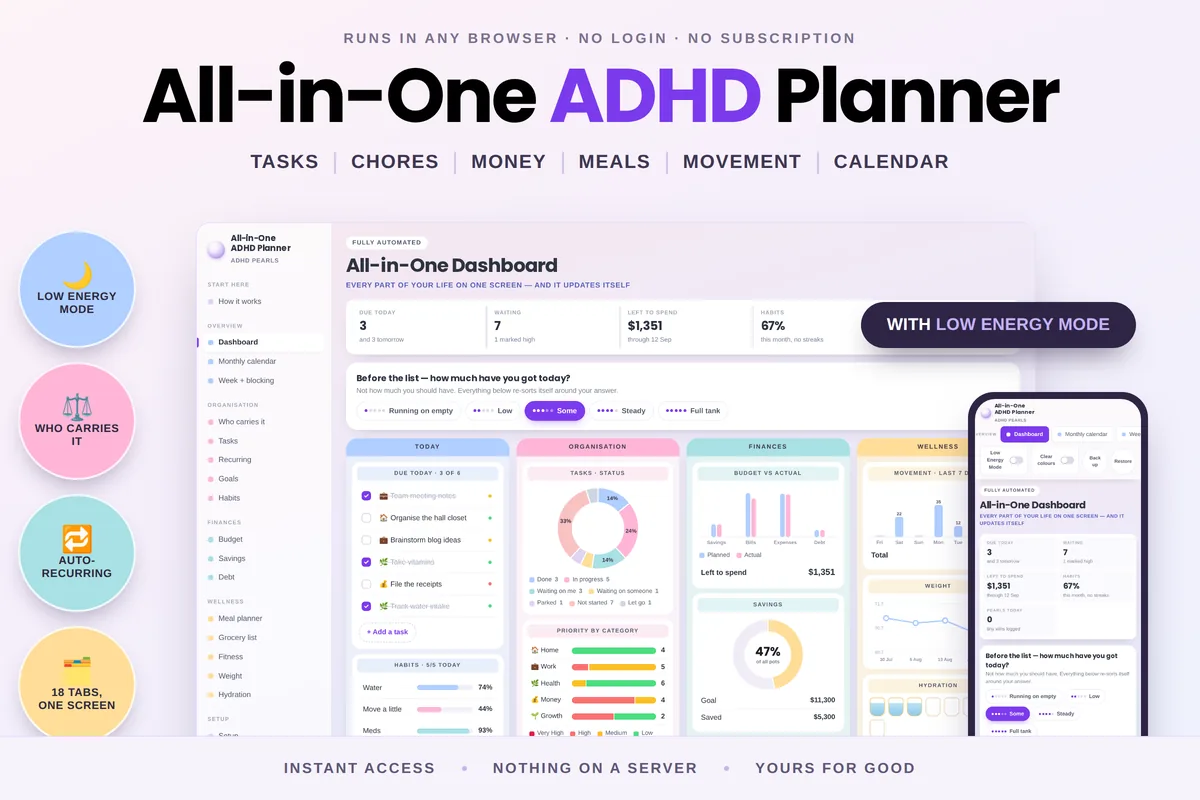
So we built the thing that would hold all four in one place: a planner where a week of meals turns its own ingredients into a shopping list, grouped by aisle rather than by recipe, so what arrives at the shop is a route instead of a wish. It does not stop me buying the crackers. It did mean that last month I stopped buying my fourth jar of cumin.
From ADHD Pearls
All-in-One ADHD Planner
Eighteen tabs that fill each other in. Say a repeating chore once and the schedule builds itself, and one tab shows who in the house actually carries what.
$27 once — private to your browser, no login, no subscription.
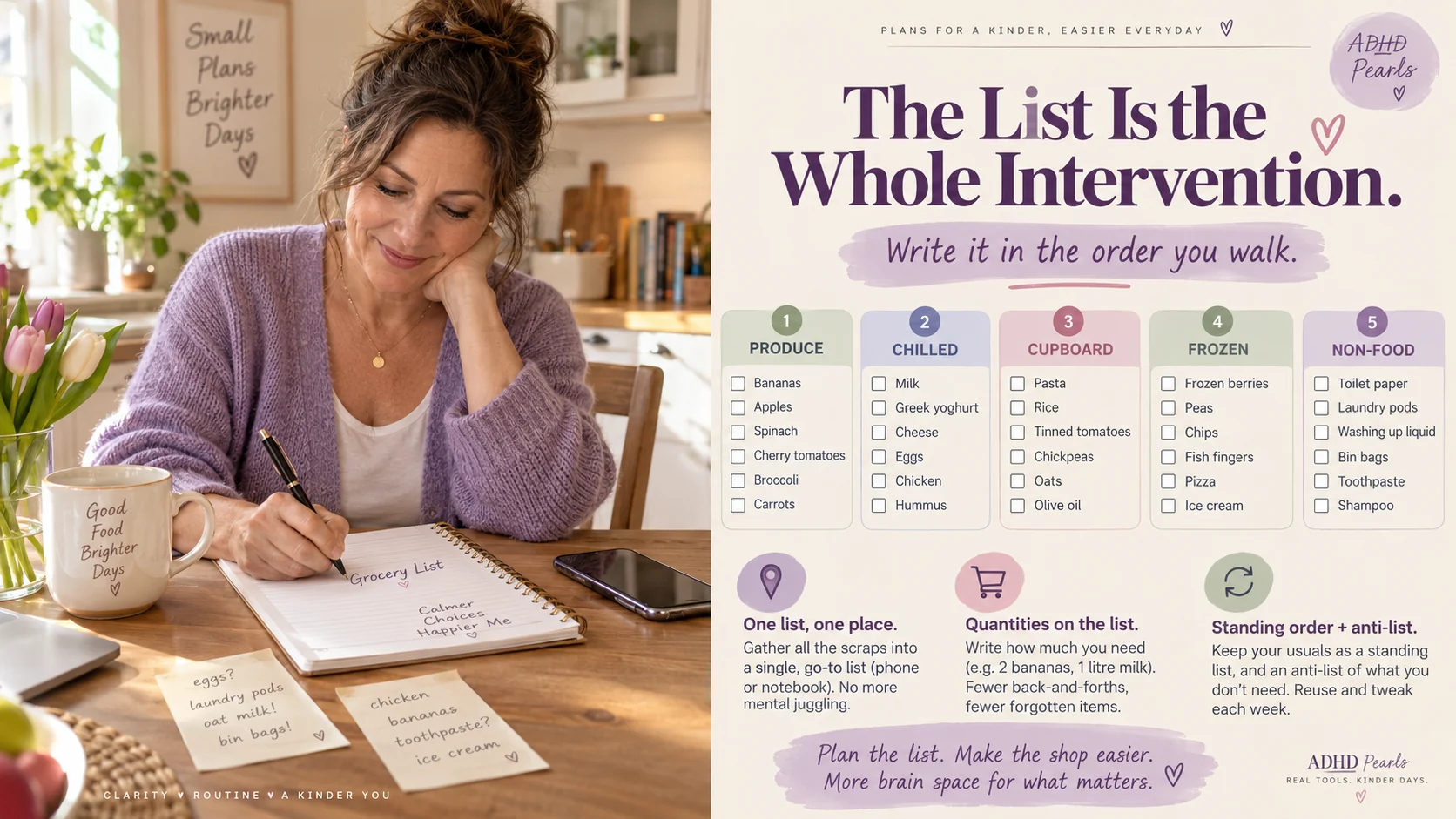
The List Is the Whole Intervention
Everything else in this article is a tweak. This is the part that changes the trip.
For ADHD, a useful grocery list is not just a reminder. It is a route through the store.
Write it in the order you walk
Most lists are written in the order things occurred to you, which means the list itself makes you backtrack. Group the list the way the shop is grouped — produce, then chilled, then cupboard, then frozen, then the non-food corner — and you have handed yourself the categorization the store deliberately does not give you.
I keep mine in five blocks with a gap between them. It looks obsessive written down. In practice it is the difference between one loop and four, and the four-loop version is where a shop turns into an event.
One list, one place
Three half-lists are worse than no list, because you will shop from whichever one you can find and then discover the other two in the car. Pick one location — phone note, whiteboard, paper on the fridge — and make everything else feed into it.
Quantities go on the list, not in your head
“Onions” is not an instruction. “3 onions” is an instruction, and it removes a decision made while standing up, in a coat, with a basket cutting into your arm. Same for the things you are buying for one specific meal: write the meal next to it, or you will get home with ingredients that do not add up to anything.
The standing order
Ten to fifteen things go into your house every week regardless of what you cook. Milk, bread, coffee, bin bags, the cereal your household riots without. These should never be re-decided. Keep them as a permanent block at the top of the list and tick rather than think.
And the anti-list
Two or three items you already own more of than any person needs. Mine is cumin, tinned tomatoes and dry pasta. Written at the bottom of the list under already have, they stopped multiplying. If you are not sure what is at home, that is a different problem with a faster fix — the fridge article covers the ten-second version.
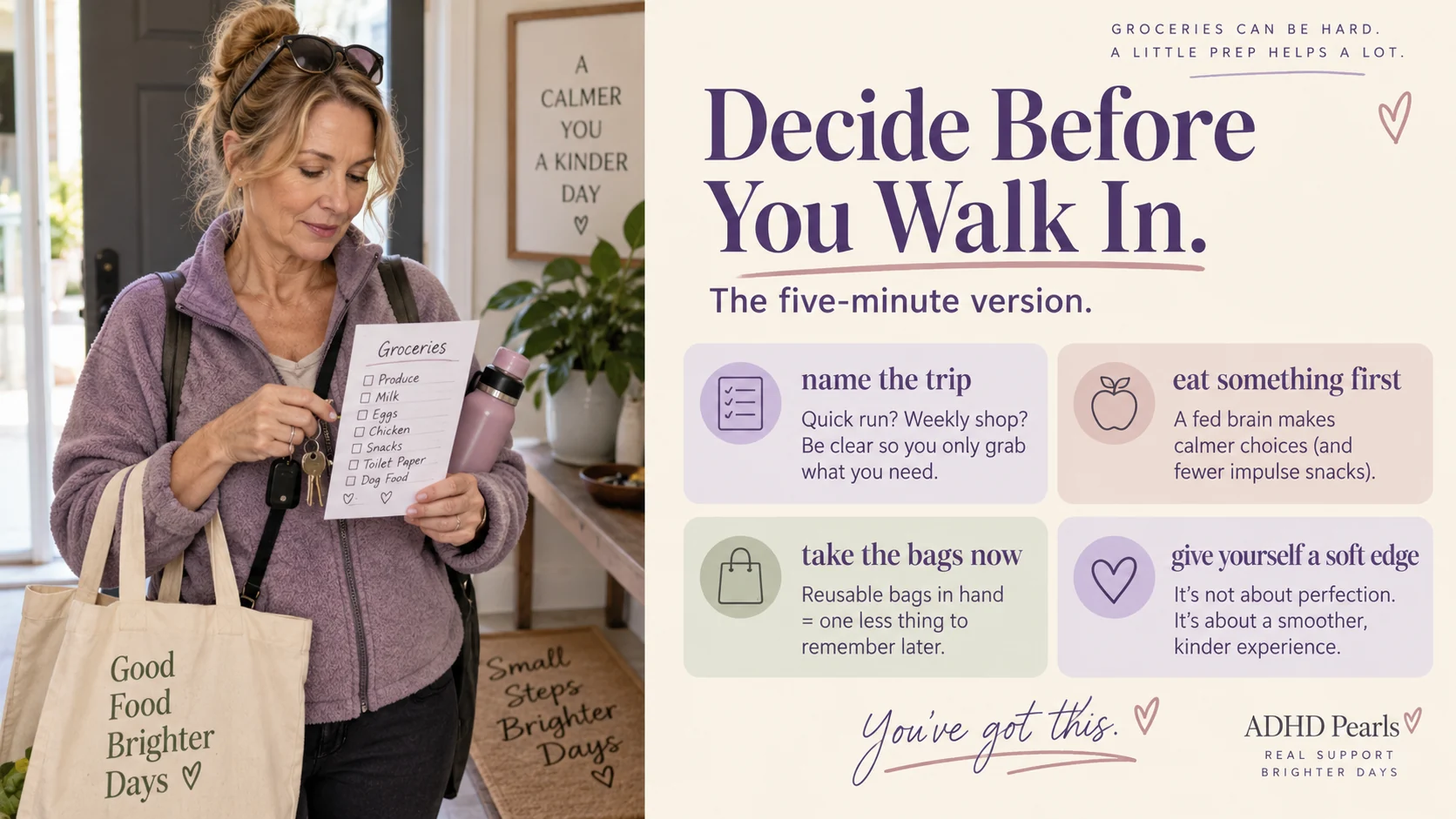
Before You Go: the Five-Minute Version
The more decisions you make before entering the store, the fewer you have to make while standing in the aisle.
1. Name the trip out loud. “This is a top-up for three dinners,” or “this is the big one.” A trip without a defined finish line expands until your capacity runs out, and then you are choosing washing powder on empty.
2. Eat something first. Not a diet rule — an interference rule. Research on hunger and buying, across five laboratory and field studies, found that hungry people acquired more non-food objects than fed people did, with no change in how much they actually liked those objects. The study was in a general population rather than an ADHD one, but the mechanism is worth knowing: hunger does not just make the biscuits louder, it makes acquiring things in general slightly more appealing. 🔋
3. Take the bags out to the car now. Not later. Later is a fictional character.
4. Give yourself a soft edge, not a hard one. Time pressure is one of the conditions that makes a big assortment genuinely harder, so shopping in the fifteen minutes before school pickup is a choice to do it on hard mode. If the only slot you have is a tight one, shorten the list rather than speeding up.
On the money side, I want to be careful. It is widely repeated that ADHD causes overspending, and the honest version is more complicated: one study of nearly 1,300 people found that ADHD symptoms were no longer significantly associated with impulsive buying once personality traits and mood were controlled for. Something real is happening at the checkout, but “my ADHD did it” may be the wrong sentence. The friction tricks that actually work live in their own article.
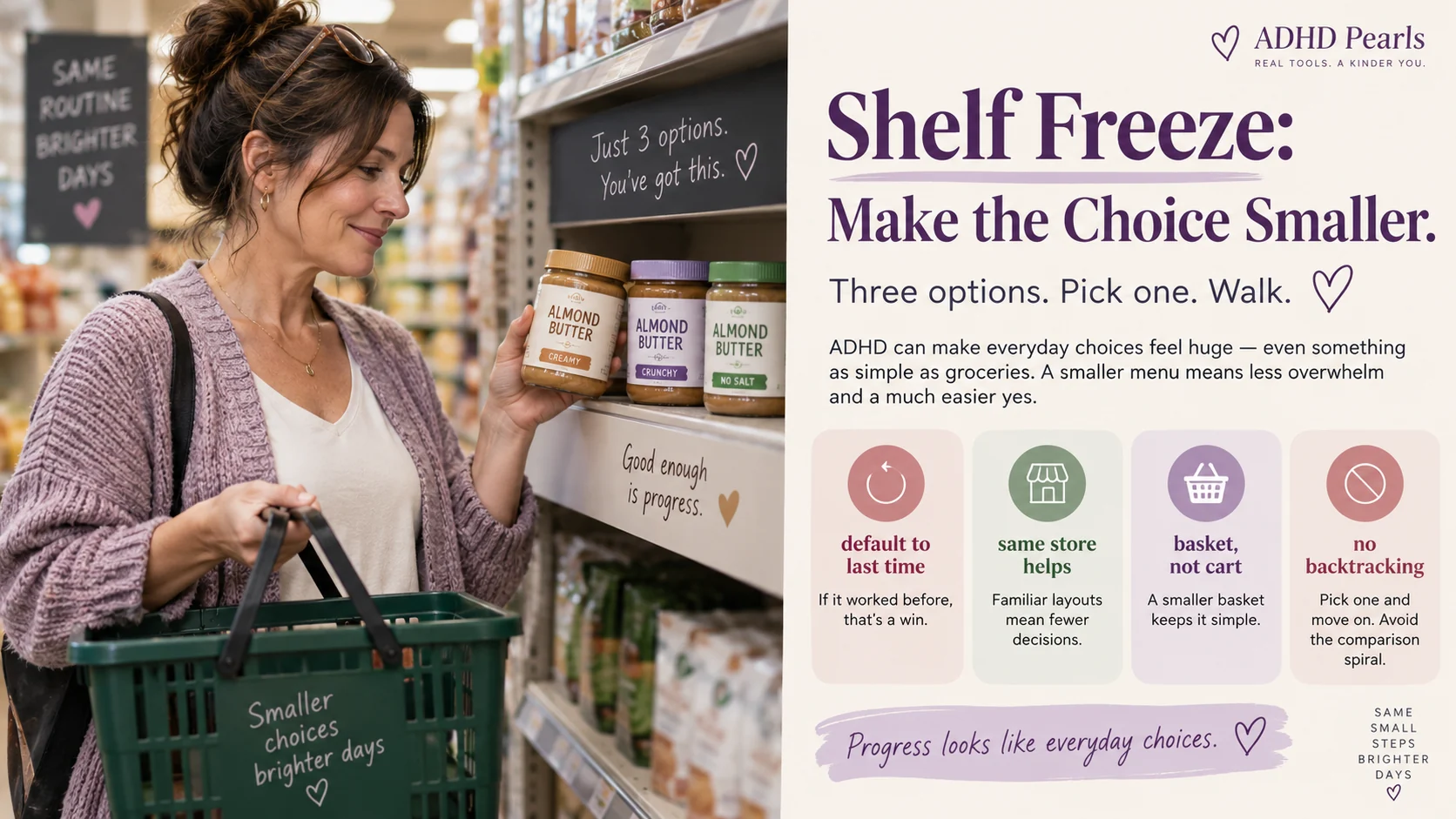
When You Freeze in Front of the Shelf
Everyone who has done this knows the specific feeling: eleven types of the thing, all slightly different, and a brain that will not close the loop. You are not indecisive. You are being asked to run a comparison with no categories and a person waiting behind you.
You are not trying to find the perfect yogurt. You are trying to leave with a yogurt.
•The three-option rule. Look at three. Pick one. Walk. The fourth option has never once changed my life.
•Default to what you bought last time. Familiarity is one of the things that makes a large assortment easier, which means loyalty to a brand is not boring, it is an executive-function saving.
•Shop the same store. Same reason. A store you know is a store where you are choosing, not searching.
•One direction, no backtracking. If you have passed it, note it for next time. The backtrack is where a twenty-minute shop becomes forty.
•Basket, not cart, for a top-up. A physical limit does the arguing for you, and your arm is more honest than your intentions.
•Headphones. Store music is set to someone else’s tempo. Something familiar and low-demand is better here than anything new — which sound helps and which hijacks is its own subject.
•If you genuinely freeze, leave the item. One missing ingredient is not worth the rest of your afternoon. Write it at the top of next week’s list and go.
The one I resisted longest was the three-option rule, because it felt like giving up on being a person who buys the right yogurt. I have made peace with being a person who buys a yogurt.
When the Shop Itself Is the Problem
For some of us the hard part is not the choosing at all. It is the lights, the PA announcements, the cart wheels, the person sampling cheese, the beeping, and the specific social dread of the checkout conversation. By the time you reach the car you are not tired, you are scoured.
Quiet hours are a real and growing thing — a number of large supermarket chains now run a weekly slot with the music off, the PA announcements limited and the lights down. Use them if the timing works. 🎵
But it is worth knowing their limits. Researchers at the University of Reading, working with autistic contributors and a full-size model supermarket, concluded in 2024 that quiet hours on their own are not enough: they are often scheduled at inconvenient times and they leave most of the other barriers in place. What the resulting guidance recommends alongside them is telling — clearer signage and store maps, trained staff, priority checkouts, more space, and somewhere to recover.
That work was done with autistic shoppers rather than ADHD ones, and sensory overwhelm is not the property of any single diagnosis. But the shape of it transfers, and so does the practical conclusion: predictability is doing as much work as quietness. Knowing the store, going at the dead hour, using the same self-checkout, parking in the same place — none of that is quieter, and all of it is easier.
There is a faint moral flavor around grocery delivery, as though shopping in person is the version that counts. It is not. The best shop is the one that reliably ends with food in your house.
What online genuinely fixes: the sensory load, the queue, the backtracking, and above all the repeat. Your last order is sitting there as a list, which means the standing order builds itself and the decisions you made in a calm moment keep applying in the weeks you have nothing left.
What it honestly costs, and nobody mentions:
•Delivery fees and minimum spends, which quietly push you to over-order to reach the threshold.
•Substitutions chosen by someone who does not know that the alternative brand is inedible in your house.
•A delivery slot you must be home for, which is a time-based obligation, which is the exact category of thing an ADHD brain is worst at.
•The browse is still there. The website has its own end caps, and they are personalized.
Click and collect sits in between and is what I use most: the list stays saved, the aisles disappear, nobody substitutes without asking, and there is no slot to be home for. It also does not unpack itself, which brings us to the part everybody skips.
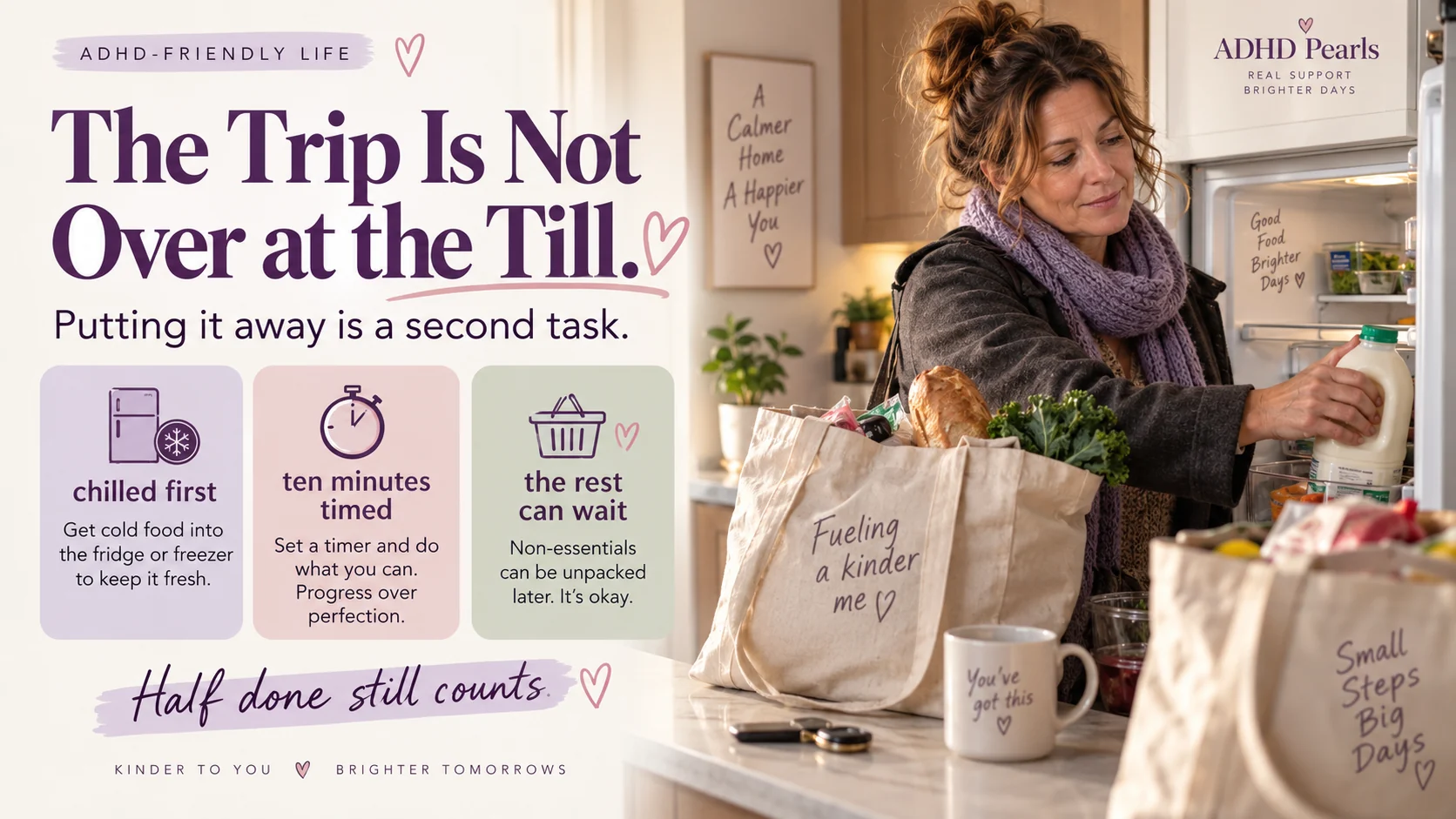
The Trip Is Not Over at the Till
The bags in the hall are the real failure point. Not the shop. The shop went fine. The shop went so fine that it used everything you had, and the bags are now a second task you did not agree to, standing between you and sitting down.
Putting away the cold food and stopping can be a complete finish, not a failed version of unpacking everything.
Three things make this survivable.
Chilled first, then stop if you need to. Frozen and fridge items go away immediately. The tins can live in the hall until tomorrow with no consequence at all. Putting away half the shopping is a complete action, not a failed one.
Ten minutes, timed, with something loud on. Unpacking is a low-decision task, which makes it one of the few chores that genuinely responds to a podcast and a countdown.
Put the list back where it lives. Next week’s trip starts the moment this one ends, and a list that survives is a list you do not have to rebuild from scratch. That is also where the week’s first “we are out of” goes, instead of into the brain that will not be holding it by Thursday. 🧠
If the food you bought keeps dying in the drawer despite all this, that is a visibility problem rather than a shopping one, and the meal system that decides before you shop and the fridge reset are the two pieces that go either side of this one.
This article is personal and educational. It is not medical or nutritional advice. If eating regularly is itself a struggle, or if food and shopping have become a source of real distress, that is worth raising with a qualified professional rather than solving with a better list.
Save this for the next trip that was supposed to take twenty minutes.
FAQ
Why is grocery shopping so hard with ADHD? Because one trip stacks about ten executive-function demands into forty minutes: planning, recalling what is at home, navigating, comparing near-identical products, tracking a total, queueing and then unpacking. Any one of them is manageable. Together, in a loud building holding tens of thousands of items, they add up to far more than the time the trip appears to take.
How do I stop forgetting the one thing I went in for? Write it down at the moment you notice it, in one fixed place, and put it at the top of the list rather than in the middle. Relying on memory for a single item is the least reliable option available, because the shop is an interruption machine and the item has no cue attached to it once you are inside.
Should my shopping list be on paper or on my phone? Whichever one you will actually have with you and will not have three competing versions of. The format matters far less than two things: that it lives in one place, and that it is grouped in the order you walk the shop rather than the order the items occurred to you.
Why do I overspend at the supermarket? Several ordinary things stack up: shopping hungry, shopping without a list, backtracking past the same displays, and buying duplicates of things you cannot picture at home. It is worth knowing that research has found the link between ADHD symptoms and impulsive buying drops away once personality and mood are accounted for, so this is not automatically an ADHD trait.
Is online grocery shopping better for people with ADHD? For many people it removes the hardest parts: the sensory load, the queue and the re-deciding, because your last order works as a saved list. It has its own costs though, including delivery minimums that encourage over-ordering, substitutions and a time slot you have to be home for. Click and collect avoids most of both sets of problems.
How do I cope with sensory overload in a supermarket? Go at the quietest hour you can, use the same store so it is familiar rather than novel, wear headphones, and use self-checkout if the interaction is part of the load. Some chains run a weekly quiet hour with reduced music and lighting. Research suggests quiet hours help but do not solve everything, and that predictability matters as much as quiet.
What is the best time of day to shop with ADHD? Whenever the store is empty and you are not rushing or hungry, which for most stores means mid-morning or an hour or two after opening on a weekday. The worst combination is time pressure plus low capacity, because feeling rushed is one of the conditions that makes choosing between similar products measurably harder.
How do I stop buying food I already have? Keep a short permanent list of the things you reliably overbuy and check the fridge and cupboard before you go rather than trying to remember them from the aisle. Duplicates are usually a visibility problem at home rather than a memory failure at the shop.
Why can I not put the shopping away when I get home? Because unpacking is a second task arriving at the moment your capacity for the first one has run out. Doing only the chilled and frozen items and leaving the rest until later is a legitimate finish, not a half-measure, and it removes the only part with real consequences.
Sources I leaned on while writing this
FMI — The Food Industry Association (2025).Food Industry Facts. fmi.org. Source for the average US supermarket carrying 33,248 items across 42,272 square feet. Industry association figures for the United States; store sizes and ranges vary widely by country and format.
Scheibehenne, B., Greifeneder, R., & Todd, P. M. (2010).Can there ever be too many options? A meta-analytic review of choice overload.Journal of Consumer Research, 37(3), 409–425. 63 conditions from 50 experiments, N = 5,036; mean effect essentially zero (D = 0.02). The moderators — lack of categorization, time pressure, unfamiliarity, difficult trade-offs — are the spine of this article. The authors state that no sufficient conditions for choice overload could be identified.
Xu, A. J., Schwarz, N., & Wyer, R. S. (2015).Hunger promotes acquisition of nonfood objects.PNAS, 112(9), 2688–2692. Five laboratory and field studies; hungry participants acquired more non-food items without liking them more. General population, not an ADHD sample.
University of Reading, Centre for Autism (2024).Autism-friendly supermarkets need more than quiet hours. reading.ac.uk. Participatory research with autistic contributors, including a full-size model supermarket, behind guidance on sensory input, predictability, signage, staff training and recovery space. Conducted with autistic shoppers rather than people with ADHD.
I still buy the crackers. Some weeks I buy a candle. The difference is that the chicken now comes home too, which is a lower bar than I used to set for myself and a much better predictor of whether anyone gets fed.
What changed was not my behavior in the shop. It was that the deciding stopped happening in the shop. When I went looking for something that would hold all of it in one place, everything I tried held recipes and left me to turn them into a route myself — which is the part that was breaking.
So we built one where the week’s meals hand their ingredients to a list that is already grouped by aisle, and where the things you buy every single week sit there permanently, unargued with. It has not made me a calm shopper. It did take the fourth jar of cumin out of my kitchen, and it means the list survives from one week to the next instead of being invented in the car park.
Found this helpful? Share it with someone who gets stuck too.
One tap makes ADHD Pearls a preferred source in your Google account, so our articles surface higher when you search. No signup, and it brings you straight back to this page.
Before you go
All-in-One ADHD Planner
Eighteen tabs that fill each other in. Say a repeating chore once and the schedule builds itself, and one tab shows who in the house actually carries what.
For the woman who sets up the perfect system on Sunday and abandons it by Tuesday.
One short letter, every week. Real talk about ADHD, task paralysis, and the tiny wins that actually move the needle for a brain like yours. No shame. No hustle culture.