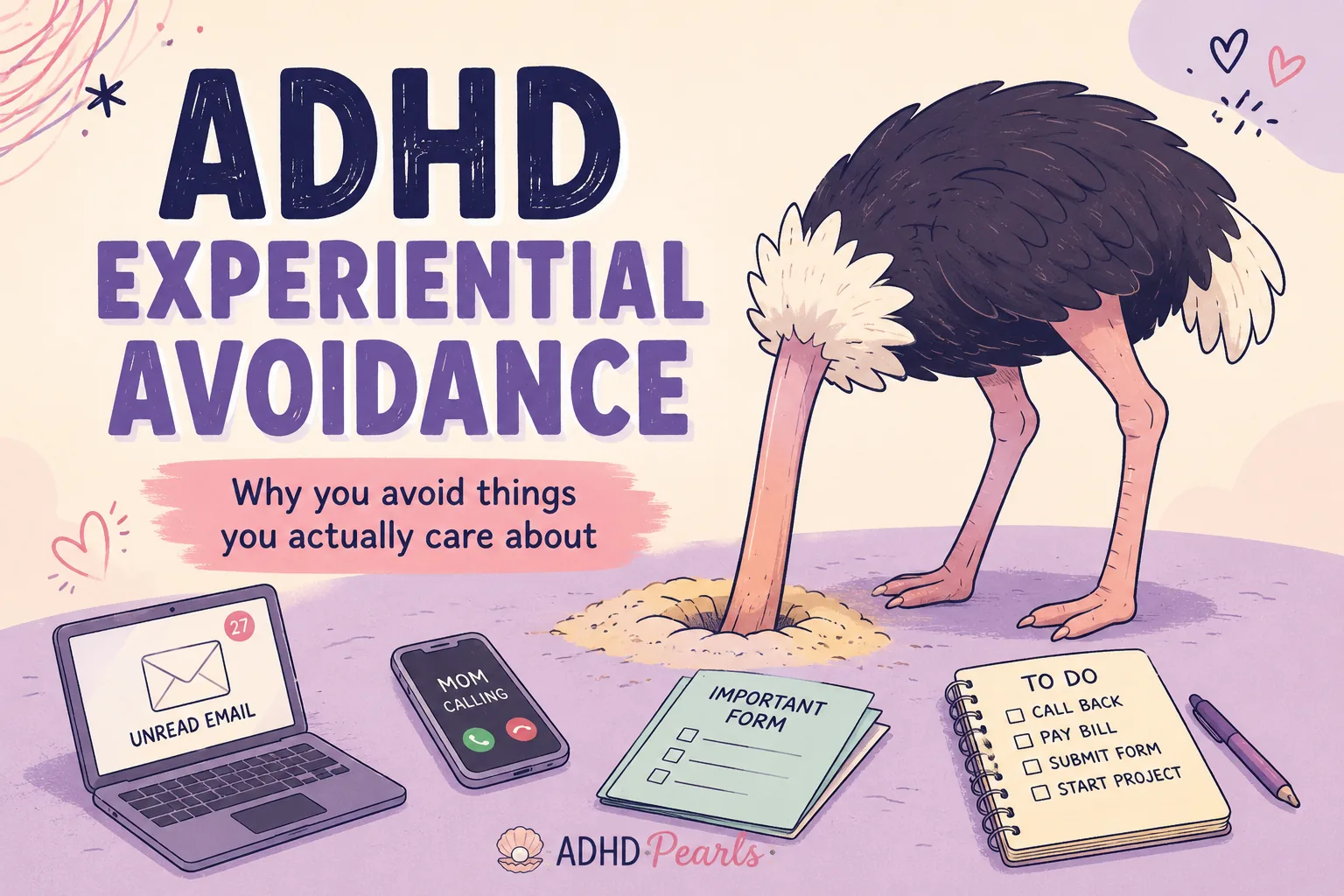
ADHD experiential avoidance is when you avoid a task, conversation, decision, or responsibility because of the uncomfortable feelings attached to it — anxiety, shame, boredom, fear of failure, uncertainty, rejection sensitivity, or overwhelm. The task may matter to you deeply. Your brain escapes the discomfort first.
Quick answer
Why do I avoid things I actually care about?
Because you are avoiding the feeling attached to the task, not the task itself. Shame, boredom, uncertainty or fear of failure arrive before you consciously decide anything, and the brain escapes the discomfort automatically. It is also why the things you care about most are often avoided hardest: more meaning attached means more feeling to escape.
Key takeaways
📌You are avoiding the feeling attached to the task, not the task itself.
📌The escape happens before you consciously decide anything, which is why willpower misses it entirely.
📌The things you care about most are avoided hardest. More meaning means more feeling to escape.
📌Avoidance works brilliantly in the short term. That is exactly why it repeats.
📌Naming the specific feeling shrinks it. “This is shame” is more useful than “I am being lazy.”
It’s not a bad email. It’s from someone I like, asking something I actually know the answer to. I have written the reply in my head at least six times — once in the shower, once at 2am when I should have been sleeping, once this morning while my coffee was getting cold.
I have not opened it.
Every time it appears in my inbox, something shifts in my chest. Not quite dread. More like the feeling before you walk into a room where something important might happen — even though I know the email is not a room. It’s not dangerous. It is just an email from a person I like.
My body disagrees.
I used to call this procrastination. I used to tell myself I was just disorganised, just bad at admin, just someone who needed a better system.
Now I think the email is not the problem. The feeling the email might make me feel — that is the problem.
What Experiential Avoidance Actually Means
The first time someone explained experiential avoidance to me, I said “oh no” out loud.
Because it reframed everything.
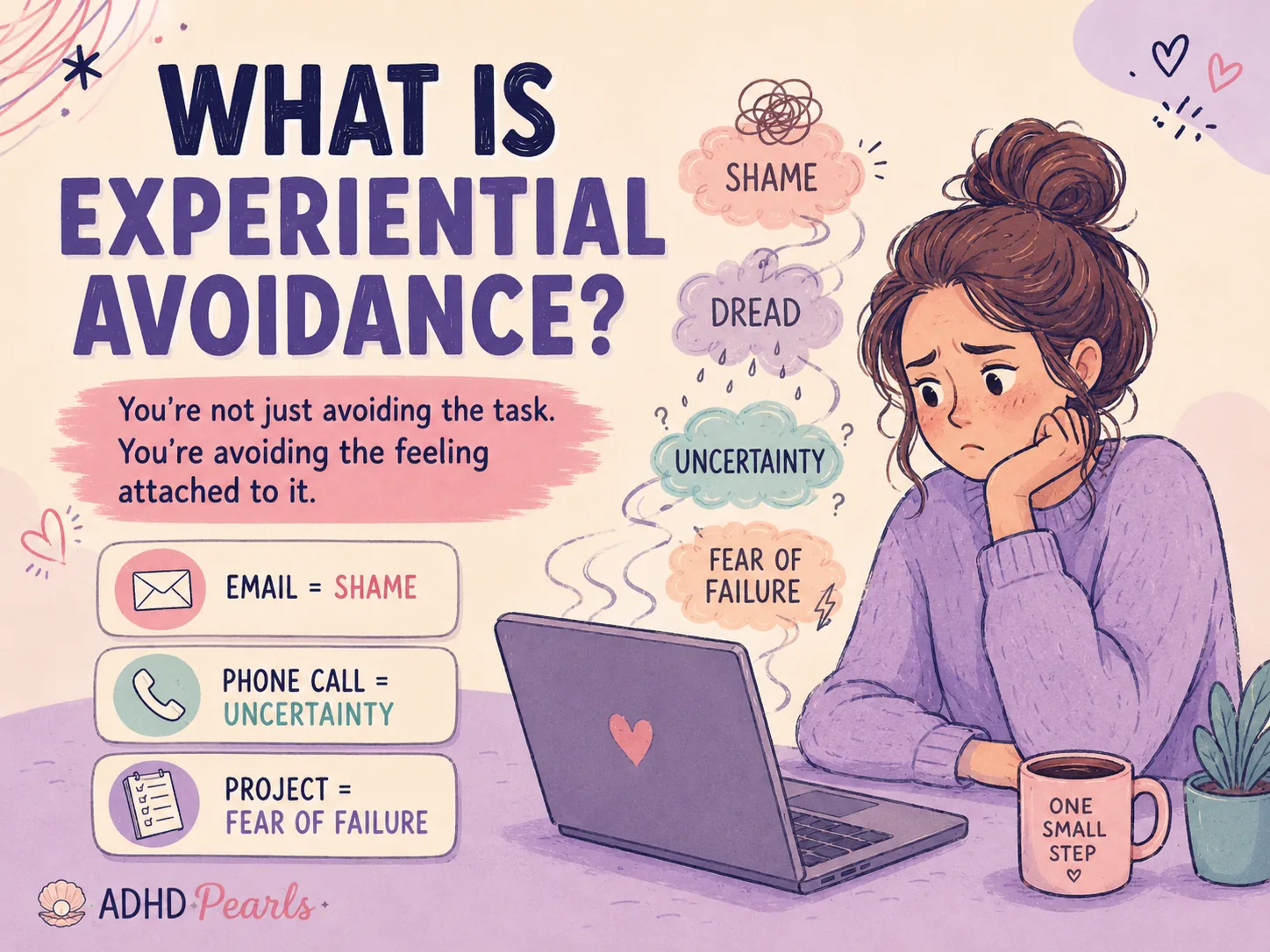
Experiential avoidance is not about avoiding the task. It is about avoiding the feeling the task triggers. Which means the task itself is almost never the real problem.
You’re not avoiding the email — you’re avoiding the shame of being slow to reply.
You’re not avoiding the phone call — you’re avoiding the uncertainty of what they might say.
You’re not avoiding the form — you’re avoiding the fear of getting it wrong, and what that might mean about you.
You’re not avoiding the project — you’re avoiding the possibility that it won’t be as good as it is in your head.
You’re not avoiding the conversation — you’re avoiding being seen as someone who dropped the ball.
Experiential avoidance is a concept from Acceptance and Commitment Therapy (ACT). The goal is not to feel nothing. It is to build enough psychological flexibility to move toward what matters even when discomfort shows up alongside it.
But first, you have to be able to name what you are actually running from.
💜 Reality Check
Sometimes I am not avoiding the task. I am avoiding the version of me I become when I open it — the one who is behind, who did not respond fast enough, who is going to have to apologise for existing slightly wrong.
You’re not avoiding the task. You’re avoiding what the task makes you feel.
From ADHD Pearls
Free Stuck Reset
One tiny move for the moments you know what to do but still can't start.
Sometimes it says “nope” so fast I do not even realise I have already left the room mentally.
I will be sitting at my desk, task right there, nothing bad has happened. And then somehow I am watching a video about a dog learning to swim and I genuinely do not know how I got there.
That is not a choice. That is a nervous system that detected something emotionally uncomfortable and rerouted before I could object.
ADHD is not just about attention. Research on executive dysfunction describes how difficulties in planning, initiating tasks, and regulating emotional responses are all part of the same system. When a task carries emotional weight — shame, dread, uncertainty, fear — the ADHD brain does not stop to assess it calmly. It escapes first and files it under “deal with never.”
I can answer three texts from acquaintances and still not open the one from someone I actually care about.
The care is not the problem. The emotional heat of the task is.
What that can feel like in real life:
a sudden vague dread with no clear source
mental static — you can see the task but cannot quite reach it
fake tiredness (you are not actually tired; your brain just wants out)
an urgent need to do something else, immediately, right now
scrolling that feels strangely compelling
cleaning something that did not need cleaning
researching something completely unrelated for forty-five minutes
✅ Tiny Reset
Next time you notice yourself rerouting — going to the fridge, opening another tab, suddenly needing to reorganise your desk — pause and ask: “What was I about to face?” Just naming it is the first interruption.
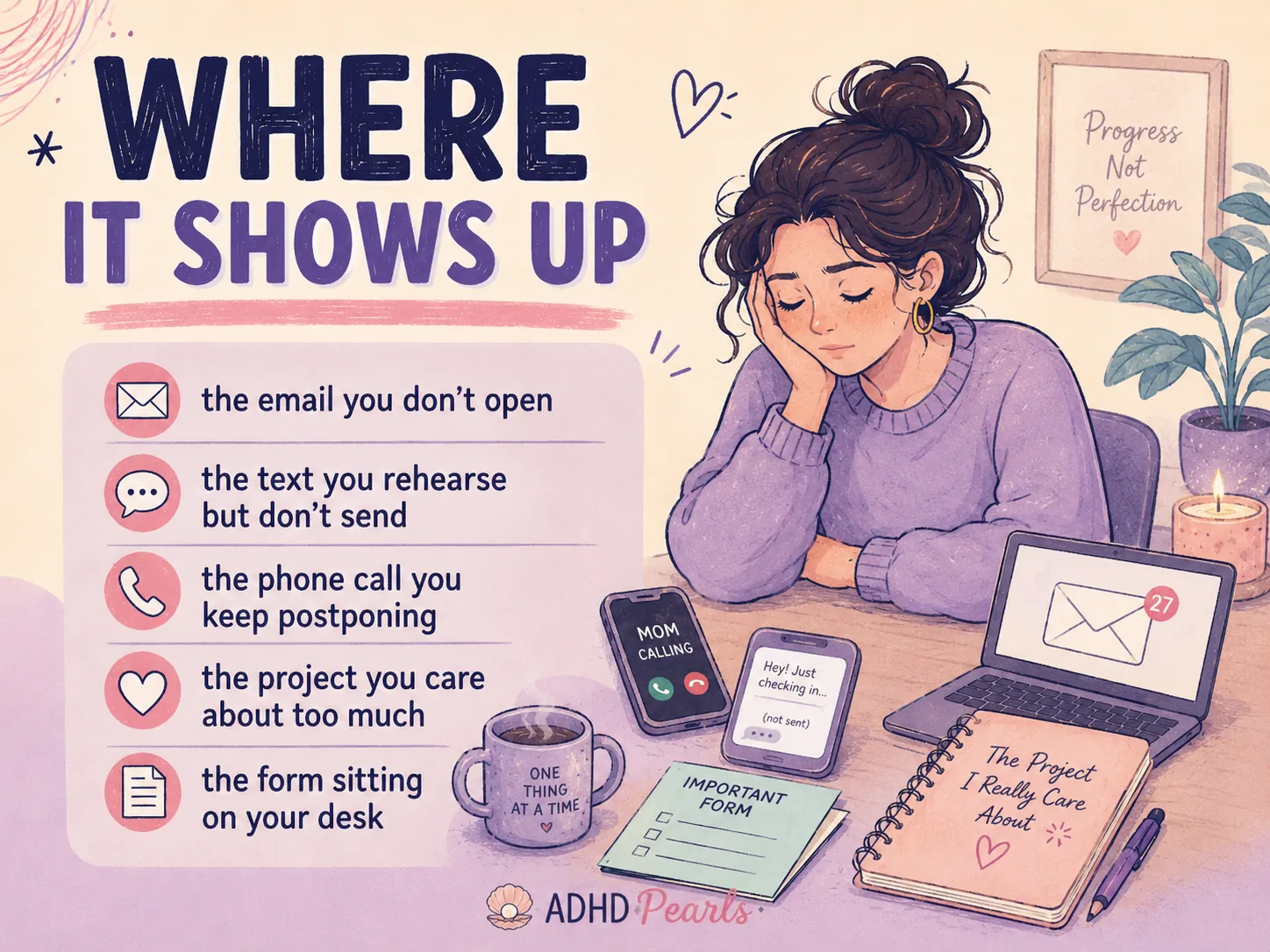
Where It Shows Up in Real ADHD Life 📩
Here is what ADHD avoidance actually looks like in my life. Not the clinical version. The embarrassing one.
The email: I have composed the reply. I have composed it five times. It lives in my head in a state of permanent readiness. It has not moved an inch closer to my outbox.
The phone call: I know I need to make it. I have looked up the number. I have put the number in a note. I have thought about making the call every single day for two weeks. I have not made the call.
The text: Saw it. Meant to reply. Did not reply. It has been four days. Replying now would require an explanation that is longer than the original message. I have not sent that either.
The form: It is on my desk. It has been on my desk so long it has essentially become furniture.
The creative project: The one I care about too much to actually start. If I never really try, I never really fail. So I open the document, stare at it for forty-five seconds, and close it again. I have been “about to start” for three months.
The tab: I keep it open because closing it feels like giving up. I have fourteen tabs open for this reason.
And then there is the one that surprises people the most:
The thing I actually want.
I have avoided things I was genuinely excited about. That is the part that is hardest to explain. Avoidance is not always about not caring. Sometimes it is about caring so much that starting feels emotionally dangerous — because if you want it badly enough, failing at it means something real.
💜 Reality Check
Avoidance looks like I don’t care. The truth is usually the opposite — I care so much that my nervous system bails before I even get a chance to begin.
The things we avoid are often the things we care most about.
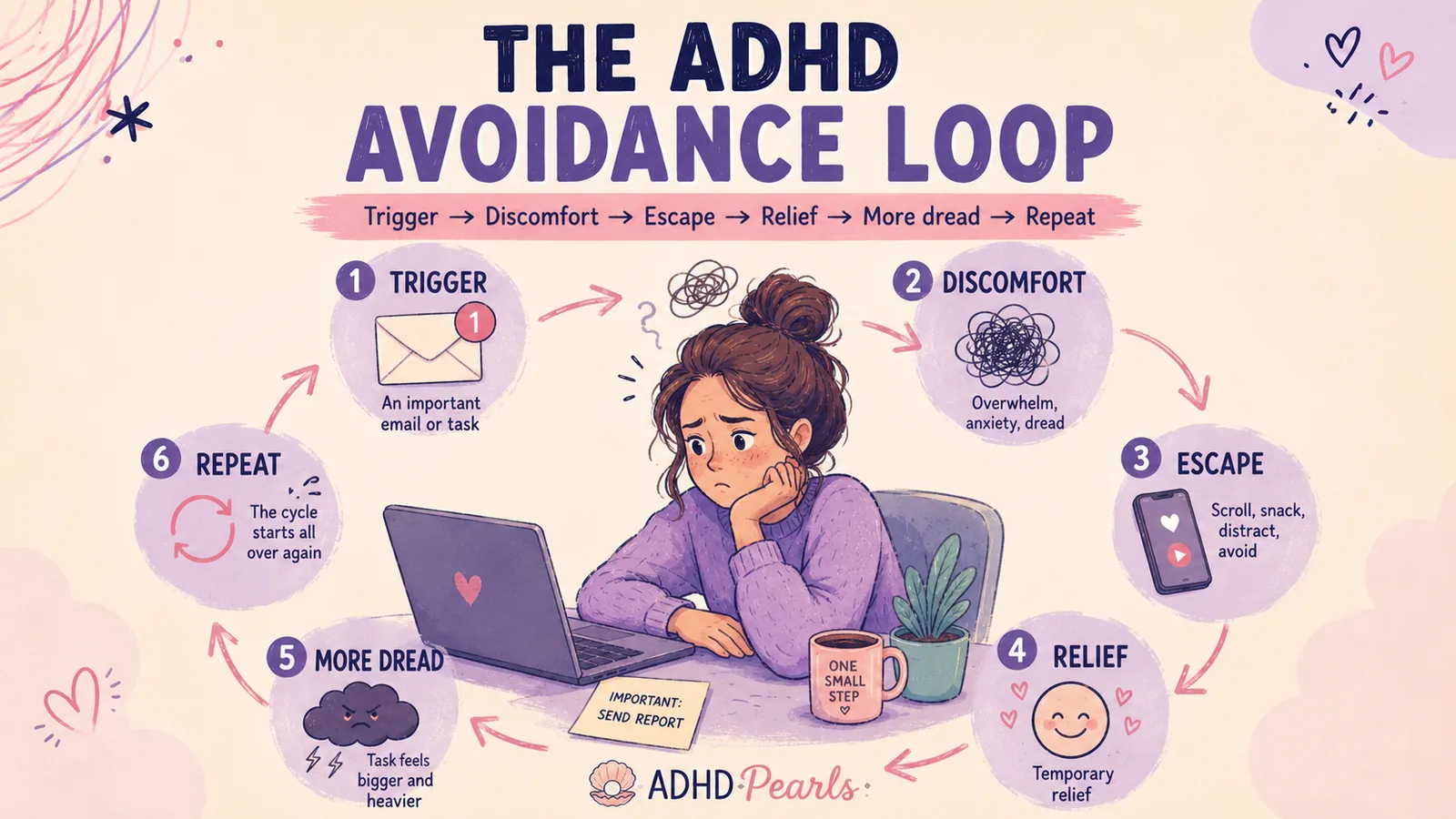
The ADHD Avoidance Loop
Here is how it tends to move, once it gets going:
Trigger — something surfaces that needs attention. An email. A bill. A name on your to-do list.
Discomfort — your nervous system registers shame, dread, boredom, or fear before you have even consciously processed what the task is.
Escape — you scroll, snack, clean something, start something else, or tell yourself “I’ll do it in a bit” in a way that genuinely feels true.
Temporary relief — your body exhales. The discomfort drops. You feel okay for a moment.
More dread — the task is still there. Now it has been longer. Now it is heavier. Now there is more to explain.
Repeat — except now shame is attached to the avoidance itself, which makes the task even harder to face the next time it surfaces.
The worst part is that avoidance works — just enough to teach your brain to keep doing it.
Research on emotional avoidance and procrastination shows how short-term relief reinforces avoidance patterns over time. Every escape gives your nervous system a real sip of relief. Of course it repeats. You are not broken. You are responding to something that actually works, in the short term.
The loop is self-reinforcing. Every escape makes the next entry point harder.
✅ Tiny Reset
When you notice you are in the loop, try naming it out loud: “I am not avoiding the task. I am avoiding feeling ____.” Just naming it interrupts the automatic part. You do not have to do anything else yet.
Avoidance Is Not Laziness. It’s Emotional Pain Management.
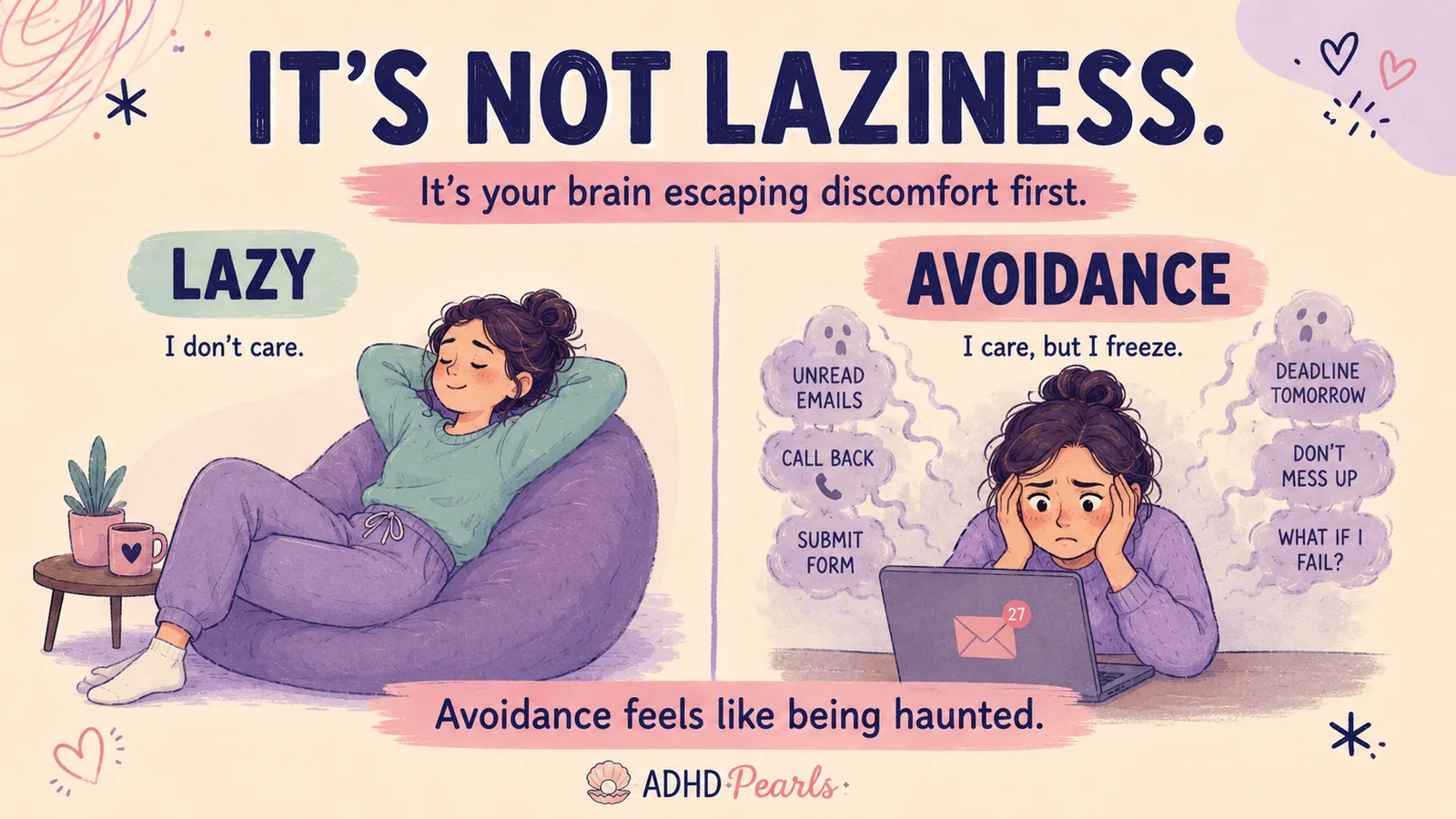
Lazy feels like peace.
Avoidance feels like being haunted.
That is the real difference. When you are genuinely disengaged from something, it does not follow you around. It does not sit in your chest at dinner. It does not surface at 3am. You do not mentally rehearse it seven times and then go make tea instead.
Lazy sounds like: “I don’t care.”
ADHD avoidance sounds like:
“I care. I just cannot make myself start.”
“I have thought about this twelve times today.”
“I am already exhausted from not doing it.”
“I know it will be bad when I finally face it, and I still cannot face it.”
If your avoidance comes with guilt, mental rehearsal, dread, and a low hum that follows you through the whole day — that is not laziness. That is emotional pain management. You just have not had that language for it until now.
I have absolutely said “I’ll do it later” when what I really meant was: “I cannot emotionally survive opening that right now.” Those are not the same sentence. But they look identical from the outside.
Lazy is choosing not to care. Avoidance is caring so much it hurts to start.
The Shame + Perfectionism Trap 😬
Sometimes I do not avoid the task because it is hard.
I avoid it because I do not want to see proof of how behind I am.
Opening the email might mean finding out I missed something. Filling in the form might mean discovering I got something wrong. Starting the project might mean realising it is not as good as it was in my head, where it was perfect and unstarted and still full of possibility.
Not opening it means none of that has to be real yet.
What shame says when it is running the avoidance:
you are already behind
they have noticed
it is going to be awkward now
you should have done this weeks ago
what kind of person lets it get this far
Sometimes opening the thing feels like opening a verdict.
And here is the trap: the longer you avoid, the louder shame gets. The louder shame gets, the harder it is to begin. The cycle does not break on its own — but it does have exit points.
If the shame layer feels familiar, the ADHD Shame Detox goes deeper into what it means to stop using your past as proof you failed — and how to actually start softer.
Why Avoidance Feels Good at First
This is important to understand without judgment: avoidance makes complete sense.
You decide not to open the email — and your chest actually loosens. You put off the phone call — and your body relaxes. You close the tab — and the dread goes quiet, just for a minute.
Of course you keep doing it. The relief is real.
The problem is what happens next. The task comes back. And it comes back slightly heavier than before. Because now there is the original discomfort plus the shame of having avoided it plus the added weight of knowing you will have to face it eventually anyway.
The longer you wait, the louder the task gets — not because it got bigger, but because it gathered shame along the way.
💜 Reality Check
The relief is real. It is just not the same as repair.
How to Break the Avoidance Loop Without Bullying Yourself 🛟
Not with a productivity system. Not with harder self-talk.
With something much smaller.
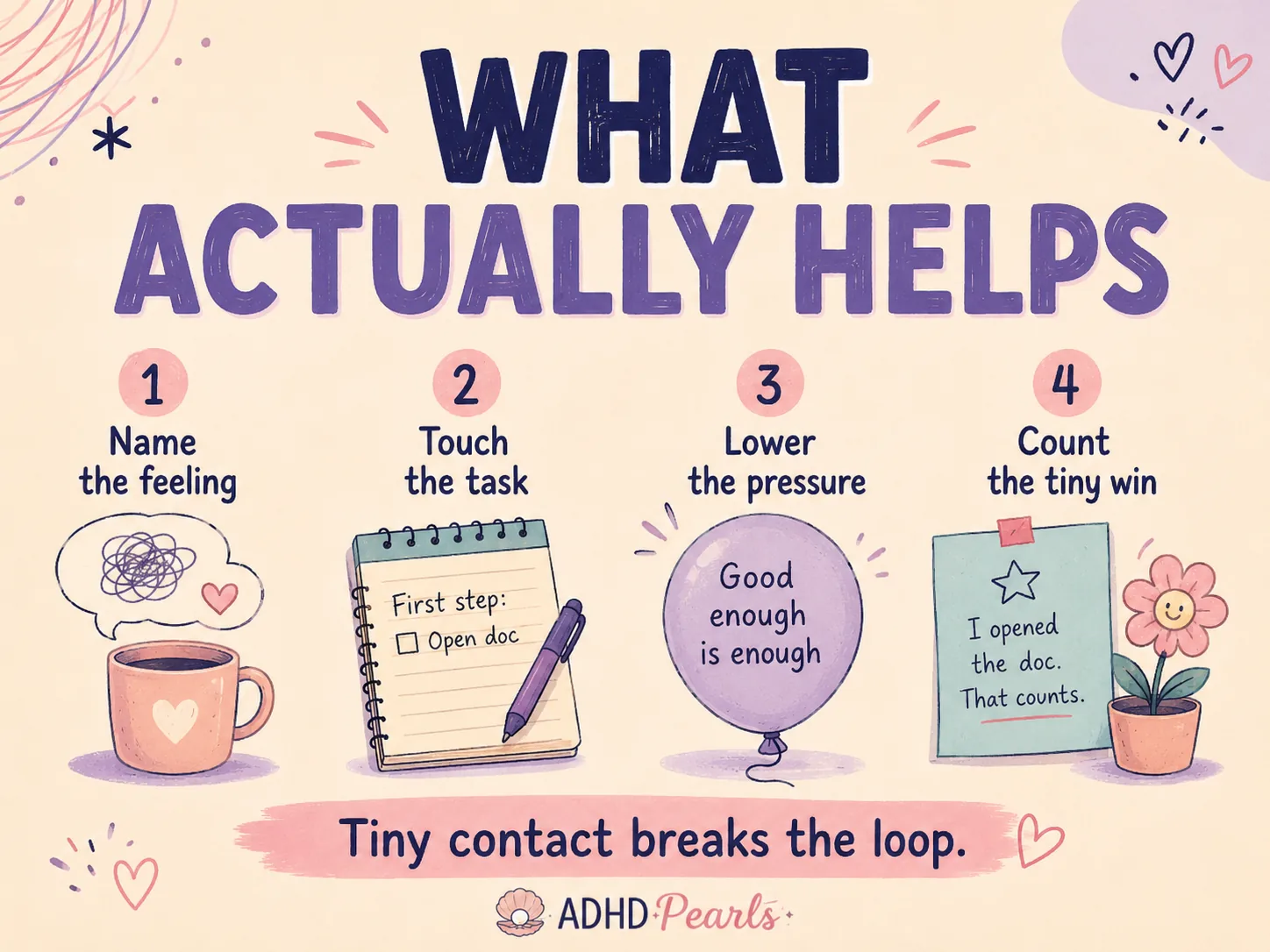
1. Name the feeling, not just the task
Instead of: “I need to answer the email.”
Try: “I am avoiding the shame I feel when I open this inbox.”
Naming what you are actually running from shifts the target. You are not fighting an email. You are working with a feeling. That is a different problem — with different, smaller solutions.
2. Make contact with the task for just 2 minutes
Not to finish it. Not to fix it. Just to touch it.
Open the email and do not reply yet.
Look at the form without filling it in.
Find the phone number and write it on a piece of paper.
Write the first terrible sentence and close the document.
Put the bill somewhere you can see it.
Contact is not completion. Contact is often enough to dissolve a small amount of dread and make the next attempt less heavy.
3. Script the scary part first
If the avoidance is about a call or a conversation, write the first sentence before you make it:
“Hi, I’ve been behind on this and I’m trying to get back on track. What do I need to do next?”
Most of the fear lives in the blank opening. A first line removes the blankness.
4. Lower the emotional temperature first
Some tasks need your nervous system to settle before they become accessible. This is not procrastination. It is preparation.
tea or coffee before you open it
a blanket — genuinely, this helps
a body double (someone nearby, even on video call)
a timer that limits your exposure to 5 minutes
a comfort show very quietly in the background
one tab only, everything else closed
5. Count the tiny contact as a real win
Not because everything is resolved.
Because you interrupted the escape loop. Even once. Even briefly. That counts. That slight change in momentum is how the loop eventually loosens.
You don’t have to finish. You just have to interrupt.
✅ Tiny Reset
Pick one avoided thing. Before you open it or touch it, write: “I think when I face this I am going to feel ____.” Naming the anticipated feeling before it arrives often makes it less overwhelming when it does.
✅ A Tiny Reset You Can Try Right Now
This takes three minutes. You do not have to finish anything.
Pick one thing you have been avoiding. Just one.
Write: “I am not avoiding the task. I am avoiding feeling ____.”
Choose the smallest possible contact point — not the task, just the edge of it.
Set a 3-minute timer.
Stop when it ends, even if nothing is finished.
Count it. It counts.
The goal is not to become fearless. The goal is to stop letting fear drive the car.
Where Perlova Fits In
I made Perlova for this exact moment.
Not for the version of you who has everything together and just needs a slightly better system. For the version who is tired, behind, possibly avoiding three things before breakfast, and still trying to find one thing that feels actually possible today.
It starts from your energy right now, not from a plan you made when you were feeling optimistic. It shrinks the next step into something genuinely doable. It counts tiny contact — not just finished tasks — as real movement. No shame scoreboard. No streak pressure. No view of everything you have not done yet.
Just: what is one thing, right now, that your brain can actually reach?
You can also grab the free ADHD Stuck Reset for the moments when paralysis has set in completely — or the free Dopamine Menu for low-energy days when you need a pre-made list of small options instead of having to invent one from scratch.
FAQ: ADHD Experiential Avoidance
What is ADHD experiential avoidance?
ADHD experiential avoidance is when you avoid tasks, decisions, conversations, or responsibilities because of the uncomfortable feelings attached to them — such as shame, anxiety, boredom, uncertainty, or fear of failure. The task may matter to you deeply, but your brain escapes the discomfort before you can begin.
Is experiential avoidance the same as procrastination?
No. Procrastination describes the delay. Experiential avoidance explains one reason behind the delay: escaping the emotional discomfort linked to the task. You can procrastinate without experiential avoidance, but most ADHD avoidance has an emotional layer underneath it.
Why do people with ADHD avoid things they care about?
Because the task may trigger overwhelm, shame, uncertainty, boredom, fear of failure, rejection sensitivity, or executive dysfunction. Caring does not always make starting easier. Sometimes it makes the task feel emotionally heavier — because there is more at stake if it goes wrong.
How do I break ADHD avoidance?
Start by naming the feeling you are avoiding, then make tiny contact with the task for 2–3 minutes. The goal is not to finish everything. The goal is to interrupt the escape loop. Lowering the emotional temperature — a timer, a blanket, a body double — often helps more than willpower.
Can experiential avoidance make ADHD shame worse?
Yes. Avoidance brings short-term relief, but when the task remains unfinished, shame often grows. That shame makes the task feel even harder to face next time. The longer you avoid, the louder the task gets — not because it got bigger, but because it gathered more shame along the way.
This article is for education and personal support, not medical advice. If ADHD symptoms are affecting your daily life — including avoidance patterns that are causing real distress or impairment — consider speaking with an ADHD-informed clinician who can help you understand what is happening and what support is available.
How is experiential avoidance different from task paralysis?
Task paralysis is being unable to start despite wanting to. Experiential avoidance is the brain steering you away from something in advance, because of a feeling attached to it, often before you consciously decide anything. The two frequently happen together.
Why do I avoid opening messages from people I love?
Usually because the message carries emotional weight, and the longer it sits the more weight it gains. Avoidance is not about the person. It is about the anticipated feeling of having let them down by not replying sooner, which grows the longer you wait.
Does avoiding something make the feeling stronger?
Generally yes. Avoidance gives short-term relief, which teaches the brain that avoidance works, and the underlying discomfort tends to grow in the meantime. This is one of the better-established patterns in behavioral psychology.
When should I get professional support for this?
If avoidance is affecting your health, finances, work or close relationships, or if the things you avoid keep expanding. Persistent avoidance is also a feature of anxiety and depression, and a clinician can help identify what is actually driving it.
Found this helpful? Share it with someone who gets stuck too.
One tap makes ADHD Pearls a preferred source in your Google account, so our articles surface higher when you search. No signup, and it brings you straight back to this page.
Before you go
Free Stuck Reset
One tiny move for the moments you know what to do but still can't start.
For the woman who sets up the perfect system on Sunday and abandons it by Tuesday.
One short letter, every week. Real talk about ADHD, task paralysis, and the tiny wins that actually move the needle for a brain like yours. No shame. No hustle culture.