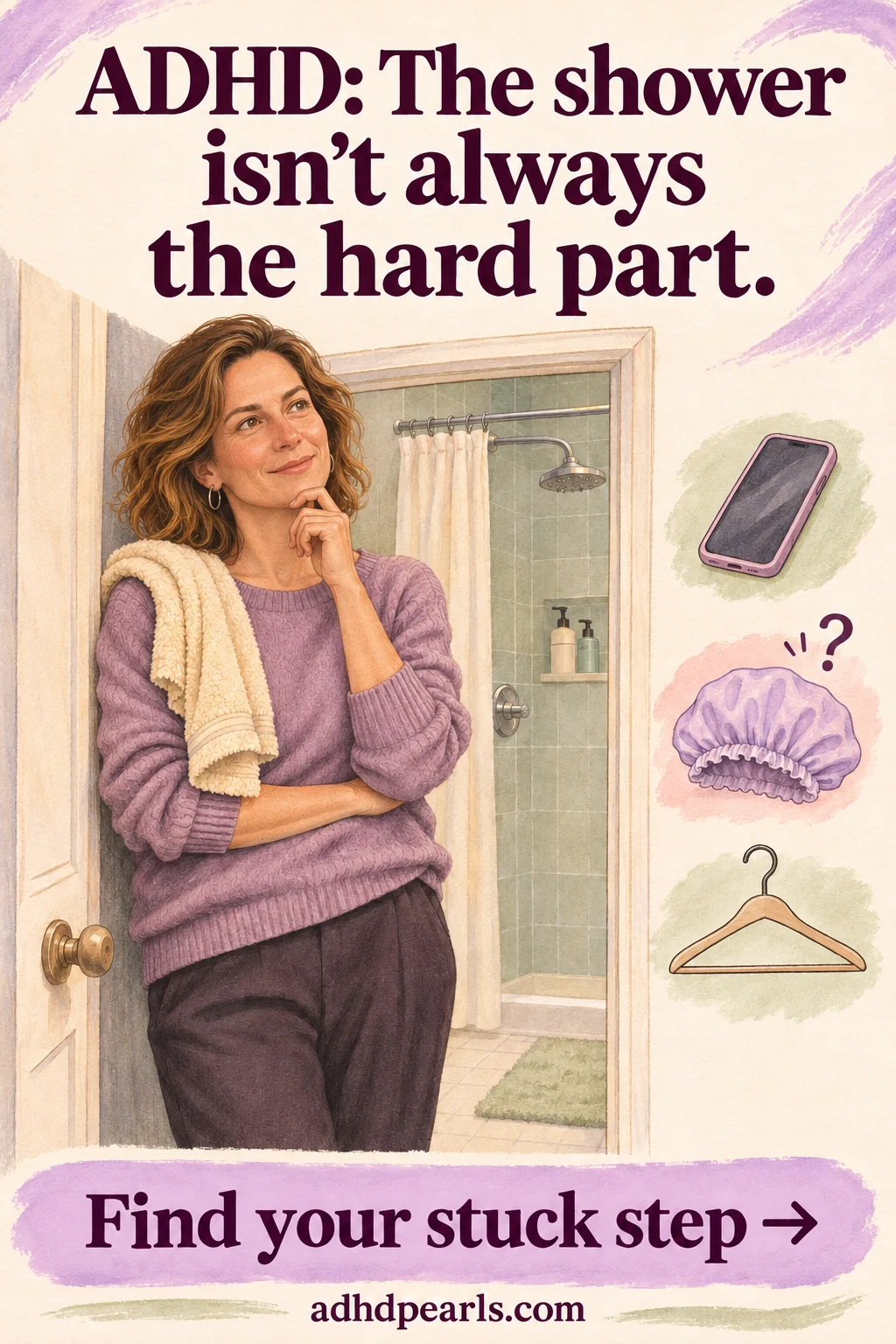
It was 9:40 on a Wednesday night and I was standing in the bathroom doorway with a towel over my shoulder. I had been “about to shower” since a quarter past seven.
Nothing was stopping me. The water worked. The towel was, as established, already on my body. I just could not get from the doorway to the tap, so I sat on the edge of the bath and read about a stranger’s kitchen renovation instead.
If you have ADHD, you may know this exact doorway. Showering, brushing your teeth and the rest of the basics can feel absurdly hard, and it has very little to do with not caring whether you are clean. This is about why it happens, and the small, slightly unglamorous fixes that get me through that doorway more often than they used to.
Quick answer
Why is showering so hard with ADHD?
Showering is not one task. It is a dozen small steps wrapped in two hard transitions, getting in and getting out, with sensory friction in the middle and almost no reward. ADHD makes low-reward tasks harder to start. Shrinking the first step, setting up the bathroom in advance and keeping a floor version for bad days helps more than willpower.
Key takeaways
📌A shower is a chain of about a dozen steps, and an ADHD brain can stall at any link in it.
📌The hardest parts are usually the two transitions: leaving what you are doing, and leaving the warm water.
📌Find the exact step where your shower breaks and fix that one, not the whole routine.
📌Every basic needs a floor version for bad days, and teeth are the one worth protecting first.
📌A skipped shower says nothing about your worth; hygiene that collapses with everything else is worth checking for depression or burnout.
Why Is Showering So Hard With ADHD When It Only Takes Ten Minutes? 🧠
For years I said “I hate showering.” That was not true. I like being in the shower. What I hated was everything around it.
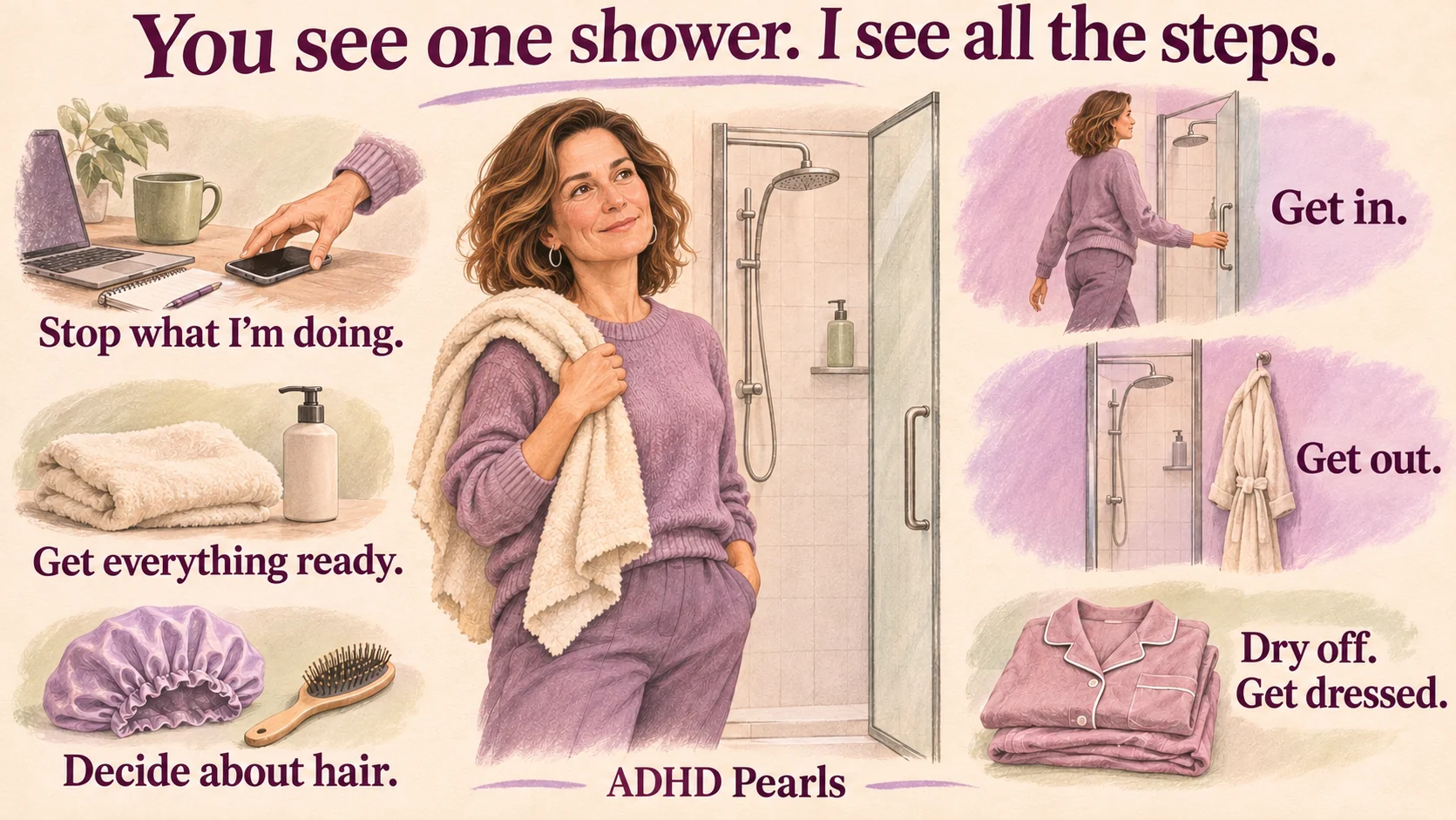
Write out what a shower actually asks of you and it stops looking like one task. Stop what you are doing. Walk to the bathroom. Find a towel. Decide whether today is a hair day. Undress in a cold room. Get the temperature right. Wash in some kind of order. Rinse. Turn it off. Get out into the cold. Dry off. Find clothes. Deal with the hair.
Headline: You see one shower. I see all the steps. Around a woman standing beside a shower, six illustrated groups: stop what I’m doing; get everything ready; decide about hair; get in; get out; dry off and get dressed. Each group bundles several smaller actions. It is an illustration of how many pieces a shower can have, not a universal six-step routine.
That is a dozen steps, and an ADHD brain can stall at any link in the chain. A therapist and an occupational therapist writing in CHADD’s Attention magazine make the same point: the sheer number of steps, and having to remember and sequence them, is a big part of why hygiene is hard with ADHD.
Then three more things stack on top:
•Two transitions, not one. Stopping something engaging to start something boring takes inhibition and task initiation, which are exactly the skills ADHD makes harder. And once you are warm, you have to do it again in reverse to get out.
•Almost no reward. Nobody sends you a notification for being clean. In a brain-imaging study of 45 adults with ADHD and 41 without, lower function in the brain’s dopamine reward pathway went along with lower motivation scores. That does not prove anything about your shower, but it fits: a task with a vague, delayed payoff gets very little pull.
•Sensory friction. Wet hair, the cold air when you step out, water pressure, the towel. In a Dutch study of 116 adults diagnosed with ADHD, both over- and under-sensitivity to sensory input were more common than in norm data, especially in women. Some days the water feels lovely. Some days it feels like an argument.
Put it together and the shower is a near-perfect storm of what ADHD finds hardest. You are not failing a ten-minute task. You are getting through a twelve-step one that nobody ever wrote down.
I don’t hate showering. I hate the forty minutes in the doorway before it, and the cold three seconds after it.
What finally got me off the edge of the bath was not motivation. It was making the first step so small it stopped feeling like a decision. I went looking for something that would do that on the nights my brain refused, and most of what I found was a full routine with a checklist, which is the exact thing I could not start.
So we built a free Stuck Reset that asks how much you have left and then gives you one entry point and nothing else. On a “barely anything” night it asked what the very first thing I would touch was. The tap. I turned it on, and that was the whole assignment. It does not wash you, and it will not work every time. But a running tap turns out to be surprisingly hard to walk away from.
From ADHD Pearls
Free Stuck Reset
One tiny move for the moments you know what to do but still can't start.
For years I tried to fix “showering” as one lump. Morning showers, evening showers, a thirty-day streak on a habit app that lasted nine days. None of it stuck, because I was fixing the whole routine when only one step was broken.
When I finally paid attention, my shower failed in the same two places almost every time. Starting, because my phone was in my hand. And hair, because wet hair at 10 p.m. means either sleeping on it or another twenty minutes with a dryer. Everything in between was fine. I was a perfectly competent showerer for about eight minutes in the middle.
This is not a diagnostic table. It is a map of the places I get stuck, and the places people in ADHD forums describe again and again, with the smallest fix for each. Find your stuck point and you only have to fix one thing.
Where it breaks
What it looks like
Smallest fix
Leaving what you are doing
“Five more minutes” on the sofa turns into two hours
Set an alarm to walk to the bathroom, not to shower. Walking there is the whole job.
The cold room
Half undressed, cold, so the sweater goes back on
Run the water first so the room warms up, or use a small heater
Too many decisions
Hair or no hair? Shave? Which products?
Decide the defaults once: hair on fixed days, everything else optional
Wet hair
A twenty-minute dryer job you do not have the energy for
Shower without washing hair, use dry shampoo, or wash hair in the sink another time
Getting out
Standing under the water for twenty-five minutes
A warm towel or robe within arm’s reach and one song as the end signal
Afterwards
Towel on the floor, no clean clothes, back to bed in a damp T-shirt
Lay out clothes, even pajamas, before you get in
Sensory friction
Water too loud, pressure stings, the towel feels wrong
Try a bath, a handheld head, lower pressure, or one towel you actually like
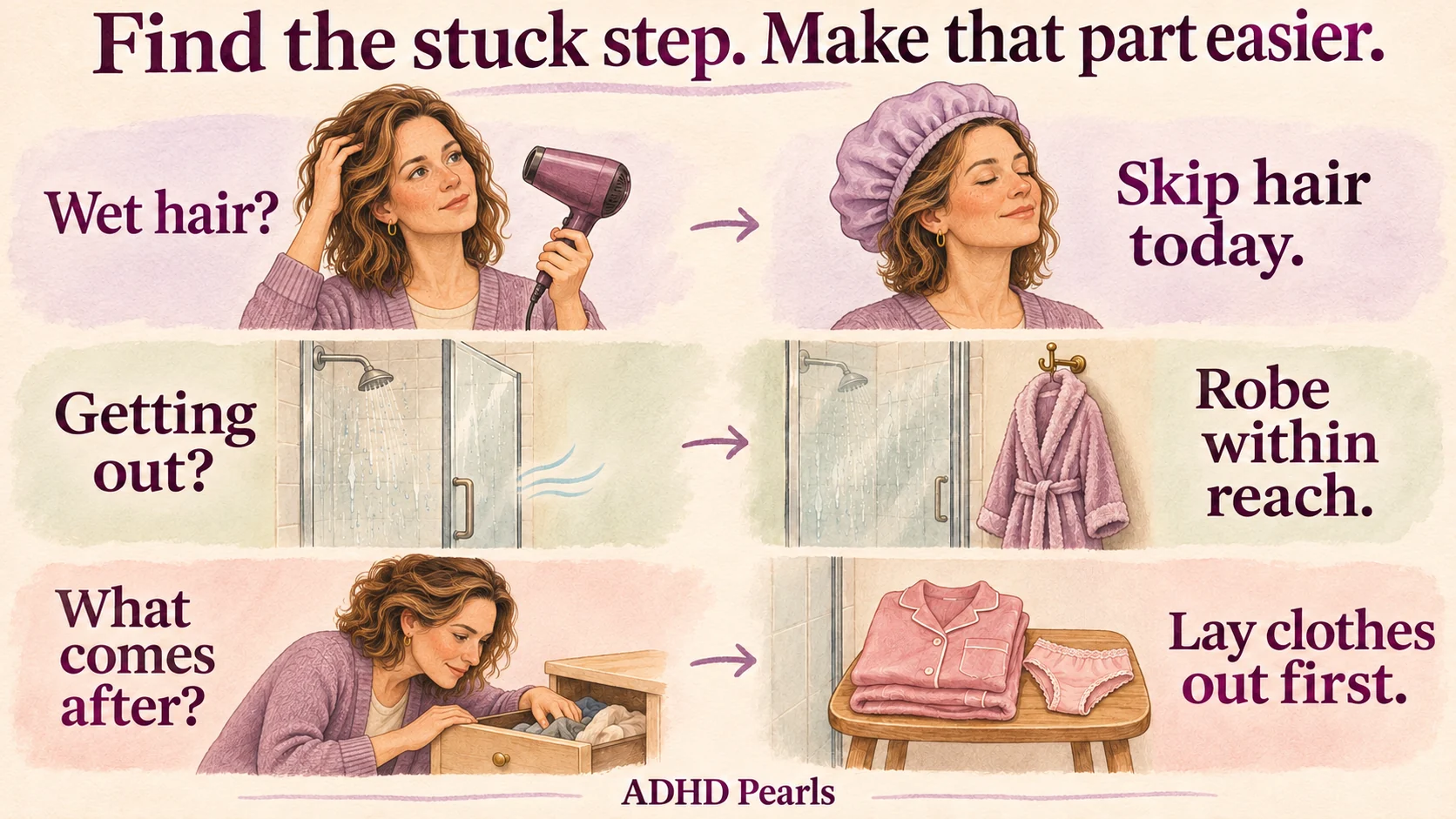
Headline: Find the stuck step. Make that part easier. Three rows, each pairing an obstacle with an adjustment: wet hair, so skip hair today; getting out, so keep a robe within reach; what comes after, so lay clothes out first.
Pick one row. Just one. If you fix the step that breaks most often, the rest of the shower usually takes care of itself, because the rest of the shower was never the problem.
Give Every Basic a Floor Version for Bad Days 🔋
The most useful thing I ever did for my hygiene was lower the bar on purpose, in advance, on a day when I still had some energy to decide.
All-or-nothing thinking is brutal here. If the “real” version is a full shower with hair, skincare and clean pajamas, then on a low-capacity day the real version does not happen, and nothing happens instead. A floor version means a bad day still gets something rather than nothing.
I keep three levels for each basic. Not because I am organized, but because I am not, and deciding at 10 p.m. is exactly where it falls apart.
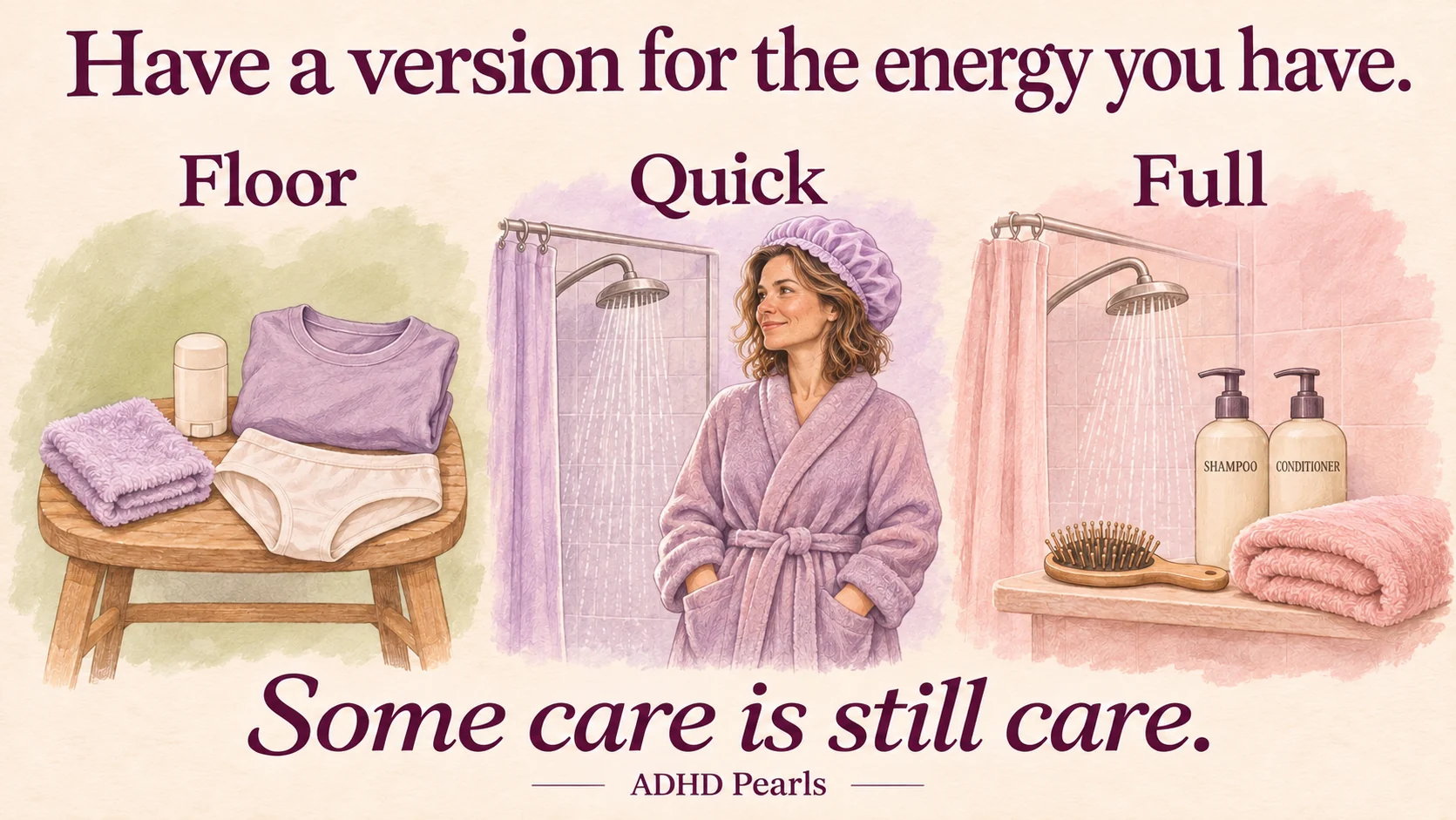
•Shower. Floor: a washcloth or wipe on face, underarms and the places that matter. Normal: a quick rinse, no hair. Full: hair day, the works.
•Teeth. Floor: thirty seconds with fluoride toothpaste. Normal: two minutes, spit, do not rinse. Full: add floss.
•Face. Floor: one wipe. Normal: wash and moisturizer. Full: whatever routine you saved on Pinterest at midnight.
•Hair. Floor: dry shampoo, a clip or a hat. Normal: brushed. Full: washed.
•Clothes. Floor: clean underwear and a clean top. Normal: anything clean. Full: an actual outfit.
Headline: Have a version for the energy you have. Three equal options. Floor: a washcloth, deodorant and clean clothes. Quick: a shower with hair tucked under a shower cap. Full: a shower with shampoo and conditioner. Closing line: Some care is still care.
If the floor version of a shower feels like cheating, it may help to know how low the medical bar actually is. Harvard Health’s senior faculty editor wrote that showering several times a week is plenty for most people, unless you are sweaty or grimy, and that a short shower focused on the underarms and groin may be enough. The daily shower is mostly a social habit. A washcloth on a bad Tuesday is not a failure. It is not far from what the experts were suggesting anyway.
Keep a hard-day kit
The floor only works if it takes no effort to reach. I keep a small basket by the bed with face wipes, body wipes, dry shampoo, deodorant, a hair clip and a travel bottle of fluoride mouthwash. On the days I cannot get to the bathroom, I can get to the basket. It is not glamorous, and it has rescued more mornings than any routine I have ever written down.
Our ADHD night routine guide uses a version of this for bedtime, a “good enough” hygiene bar decided in advance. It turned out to work for the whole day, not just the evening.
The floor is not a downgrade you are supposed to feel bad about. It is the version that exists on the days the full version does not. On my worst weeks I have lived on floor versions for five days straight, and I was still more cared for than if I had waited until I could do it properly. If you are running on empty for more than a day or two, low-energy days with ADHD covers how to plan around that capacity instead of against it.
Why Is Brushing Your Teeth So Hard With ADHD? Protect This One First 🦷
Brushing takes two minutes, which is exactly why it is so maddening when it does not happen. But the two minutes were never the hard part. You have to remember it, stop whatever you are doing, walk to the sink and put up with the taste and the foam, all for a payoff you cannot see in the mirror.
Still, if I could keep only one basic going on a bad week, it would be teeth. Skipping a shower for two days leaves no lasting mark. Teeth keep a record.
The numbers are a little sobering. In CareQuest Institute’s nationally representative oral health survey, adults who had been diagnosed with ADHD were more likely than adults without it to rate their oral health as fair or poor (35.5% vs 24.9%), to feel embarrassed by their teeth or mouth (48.4% vs 29.6%), and to have gone to an emergency department for dental care in the past year (13.0% vs 2.3%). If you are embarrassed about your teeth, you are in a very big, very quiet club.
The NHS advice is simple: brush for about two minutes twice a day, make one of those last thing before bed, use a fluoride toothpaste, and spit rather than rinse so the fluoride stays on your teeth. Getting there is the hard part. These are the moves that helped me most:
•Move the toothbrush to where you already are. For one long winter mine lived in a mug next to the kettle, and I brushed while the water boiled. Not elegant. Extremely effective. KC Davis suggests the same in ADDitude: toothbrushes in several places, so you can brush whenever the thought actually arrives instead of at the official time.
•Brush in the shower on the days you do shower, so two tasks share one transition.
•Let an electric brush count for you. One with a two-minute timer takes the counting off your plate, and the buzz is a little more interesting than silence.
•Change the toothpaste if the mint feels like an assault. Milder flavors exist. Just check the label still says fluoride.
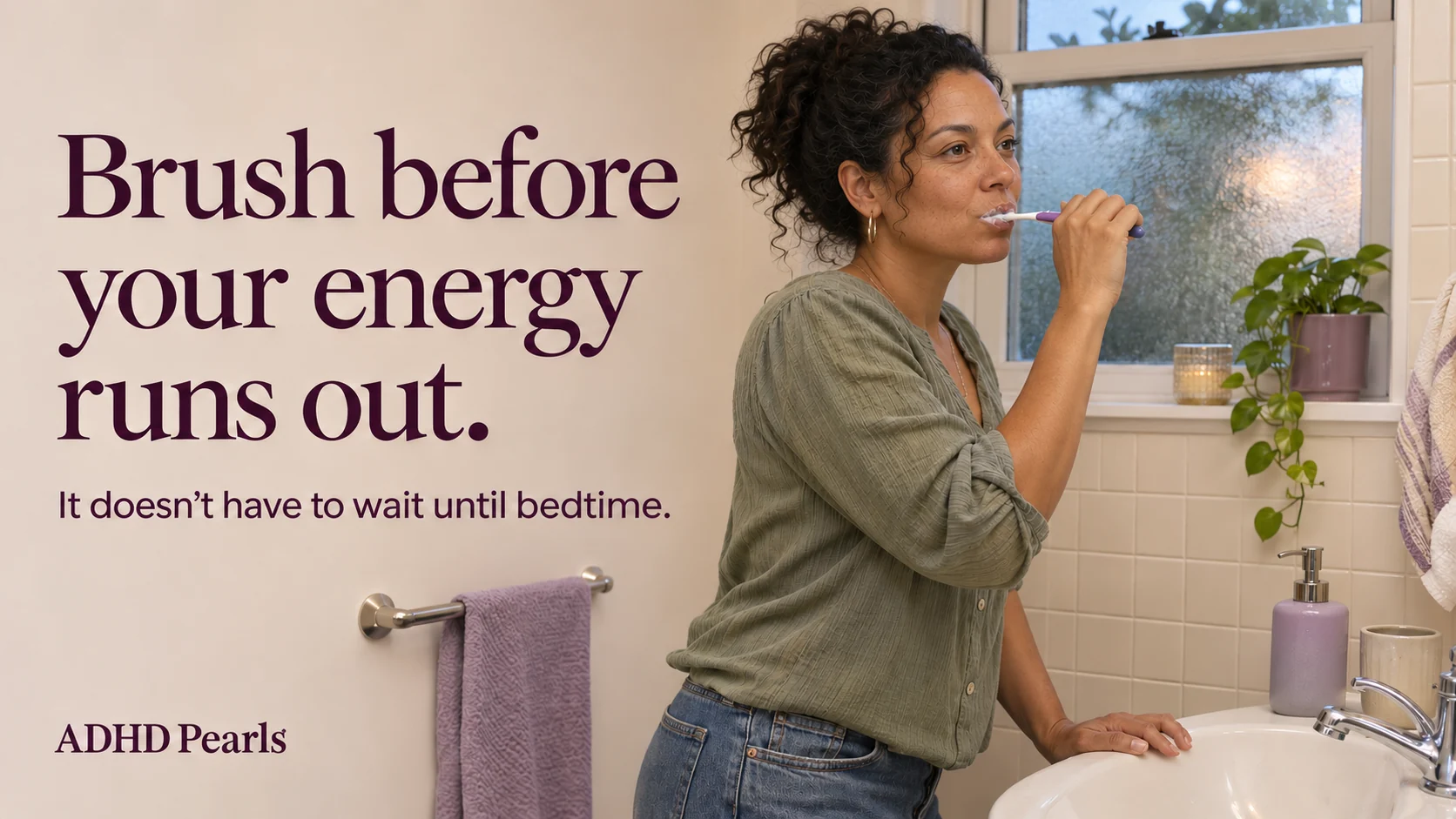
•Brush earlier. Brushing at 8 p.m. while you still have something left beats planning to brush at midnight when you have nothing left.
•Keep a backup by the bed. A fluoride mouthwash for the nights you are genuinely not getting up. The NHS suggests using it at a different time from brushing, so it does not wash the toothpaste away.
An earlier evening slot can be easier to follow through on.
One more thing worth knowing: stimulant medication can cause dry mouth for some people, and CareQuest notes that ADHD medications may contribute to tooth decay and gum problems. If that sounds familiar, tell your dentist and your prescriber. Do not quietly change anything on your own.
And if you have avoided the dentist for years because of the state of things, you are very unlikely to be the first person they have seen like this. Saying “I have ADHD and brushing has been hard” at the start of the appointment is allowed. I said it once, braced for a lecture, and got a recommendation for a toothbrush with a timer instead.
Set Up the Bathroom So It Starts Itself 🚿
Every missing item is a new decision, and every new decision is another exit. The night I got into the shower and found the shampoo empty, I got out, dripped down the hall to find the spare, sat on the bed “for a second,” and that was the end of that shower.
The goal is a bathroom where the first step is already done for you. A few changes that did most of the work for me:
•Products visible, in the order you use them. Not in a cupboard. Clear bottles or pump dispensers also show you when something is running low before it actually runs out.
•A towel and a robe you can reach from inside the shower. The cold three seconds is a real obstacle, not a character flaw.
•A warmer room. Run the water first, close the door, or use a small heater if the bathroom is freezing.
•Clothes laid out before you go in, even if the clothes are pajamas. Especially if the clothes are pajamas.
•Boring defaults. Same body wash, same order, every time, so there is nothing left to decide once you are in. It also fixes the very ADHD moment of stepping out and wondering whether you actually washed your hair. If the order never changes, you know you did.
•Duplicate stations. A second toothbrush downstairs, deodorant in your bag, wipes by the bed, lotion next to the sofa. Care that lives where you already spend time happens far more often than care that lives in one room upstairs.
I resisted duplicate stations for ages because it felt like admitting defeat. Then I put a bottle of hand cream next to the sofa and used it more in one week than in the previous year. The problem was never the hand cream. It was the stairs. 🧴
Make the Shower Less Boring Than Your Phone 🎧
Let’s be honest about the real competition. My shower is not losing to a bath or a nap. It is losing to my phone. People in ADHD forums describe the same loop over and over: putting off a ten-minute shower for two hours, scrolling, because the brain wants entertainment and the shower offers none.
So I stopped trying to beat the phone with discipline and started giving the shower a little of the phone’s reward.
•A shower-only podcast. One show I only let myself play in the shower. Two episodes in, I wanted to shower just to find out what happened next.
•Race a song. CHADD’s piece suggests getting in before a song ends or showering to an upbeat playlist. Faster music, faster shower. I keep one five-minute song for floor days.
•Body double it. A friend on a call while you both get ready, or just telling someone in the house you are going in now. Body doubling works for showers for the same reason it works for paperwork.
•One thing you like the smell of. Not a new routine. One shower gel you actually look forward to.
•Attach it to something that already happens. After coffee, after the gym, as soon as you get home. A shower that floats free in the day gets pushed indefinitely; a shower that comes after something gets a starting gun.
The trick that sounds silliest worked best for me: start the water before you start the shower. Turning the tap on from the doorway is a ten-second job. Then the water is running, and my mild guilt about the water bill does what my motivation would not. I am not proud of this. I am clean, though.
When a Skipped Shower Turns Into Shame
Here is the part that made everything worse for years. Skip a shower, feel gross, feel ashamed of feeling gross, avoid people, avoid the mirror. And somehow the shame made the next shower harder, not easier.
Therapist KC Davis, author of How to Keep House While Drowning, puts it in four words: care tasks are morally neutral. Being bad at showering is not being bad at being a person. You deserve to feel clean because it feels better, not because you have earned it.
That idea did not make me shower more on the spot. What it did was stop the second half of the spiral, the part where I decided a missed shower meant something about me. Without that part, a missed shower is just a missed shower, and tomorrow is an ordinary day instead of a penance. If the shame runs deeper than the shower, the ADHD shame detox is where I would go next.
When it might be more than ADHD
ADHD makes the basics harder. But hygiene that suddenly collapses, along with sleep, appetite and interest in things you used to enjoy, can also be a sign of depression or burnout. That is worth taking seriously rather than powering through. Is it ADHD or depression? and ADHD burnout can help you sort out which one you might be looking at.
And if the problem is mostly sensory, if water, sound or textures feel genuinely unbearable, that is real too. It is the same kind of thing that makes clothes feel wrong, and an occupational therapist can help with it in ways a list of tips cannot.
This article is personal and educational. It is not medical or dental advice. ADHD, depression, burnout, anxiety, sensory processing differences, skin conditions, medication side effects and other health issues can overlap. Please get proper medical or dental guidance if self-care problems are affecting your health or daily life.
Save this for the next time you are standing in the bathroom doorway.
Pinterest graphic. Headline: ADHD: The shower isn’t always the hard part. Button text: Find your stuck step.
FAQ: ADHD, Showering and the Basics
Why is showering so hard with ADHD?
Because a shower is not one task. It is around a dozen small steps with two hard transitions, getting in and getting out, plus sensory discomfort and very little reward. ADHD makes starting low-reward tasks harder, so the shower stalls at whichever step is weakest that day.
Is poor hygiene a sign of ADHD?
Not on its own. Struggling with hygiene is common with ADHD because it involves many steps, low reward and sometimes sensory discomfort, but it is not a diagnostic symptom. Hygiene that drops suddenly alongside low mood, sleep or appetite changes can also point to depression or burnout, so it is worth raising with a clinician.
How do I make myself shower when I have ADHD?
Make the first step tiny, such as turning the tap on from the doorway, and set the bathroom up so nothing is missing once you are in. Pair the shower with something you enjoy, like a podcast you only play in the shower, and keep a floor version for the days a full shower is not happening.
Why do I stay in the shower so long with ADHD?
Getting out is a second transition, and it usually means leaving warm water for cold air. Many people with ADHD find stopping just as hard as starting. A warm towel or robe within reach and a song or timer as an end signal can make getting out easier.
How can I brush my teeth more consistently with ADHD?
Move the toothbrush to where you already are, brush earlier in the evening while you still have energy, and let an electric brush with a timer count the two minutes. If mint toothpaste feels harsh, try a milder flavor that still contains fluoride, and keep a fluoride mouthwash as a backup for bad nights.
Does struggling with hygiene mean I'm lazy?
No. Showering and brushing are repetitive, multi-step, low-reward tasks, which is exactly the kind of task ADHD makes hard to start. Knowing how to do them was never the problem. A smaller first step, a better setup and a floor version for bad days usually help far more than trying harder.
Why is brushing my teeth so hard when it only takes two minutes?
Because the two minutes are not the hard part. You have to remember, stop what you are doing, walk to the sink and tolerate the taste and texture, all for a payoff you cannot see. Keeping a toothbrush where you already are, brushing earlier and letting an electric brush time it can help.
Is it okay to skip a shower some days?
For many people, yes. Harvard Health notes that showering several times a week is plenty for most people unless you are sweaty or grimy, and that a short shower focused on the underarms and groin may be enough. Skin conditions, sweaty work or medical advice can change that, so follow your own needs.
Can ADHD medication affect your teeth?
It can for some people. Stimulant medication may cause dry mouth, and saliva helps protect teeth, so less of it can raise the risk of decay and gum problems. If you notice a dry mouth, tell your dentist and your prescriber rather than changing your medication on your own.
Sources I leaned on while writing this
Robertson, A., & Comstock, C. (2024).ADHD and Showering.Attention magazine, CHADD, April 2024. A therapist and an occupational therapist on the executive function and sensory reasons hygiene is hard with ADHD, with practical adjustments including heaters, visible products, music and body doubling.
CareQuest Institute for Oral Health (2024).Links Between ADHD and Oral Health. From the nationally representative State of Oral Health Equity in America survey; compares adults who reported an ADHD diagnosis with those who did not. A survey, not a clinical study.
Shmerling, R. H. (2019, updated 2021).Showering daily — is it necessary? Harvard Health Publishing. About two-thirds of Americans shower daily; several times a week is plenty for most people unless they are sweaty or grimy. General population, not ADHD-specific.
NHS.How to keep your teeth clean. Brushing for about two minutes twice a day, fluoride toothpaste, spitting rather than rinsing, and using mouthwash at a different time from brushing.
I still stand in the bathroom doorway some nights. Less often, and for less time, and the towel is usually on the hook rather than on my shoulder, which I am choosing to count as personal growth.
What changed was not that I became someone who loves showering. It was that the first step got small enough to do without deciding. That is all the Stuck Reset we built does: you tell it how much you have left, and it gives you one entry point and permission to stop there. It will not wash your hair. But on the nights the tap is the whole problem, turning it on is usually enough.
Found this helpful? Share it with someone who gets stuck too.
One tap makes ADHD Pearls a preferred source in your Google account, so our articles surface higher when you search. No signup, and it brings you straight back to this page.
Before you go
Free Stuck Reset
One tiny move for the moments you know what to do but still can't start.
For the woman who sets up the perfect system on Sunday and abandons it by Tuesday.
One short letter, every week. Real talk about ADHD, task paralysis, and the tiny wins that actually move the needle for a brain like yours. No shame. No hustle culture.