I sat in the car outside the supermarket for eleven minutes because going in meant deciding what we were eating, and I did not have a decision left in me. Four items. I had written the list myself, that morning, in my own handwriting.
I drove home. We had toast. I told myself I would do a proper shop tomorrow — a sentence I had been saying, in various tones of voice, for about five weeks.
For most of that autumn I filed the whole thing under lazy again. It was not that. The month before, I had run a house, a job and somebody else’s birthday party without visibly dropping anything. That is the part nobody warns you about: burnout does not arrive after your laziest stretch. It arrives after your most impressive one.
Quick answer
What is ADHD burnout?
ADHD burnout is the collapse that follows months of running an ordinary life on extra effort. The coping systems stop working, small tasks become impossible, and sleep stops restoring you. It is not laziness, and it is not automatically depression — it builds from sustained load, and it usually shows up after a stretch where you were coping well.
Key takeaways
📌The bill arrives after the hardest-working stretch, not the laziest one.
📌The tell is not tiredness — it is that the systems that used to hold you all stop working at the same time.
📌Nobody has an official name for this: the WHO recognizes burn-out only as a work phenomenon, so a life-wide version has no box to tick.
📌Recovery research names four ingredients — detachment, relaxation, mastery and control — and control is usually the one you can get first.
📌You do not recover by resting harder. You recover by carrying less, for long enough that rest can land.
Everyone expects burnout to feel like exhaustion. Mine felt more like a quiet, total loss of interface. The world kept sending me perfectly reasonable requests and I could no longer find the part of myself that answers them.
The clearest sign was not how tired I was. It was that everything that used to work stopped working in the same fortnight. The alarm I had never once slept through. The reminders I actually obeyed. The trick of doing the dishes while the kettle boiled. All of it just… stopped catching.
The signs that are easy to mistake for a character flaw
•Tasks you have done a thousand times suddenly need a running start — and often do not get one.
•You sleep nine hours and wake up with the same flat battery you went to bed with. 😴
•Small sensory things turn unbearable: the radio, the label in your shirt, someone chewing.
•You are irritable in a way that embarrasses you afterward, usually at the people who deserve it least.
•You cancel the good things first, because they are the only things with a cancel button.
•Admin you care about — a form, a renewal, a message from a friend — sits untouched while you feel the weight of it hourly.
That last one is the cruelest, because it looks so much like not caring. It is the opposite of not caring. Nobody who stopped caring feels the envelope on the counter at two in the morning.
Burnout is not evidence that you are weak. It is the invoice for how much effort your ordinary week has been quietly costing.
And here is the thing about ADHD specifically: your baseline already runs on effort that other people do not have to spend. The reminders, the lists, the double-checking, the rehearsing of a phone call before you make it, the face you put on in meetings. None of that is visible in your calendar. All of it is drawing from the same account.
The winter it caught up with me, I went looking for something that would help me plan a day I could actually survive. Every planner and app I opened wanted the whole week from me on a Sunday night — from the version of me who, on Sunday night, is optimistic and rested and completely fictional by Tuesday.
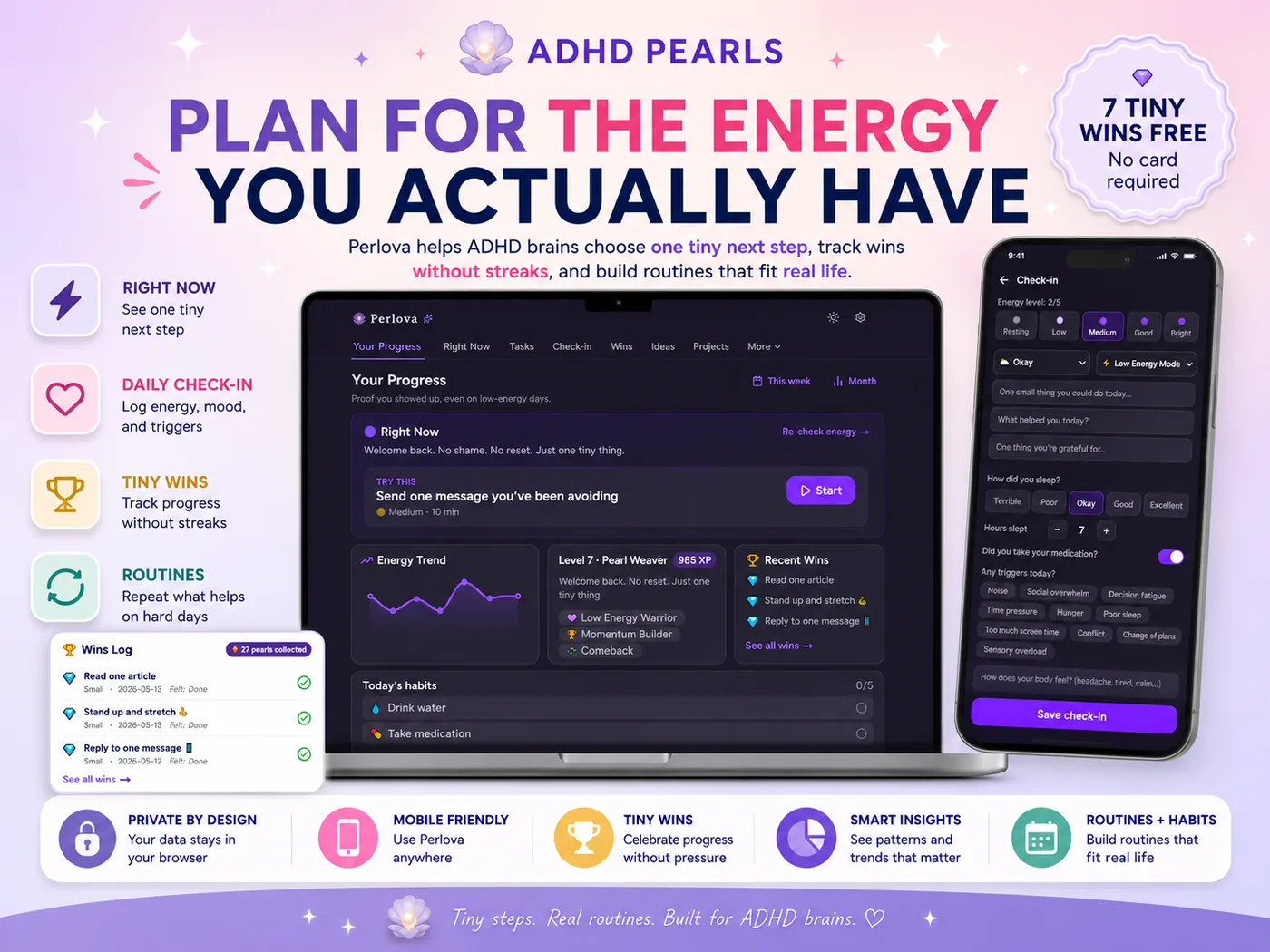
So we ended up building Perlova around a smaller question: what have you actually got today, and what is the one next thing that fits inside it. It does not give me more capacity, and on the worst weeks I did not open it at all. What it did stop was me writing Tuesday’s list for a woman who was not going to exist on Tuesday.
From ADHD Pearls
Perlova — plan from the energy you actually have
One doable next step, wins without streaks, and routines that fit real ADHD life. No card, no shame.
Nobody Has a Name for This (And That Is a Practical Problem)
When I finally looked for the official version of what was happening to me, I found a small bureaucratic hole where a definition should be.
The World Health Organization does include burn-out in the ICD-11, but it is classified as an occupational phenomenon and explicitly “not classified as a medical condition” — described as energy depletion, mental distance from your job, and reduced professional efficacy. The WHO also says plainly that the term “refers specifically to phenomena in the occupational context and should not be applied to describe experiences in other areas of life.”
Read that again with an ADHD woman’s week in mind. The official concept covers your job and nothing else — not the household admin, not the school emails, not the three-hour Sunday of catching up on your own life. The part that broke me was never the job on its own. It was the job plus everything else that has no employer.
Sweden is the one country that went further: since 2005 it has had a formal diagnosis for stress-driven collapse, exhaustion disorder, coded F43.8A in its national version of ICD-10, with tens of thousands of people on long-term sick leave under it. No other country has an equivalent, which tells you the state is real enough to be diagnosable somewhere and invisible almost everywhere else.
And “ADHD burnout” as a term? 🧠 It is widely used, and it is not a research construct. There is no agreed definition, no measure, no study of recovery from it. Most of what comes up when you search it is written by clinics rather than researchers, which does not make it wrong — it just means the confident-sounding stage models are describing a pattern, not reporting findings.
Why this matters practically: there is no box for it. If you go to a doctor exhausted and unable to function, the available boxes are depression, anxiety, or a stress-related disorder, and you will most likely be assessed for those. That is not a conspiracy, and it is not a reason to skip the appointment — genuinely, go — but it is worth walking in with the load described, not just the mood.
The Cycle, and Why It Keeps Coming Back
The reason burnout feels like a personal failing is that you have almost certainly been through it more than once, and the repetition looks like proof.
It is not proof. It is a loop with four predictable beats. 🔄
•You say yes at full capacity. Not greedily — the yes was reasonable in the moment, and the moment was a good day.
•You cover the gap with effort. More lists, more checking, more masking, later nights. This works, which is the trap.
•The scaffolding collapses. Not gradually. One week the systems all stop catching at once.
•Shame refills the calendar. You feel so behind that the first decent day gets spent proving you are still capable — which is beat one again.
Beat four is where I lived for years. I would get one genuinely good Saturday, feel about thirty percent recovered, and spend a hundred percent of it, because being behind is unbearable in a way that being tired is not. If that loop sounds familiar, the piece that helps is less about rest and more about what you do with the evidence of the bad months.
There is some real research underneath beat two. A 2024 field study of 171 employees found that the link between ADHD symptoms and job burnout was mediated by executive function difficulties — and that different difficulties fed different parts of burnout. Trouble managing time tracked with physical fatigue; trouble with self-organization and problem solving tracked with emotional exhaustion and cognitive weariness. It is self-report and cross-sectional, so it cannot prove direction. But the shape matches the lived version: the burnout is not coming from the work itself, it is coming from what it costs you to keep up with the work.
A Swedish qualitative study of twenty working adults with ADHD — fifteen of them women — put the same thing in plainer words. Participants described exhaustion built up from repeated workplace relapses, and a specific double bind: disclosing the diagnosis might get them accommodations, or might get them treated differently. Twenty people is a very small study, and they were recruited through a patient organization, so they are not a representative sample. It is still the closest thing to a mirror I have read in a journal.
If you are in your forties and this cycle has recently got dramatically steeper, there is a version of it with hormones in the mix that deserves its own read: ADHD burnout in perimenopause. And if the load in question is mostly other people’s, the mental load piece is the other half of this one.
Burnout, a Bad Week, or Depression?
I needed something less mystical than “listen to your body” and less useless than “reduce stress.” Mostly I needed to know whether I was in a dip or in trouble.
This is not a diagnostic table. It cannot tell you what you have, and the two columns overlap heavily — burnout can turn into depression, and depression can look exactly like this. It can only help you ask a better question at the appointment. 🭺
What you notice
Leaning burnout
Worth asking about depression
What the tiredness responds to
Lifts noticeably when demands come off — a quiet week, a holiday, someone else taking the school run
Barely moves regardless of what comes off your plate
Things you love
Still want them, cannot reach them — the wanting is intact and faintly agonizing
The wanting itself has gone flat
Self-talk
“I cannot keep doing this”
“There is something wrong with me” — and it feels permanent
Shape over time
Traceable to a stretch of too much, and worse at the demand end of the week
Present fairly evenly, including on days with nothing in them
A bad ADHD week instead?
A bad week is loud, specific and short — one deadline, one hormonal stretch, one broken routine — and your systems still work once it passes. Burnout is when the systems themselves stop working for weeks at a time.
If the right-hand column keeps describing you, that is a conversation with a doctor rather than a planning problem, and the ADHD-or-depression question has its own article. Please make the appointment even if you suspect they will say “stress.” Thyroid problems, anemia, sleep apnea, perimenopause and medication effects all produce this exact flavor of flattened, and several of them are straightforward to check.
Recovering When You Cannot Take Time Off
Almost every burnout guide eventually says take a break. Cheerfully. As if the reason you have not is that nobody suggested it.
I could not take a break. There were children, there was a mortgage, and the household does not accept a sick note. So the useful question was never how to stop — it was what actually has to be true for recovery to happen inside a life that keeps running.
The most helpful framework I found does not come from the ADHD literature at all. It comes from occupational psychology: Sonnentag and Fritz identified four ingredients that make non-work time actually restorative — psychological detachment, relaxation, mastery, and control. Most of us, in burnout, get none of the four, and then conclude that rest does not work on us.
Detachment: being genuinely away from it
Not physically away. Mentally away — not thinking about the thing. This is the hardest one with an ADHD brain, because the tab does not close: I have mentally re-run a work conversation while in a swimming pool with my son. 🌀
What helped was giving the loop somewhere to go rather than trying to win against it. Everything unfinished gets written down before I stop for the day, because the brain will not release what it thinks it is the only copy of. It takes four minutes and it is the difference between lying down and lying down usefully.
Relaxation: low activation, no performance
This is the one people think they are doing on their phone. They are not — and I say that as someone who lost an entire evening to videos of strangers pressure-washing driveways. That is not restorative, it is anesthetic, and the difference between fake rest and real rest is the single most useful distinction in this whole subject.
Mastery: something small you are good at
The counterintuitive one. Mastery means a low-stakes activity that gives you a feeling of competence — and when everything else in your life is failing, a small, finishable, visibly-done thing is medicine. 🔋
For me it was a fifteen-minute jigsaw with my daughter. Objectively pointless. It is also the only thing in my day with a clear edge and a definite finish, and I ended those fifteen minutes measurably less flattened than I started them.
Control: getting to choose
This is the one to go after first, because it is usually the only one available. Control is deciding what you do with your own gap — not having the gap allocated to you by whoever asks first.
The practical version is embarrassingly small. When I got forty minutes, I stopped letting the loudest item take it. I chose, out loud, one thing: this is a lying-down forty minutes, or this is a get-the-renewal-done forty minutes. Same forty minutes, wildly different afterward.
Worth naming the limits: this research is on general working populations and ordinary off-job time, not on ADHD and not on recovery from a full collapse. It is a good map for what makes rest work. It is not a treatment protocol, and if you are past the point where the four ingredients help, that is information for a clinician, not a sign you did rest wrong.
Here is the part I got wrong for years: I kept trying to recover by adding. A morning routine. A supplement. A better app, purchased at 1am, in a fit of optimism, with the confidence of a woman who has never met herself.
Recovery from this is subtraction. Not forever — for a defined stretch, because ADHD brains manage “two weeks” far better than “indefinitely.” 📋
•Drop one recurring commitment for two weeks. The one you would be most relieved to miss. Say it is for a fortnight, so nobody has to renegotiate anything permanent.
•Lower the standard on exactly one visible thing. Mine was ironing anything that is not for a funeral. The house did not notice.
•Delete decisions, not just tasks. Five dinners on rotation beats deciding nightly. Deciding is the expensive part, not the cooking.
•Nothing new gets said yes to for fourteen days. The script is “not in the next two weeks — ask me after the tenth.”
•Tell one person the true sentence. Not a request for help. Just: I am running on empty and it is not going to be a good fortnight.
And a short list of what not to cut, learned the hard way: medication and medical appointments, sleep, whatever small thing keeps you connected to one human being who is not depending on you, and the one activity that reliably makes you feel competent. Those are load-bearing. Working at reduced capacity is a skill in itself — the goal is a smaller day, not a failed normal one.
What Coming Back Actually Looks Like
It is not a switch. I kept waiting for the morning I would wake up restored, and then treating each non-restored morning as evidence that nothing was working.
What actually happened was duller and slower. Capacity came back before confidence did. I could do the thing weeks before I believed I could do the thing, and for a while the only honest measure was that the recovery time after a hard day was getting shorter — three days, then one, then an evening.
The thinking came back last. Reading a full page, holding a conversation without losing the thread, writing anything longer than a text — that was months, not weeks, and nobody had warned me it would be the slowest bit to return.
The one trap to watch for is the first good day. That surge of capability is not a signal to catch up on six weeks. It is the exact moment the loop restarts. Spend half of it, at most, and leave the other half deliberately unspent — which feels ridiculous and is the whole intervention.
This article is personal and educational. It is not medical advice. ADHD, depression, anxiety, thyroid issues, sleep disorders, anemia, perimenopause, medication side effects and other health conditions can overlap and can all produce exhaustion. Please get proper medical guidance if your symptoms are affecting daily life.
Save this for the fortnight when everything stops catching at once.
FAQ
What is ADHD burnout? It is the collapse that follows a long stretch of running an ordinary life on extra effort — coping systems stop working, small tasks become impossible, and rest stops restoring you. It is a widely used description rather than a formal diagnosis, and it typically follows a period of coping rather than a period of struggling.
How long does ADHD burnout last? There is no research answer, because ADHD burnout has never been formally studied as a condition. What people describe most often is weeks to months rather than days, with the mental clarity returning last. If the load that caused it does not change, the pattern usually returns.
Is ADHD burnout the same as depression? No, though they overlap and one can lead to the other. Burnout tends to ease when demands come off and leaves the wanting intact — you still want the things you cannot reach. If low mood is there regardless of your workload, or feels permanent, that is worth raising with a doctor.
Can you recover from ADHD burnout without taking time off work? Often yes, but not by resting harder in the gaps you already have. It usually takes visibly subtracting load for a defined stretch and protecting the time that is left, so that rest can actually do something. If you cannot subtract anything at all, that is worth saying out loud to a doctor or your employer.
What are the first signs of ADHD burnout? Usually that several coping systems stop working at once — reminders you have always obeyed stop catching, familiar tasks need a running start, and you start canceling the things you enjoy first. Increased sensory intolerance and irritability that embarrasses you afterward are common early signals too.
Why does sleep not fix ADHD burnout? Because sleep repays sleep debt, and burnout is a depletion built from sustained demand rather than from one bad night. Research on recovery suggests off-work time restores you only when it includes genuine mental detachment, low-activation rest, a sense of competence and some control over your own time — sleeping longer supplies none of those on its own.
Is ADHD burnout an official medical diagnosis? No. The WHO includes burn-out in the ICD-11 as an occupational phenomenon and states it is not classified as a medical condition, and there is no recognized diagnosis for a life-wide, ADHD-specific version. Sweden is the only country with a formal diagnosis for severe stress-driven exhaustion.
Does burnout make ADHD symptoms worse? It commonly feels that way. When capacity drops, the compensating strategies that were quietly holding things together stop being affordable, so the underlying difficulties become far more visible. That is a change in available resources, not a change in your ADHD.
What should I stop doing first? Whichever recurring commitment you would be most relieved to miss — dropped for a stated two weeks, not permanently, so nobody has to renegotiate anything. Keep medication, sleep, medical appointments and the one activity that makes you feel competent; those are load-bearing.
Turjeman-Levi, Y., Itzchakov, G., & Engel-Yeger, B. (2024).Executive function deficits mediate the relationship between employees’ ADHD and job burnout.AIMS Public Health, 11(1), 294–314. 171 employees; ADHD measured by self-report screening (ASRS), burnout by the Shirom-Melamed measure. Self-management to time mediated physical fatigue; self-organization and problem solving mediated emotional exhaustion and cognitive weariness. Cross-sectional and self-report, so it cannot establish direction.
Oscarsson, M., Nelson, M., Rozental, A., Ginsberg, Y., Carlbring, P., & Jönsson, F. (2022).Stress and work-related mental illness among working adults with ADHD: a qualitative study.BMC Psychiatry, 22, 751. 20 Swedish working adults with ADHD (15 women, mean age 41.9). Source for exhaustion accumulating through repeated relapses and for the disclosure dilemma. Small, self-selected sample recruited via a patient organization.
I did not recover because I found the right morning routine. I recovered because, for about two months, I was carrying visibly less than I am capable of carrying — which felt like failing, right up until the day I read a whole page of a book and noticed I had understood it.
The thing I could not find anywhere, in the middle of it, was a way to plan a day around the capacity I actually had that morning instead of the capacity I had in March. So we built one: you tell it what kind of day this is, and it gives you one next step sized for that, with no streak to break when you disappear for a fortnight.
It did not fix the load. Nothing on a screen fixes the load. It did mean that on the flattest days I had something to do that was not either heroics or nothing — and after the autumn I had, an option in between those two was most of what I needed.
Found this helpful? Share it with someone who gets stuck too.
One tap makes ADHD Pearls a preferred source in your Google account, so our articles surface higher when you search. No signup, and it brings you straight back to this page.
Here's why other planners didn't stick
They assume you'll show up the same every day. Perlova starts with how you feel right now.
Other ADHD planners
×Ask you to plan ahead, when your brain isn't there yet
×Assume you have consistent energy every day
×Show you everything you're already behind on
×Fall apart the first time you miss a day
×Require willpower just to open them
Perlova
✓Starts with your energy right now — not a perfect plan
For the woman who sets up the perfect system on Sunday and abandons it by Tuesday.
One short letter, every week. Real talk about ADHD, task paralysis, and the tiny wins that actually move the needle for a brain like yours. No shame. No hustle culture.