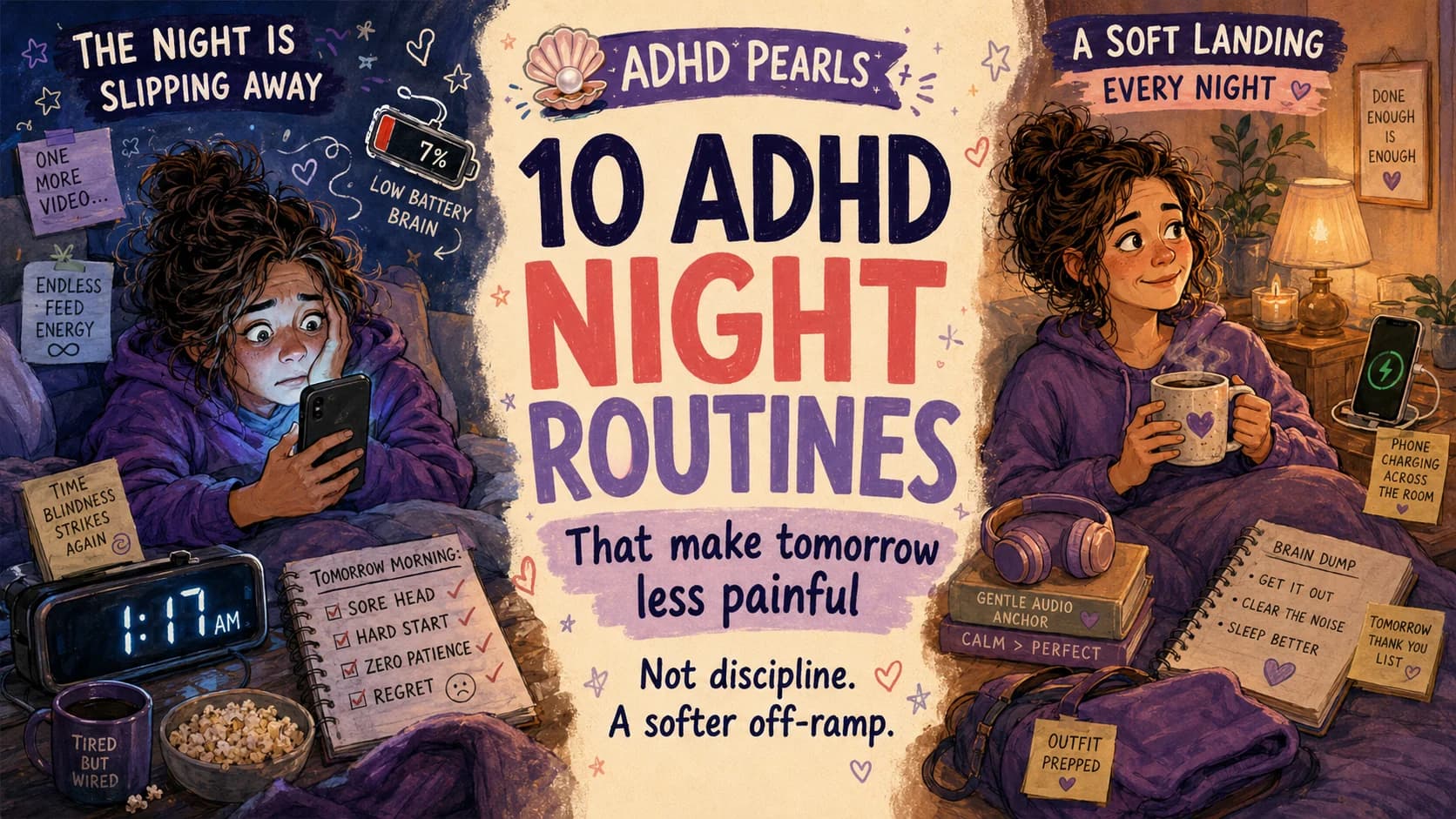
For years, my night routine was simple: lie in bed and let my phone slowly drain my will to live.
I'd tell myself it was relaxing. It was 11:40 PM. Then 12:30. Then I'd surface from a video about someone restoring an old typewriter, look at the clock, feel a jolt of dread about tomorrow, and keep scrolling anyway - because going to sleep meant the day was over and I hadn't had a single minute that felt like mine.
That's the thing nobody says about ADHD nights. The late scroll isn't laziness. It's a tired brain trying to steal back a day that got away from it.
These ten routines aren't about willpower or a 90-minute spa ritual. They're small ways to interrupt the spiral so tomorrow morning hurts a little less.
This article is personal and educational. It is not medical advice. Ongoing sleep problems can be linked to insomnia, anxiety, depression, sleep disorders, and perimenopause. If your sleep is seriously affecting your life, please talk to a qualified clinician.
Quick answer
What does an ADHD night routine that actually works look like?
Short, started earlier than feels natural, and built to interrupt the late-night spiral. Set a wind-down cue, swap the scroll for one calming anchor, do a two-minute morning setup so tomorrow-you isn't punished, brain-dump the racing thoughts onto paper, and aim for a fixed lights-out. You won't do all ten every night - and you don't need to.
Key takeaways
😴The late-night scroll is usually reclaimed time, not laziness - name it and it's easier to change.
🌀Start the wind-down earlier than you think; ADHD time blindness eats the evening fast.
🧠Give your brain one quiet anchor to land on instead of demanding silent stillness.
📌A two-minute morning setup tonight is a gift to a foggy, half-asleep you tomorrow.
📋Keep a bare-minimum version so a wrecked day still ends with a real routine.
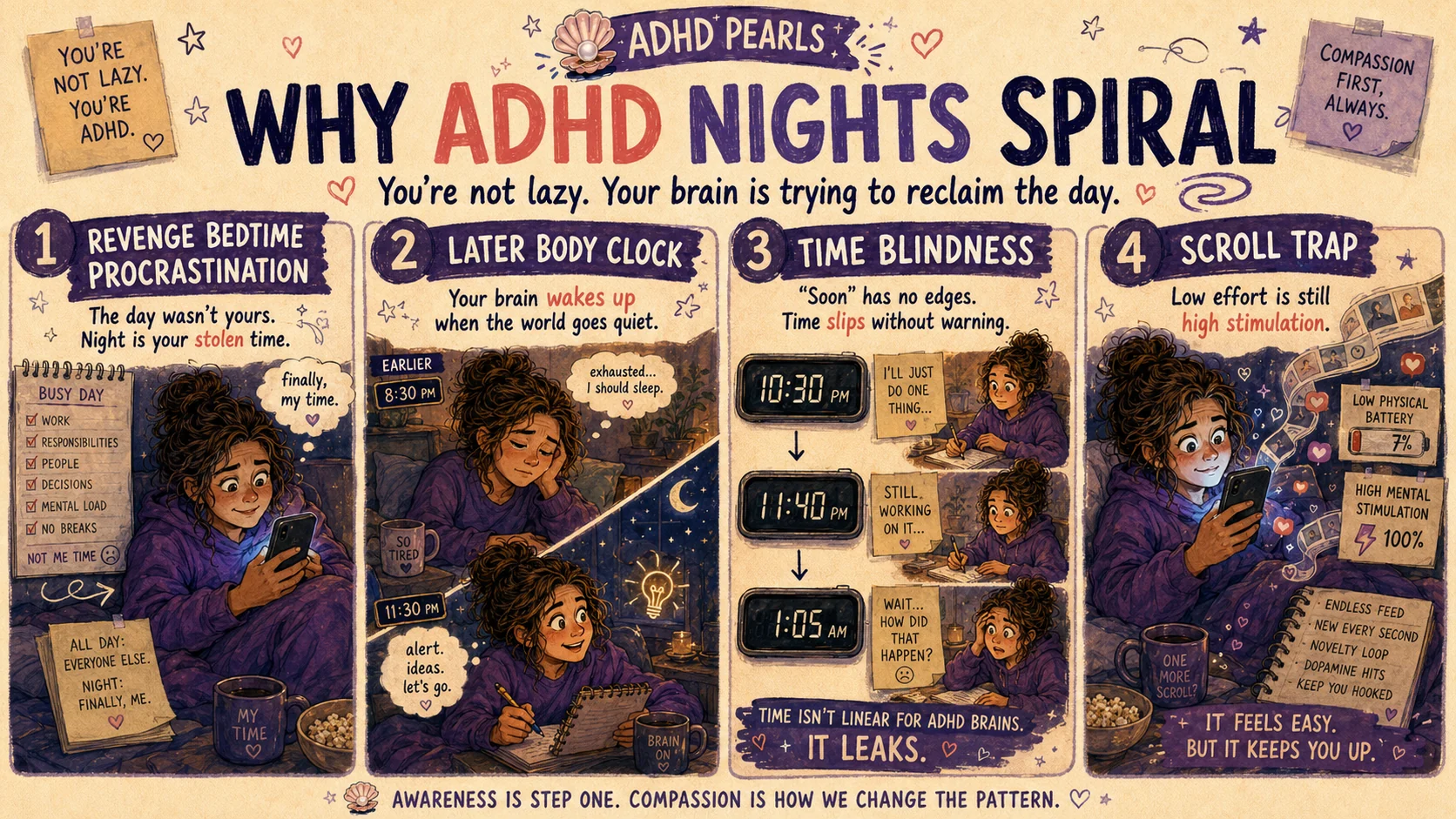
Before the routines, the why - because once you see it, you stop fighting yourself and start working with the actual problem. And you're not the exception: research suggests roughly 60-70% of adults with ADHD deal with ongoing sleep problems, so hard nights are the norm here, not a personal failing.
Revenge bedtime procrastination. If the day belonged to work, kids, and chores, the brain refuses to hand over the night too. Staying up feels like the only free time you got. There's a whole piece on revenge bedtime procrastination if that hits home.
A later body clock and a night-time spark. Many ADHD brains feel most alive once the day goes quiet - great for creativity, brutal for 7 AM.
Time blindness. "I'll go to bed soon" has no edges, so soon becomes 1 AM with no warning.
The scroll trap. Phones offer endless low-effort stimulation, which is the opposite of winding down - it's fake rest.
ADHD nights often unravel because the brain is reclaiming time while losing track of time and stimulation.
One thing worth untangling first, because the two get confused and need different fixes:
Revenge bedtime procrastination
Insomnia
You delay sleep on purpose to reclaim free time
Your body won’t fall asleep even when you try
The day never felt like it was yours
Racing mind, a late body clock, or other causes
“I’m not ready to let the day end”
“I want to sleep and physically can’t”
Real downtime earlier in the day plus a wind-down cue
Sleep-hygiene basics, and a clinician if it persists
From ADHD Pearls
ADHD Morning + Night Cards
36 printable micro-step cards for hard ADHD mornings and hard ADHD nights — one clear next step, no full routine required.
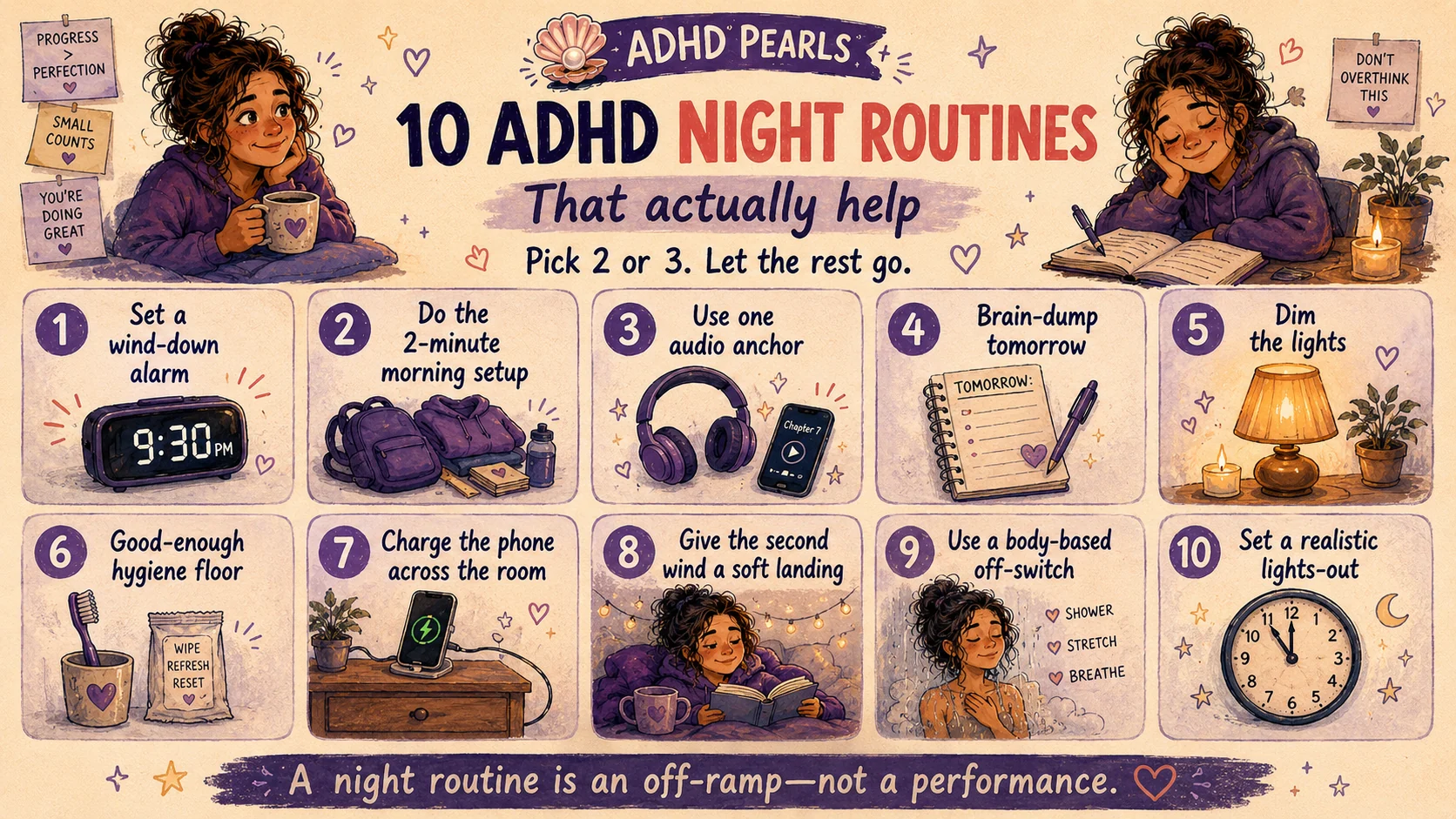
Don't try to install all ten tonight. Pick two or three that fit your actual evening and let the rest go.
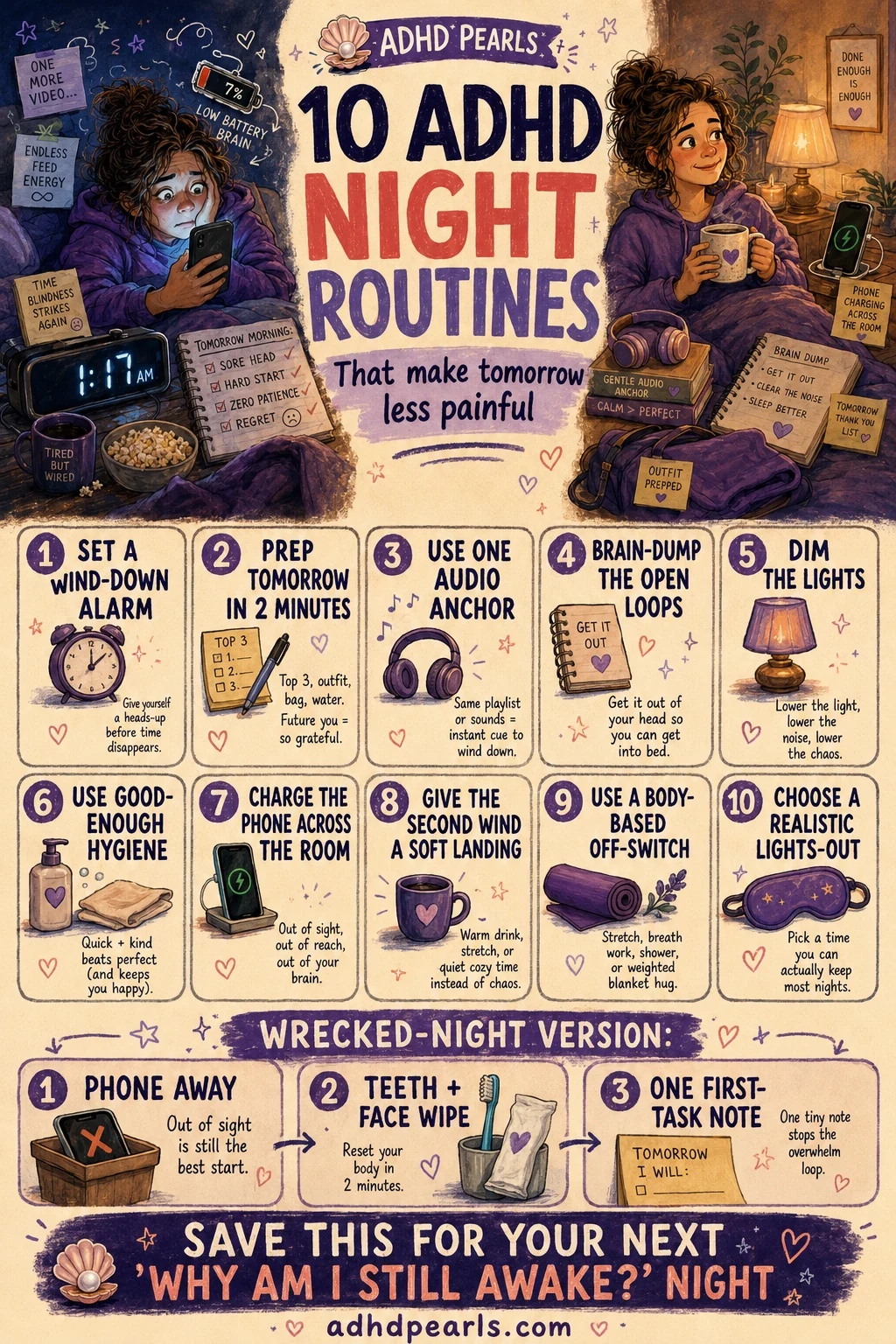
1. Set a wind-down alarm, not just a wake alarm
The hard part isn't waking - it's noticing it's time to stop. An alarm labelled "start winding down" at, say, 9:30 gives time-blind brains the edge the evening doesn't have.
2. Do the two-minute morning setup
Clothes out, coffee prepped, bag by the door, one sticky note for tomorrow's first task. Two minutes now spares foggy morning-you a dozen decisions she can't handle. This is the bridge to a workable ADHD morning routine.
3. Swap the scroll for one audio anchor
You're not going to lie in silence and meditate into sleep - let's be real. But a podcast, an audiobook, or a calm playlist gives your brain one quiet thing to follow instead of an infinite feed to chase.
4. Brain-dump tomorrow onto paper
The 2 AM thought-spiral runs on open loops. Write the worries and the to-dos down so your brain can stop holding them. It's not organized - it's a place to put the noise.
5. Dim the lights an hour before bed
Bright light tells your brain it's still daytime. Lamps over overheads, screens dimmed, maybe a warm bulb - you're sending a quiet signal that the day is closing.
6. Pick a "good enough" hygiene bar
On low nights, full skincare won't happen and that's fine. Decide your floor in advance - teeth and a face wipe - so you don't skip everything out of all-or-nothing fatigue.
7. Charge the phone across the room
If it's on the nightstand, the scroll wins. Across the room, you have to physically get up - which is also why it's a better alarm in the morning.
8. Give the second wind a soft landing
If your brain lights up at night, don't just fight it. Park a low-stimulation outlet for it - a few pages of a real book, a small tidy, light stretching - so the energy has somewhere gentle to go instead of feeding a 1 AM project.
9. Use a body-based off-switch
A warm shower, slow breathing, or a body scan shifts you out of your head and into your body. For a racing brain, that's often more effective than trying to think your way calm.
10. Set a realistic lights-out, not a fantasy one
"10 PM" when you reliably sleep at midnight just becomes two hours of failure. Set a target you can actually hit, then move it earlier by fifteen minutes at a time.
Pick two or three routines that fit your real evening; the goal is a softer off-ramp, not a perfect performance.
Two more that help on the worst nights
Cut caffeine by early afternoon. Caffeine can linger in your system for six hours or more, so a 4pm coffee is still working at 10pm. Watch the hidden sources too, like soda, tea, and pre-workout.
Use the 20-minute rule. If you are still awake after about 20 minutes, get up, go to another room, and do something calm and low-light until you feel sleepy, then go back to bed. Lying there frustrated only wires the brain further.
A night routine isn't about discipline. It's about gently taking the night back before the night takes tomorrow.
Low energy mode: a soft landing for a brain that wakes up at night
The Bare-Minimum Night (For Wrecked Days)
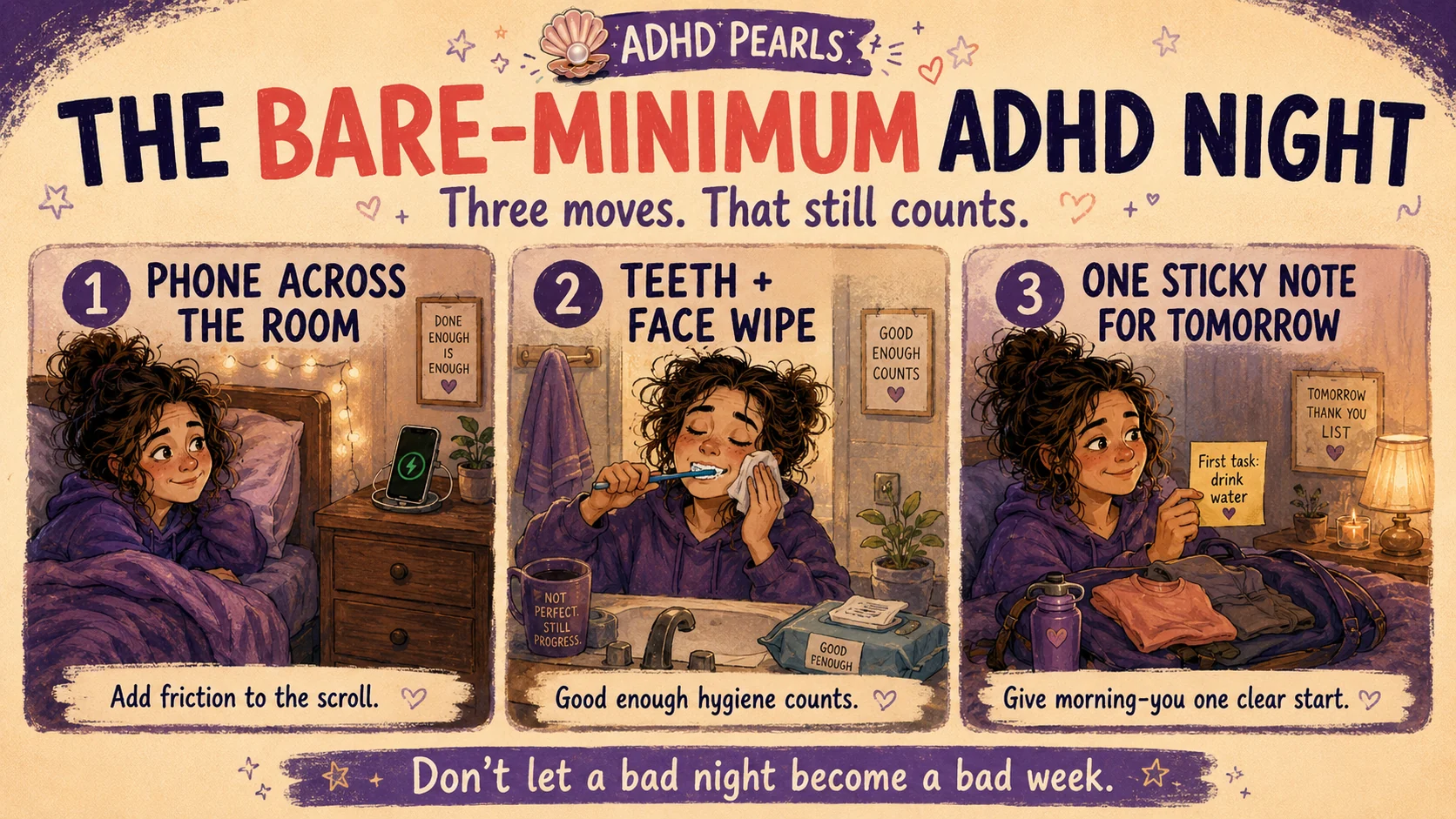
Some nights you have nothing left. The routine can't require energy you don't have, or it'll die the first hard week.
So pre-decide the floor. On a wrecked night, the whole routine is three moves:
Phone across the room.
Teeth and a face wipe.
One sticky note for tomorrow's first task.
On wrecked nights, three low-friction moves still count as keeping your routine.
That still counts as keeping your routine. The point isn't a perfect evening - it's never letting a bad day become a bad week. Matching the plan to your real capacity is the same idea behind low-energy days.
FAQ: ADHD Night Routines
What is a good night routine for ADHD?
A good ADHD night routine is short, low-friction, and starts earlier than feels natural. It usually includes a wind-down cue, swapping the scroll for one calming anchor, a quick morning setup, and a realistic lights-out. The point is to interrupt the late-night spiral, not perform a ritual.
How do I stop revenge bedtime procrastination?
Start by building real downtime into your day, so the night does not feel like your only free time. Then add friction to the scroll and a set wind-down cue. Naming the pattern, reclaiming time rather than being lazy, makes it easier to change without shame.
When should I stop drinking caffeine if I have ADHD?
Caffeine can linger in your system for around six hours or more, so cutting it off by early-to-mid afternoon gives it time to clear before bed. Watch hidden sources too, like soda, tea, and pre-workout. If afternoon coffee feels essential to function, that is worth mentioning to your clinician.
What should I do if I can't fall asleep?
A common approach is the 20-minute rule: if you are still awake after about 20 minutes, get up, go to another room, and do something calm and low-light until you feel sleepy, then return to bed. Lying there frustrated tends to wire the brain further. Repeat as needed.
How can I fall asleep faster with ADHD?
Give your brain one quiet thing to follow instead of demanding stillness: a podcast, an audiobook, a body scan, or slow breathing. Lower the light and stimulation an hour before bed, and get the racing thoughts onto paper. For many ADHD brains, one soft anchor beats lying in silence.
Why does my ADHD brain get a second wind at night?
Many ADHD brains feel most alert and creative late, partly from a delayed body clock and partly because the quiet finally removes the day's overstimulation. The spark feels great but wrecks the next morning. A night routine works with it by giving the energy a gentle place to land.
Why can't I make myself go to bed even when I'm tired?
Tired and able-to-stop are different skills for ADHD brains. Time blindness hides how late it is, the scroll keeps you stimulated, and bed means the day is over. A wind-down alarm and an audio anchor give your brain the edges and the off-ramp it needs.
How do I stop scrolling at night with ADHD?
Add friction and a replacement. Charge the phone across the room, switch to an audio anchor like a podcast or audiobook, and decide your scroll cut-off in advance rather than in the moment. Scrolling is stimulation, not rest, so swapping it for one calm activity helps you wind down.
How early should an ADHD wind-down start?
Earlier than you would guess, often a full hour before your target sleep time, because the evening disappears fast. Begin dimming lights and stepping back from screens before you feel ready, since the I'll-stop-soon feeling rarely arrives on its own.
Tomorrow Starts Tonight - Gently
I still get a night-time spark. I still love the quiet after everyone's asleep. But I stopped letting the whole night vanish into a feed, and tomorrow morning stopped feeling like a punishment I'd set up for myself at 1 AM.
Pick two routines. Keep the bare-minimum version for bad nights. That's enough to start taking your mornings back.
Save this ADHD night routine guide for the next time you are tired but still cannot stop.
Sources I leaned on while writing this
ADDitude: ADHD and sleep. additudemag.com. Background on delayed sleep patterns and night-time alertness in ADHD.
One tap makes ADHD Pearls a preferred source in your Google account, so our articles surface higher when you search. No signup, and it brings you straight back to this page.
Before you go
ADHD Morning + Night Cards
36 printable micro-step cards for hard ADHD mornings and hard ADHD nights — one clear next step, no full routine required.
For the woman who sets up the perfect system on Sunday and abandons it by Tuesday.
One short letter, every week. Real talk about ADHD, task paralysis, and the tiny wins that actually move the needle for a brain like yours. No shame. No hustle culture.