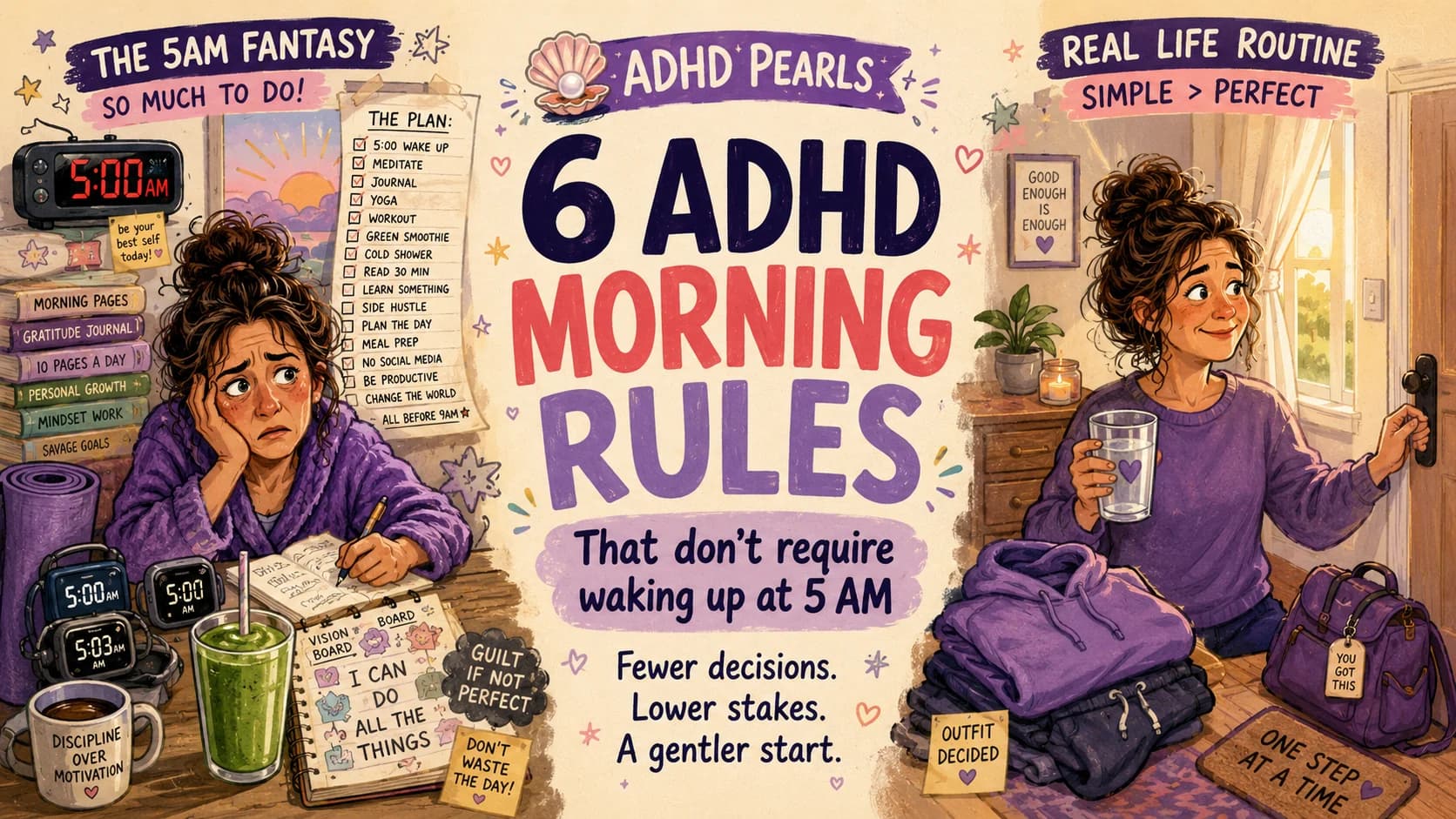
I have started a perfect 5 AM morning routine roughly nine hundred times.
Green smoothie. Journaling. A walk at dawn. I'd see the routine online, feel a hot rush of "this is the year," set four alarms, and then sleep through all of them while dreaming about being the kind of person who doesn't sleep through alarms.
By 7:40 I'd be doing my makeup in the car, eating dry cereal from the box, already behind. The routine wasn't the problem. The routine was a fantasy wearing a clipboard.
What actually changed my mornings wasn't more discipline. It was fewer decisions, lower stakes, and rules built for the brain I have at 7am - not the brain I imagine I'll have someday.
This article is personal and educational. It is not medical advice. Sleep problems, exhaustion, and trouble waking can also be linked to sleep disorders, depression, thyroid issues, and perimenopause. If mornings are seriously affecting your life, please talk to a qualified clinician.
Quick answer
What does an ADHD morning routine that actually sticks look like?
Short, pre-decided, and bad-day-proof. Use one fixed first anchor every morning, set up clothes and coffee the night before, and keep one non-negotiable instead of ten. Pick a wake time that fits your real body clock, not a 5 AM ideal, and build in a low-energy version so a rough morning still counts. The goal is fewer decisions, not more willpower.
Key takeaways
🌀5 AM isn't the goal. A consistent-enough wake time that fits your real life is.
📌One fixed first anchor beats a 12-step ritual you abandon by Wednesday.
🔋Most of a good morning is built the night before, while you still have a working brain.
📋Keep one non-negotiable, not ten. Everything else is a bonus.
😴Build a low-energy version so a bad morning still counts and the streak survives.
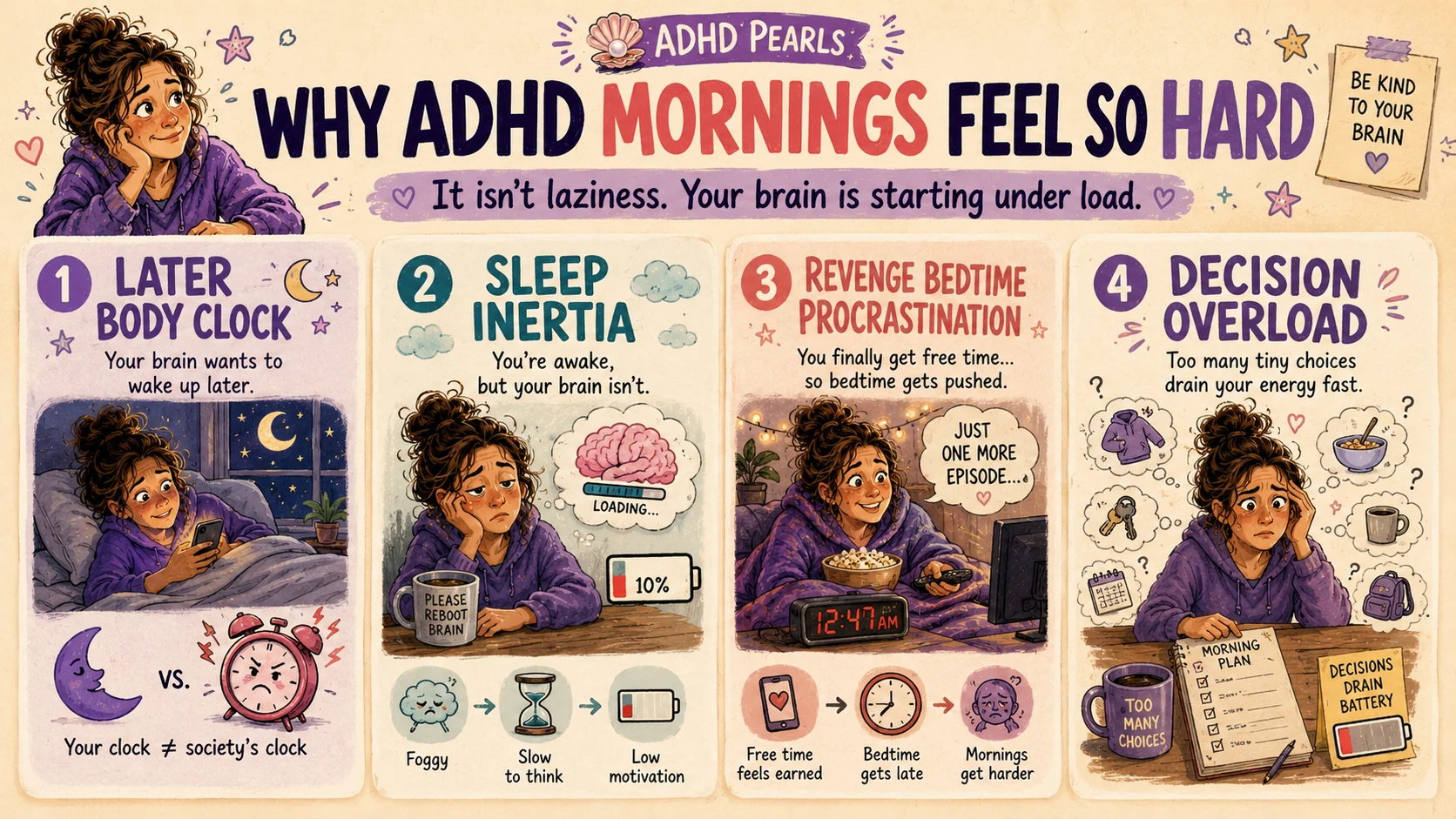
It helps to know you're not failing a simple thing. You're doing a genuinely hard thing with a brain that's stacked against it before you even open your eyes.
A few reasons mornings hit ADHD brains harder:
A later body clock. Many ADHD brains naturally run on a delayed schedule, so early starts fight your biology, not just your motivation.
Last night's revenge. If you stayed up reclaiming time you didn't get during the day, morning was doomed at midnight. That's revenge bedtime procrastination, and it's extremely common.
Decision overload. A "simple" morning hides dozens of micro-decisions, and a half-asleep ADHD brain stalls on every one.
ADHD mornings can begin under load before the day has even properly started.
So the fix isn't a better personality. It's a morning that asks less of the part of your brain that isn't online yet.
Here’s the difference between the morning routine that kept failing me and the one that finally stuck:
The rigid “5 AM” routine
An ADHD-friendly morning
Fixed early wake time, run on willpower
A consistent wake time that fits your real body clock
Dozens of in-the-moment decisions
Decisions pre-made the night before
A long, multi-step ritual
One fixed first anchor and one non-negotiable
One missed day breaks the whole streak
A bad-day version that still counts
From ADHD Pearls
ADHD Morning + Night Cards
36 printable micro-step cards for hard ADHD mornings and hard ADHD nights — one clear next step, no full routine required.
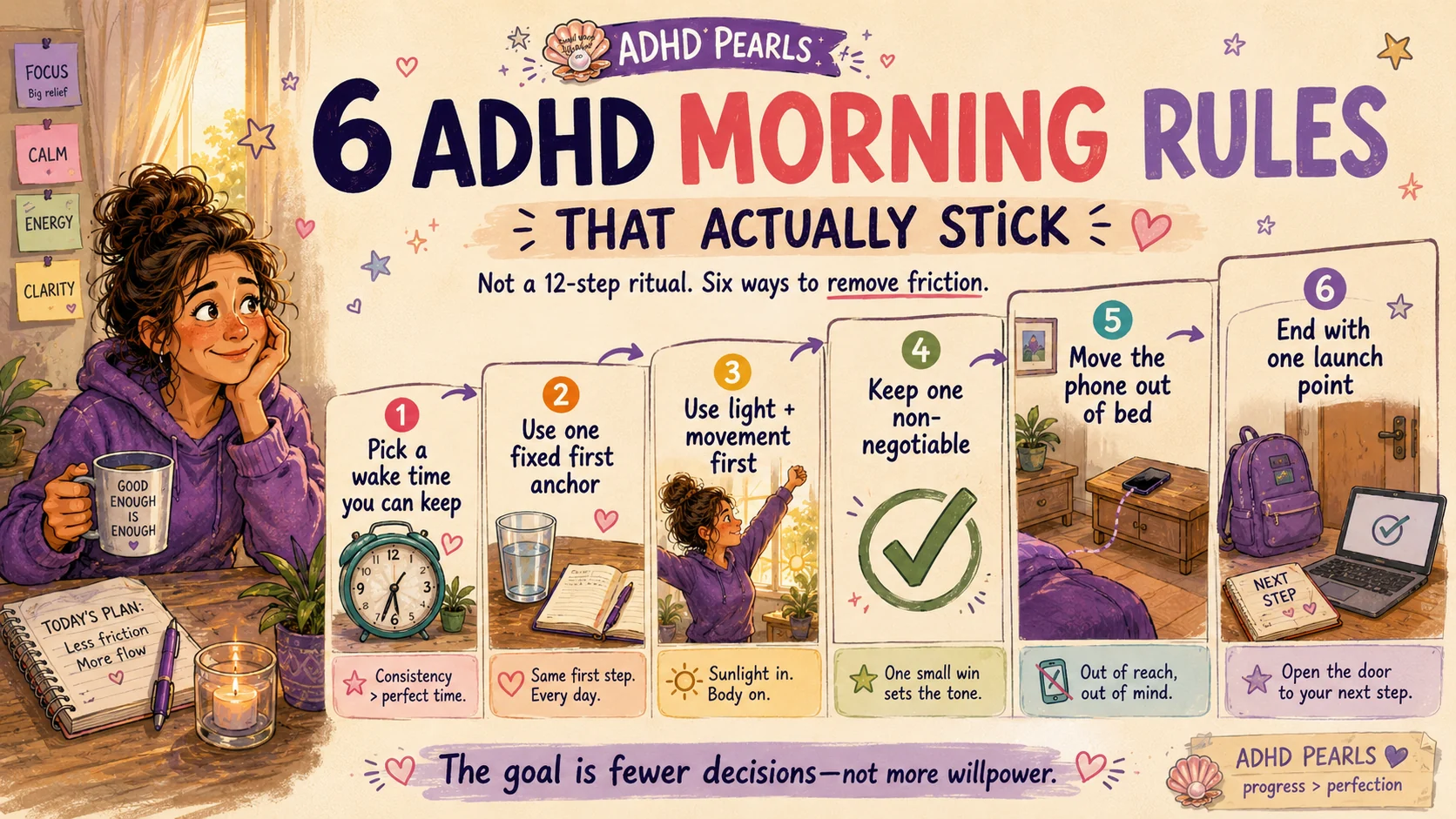
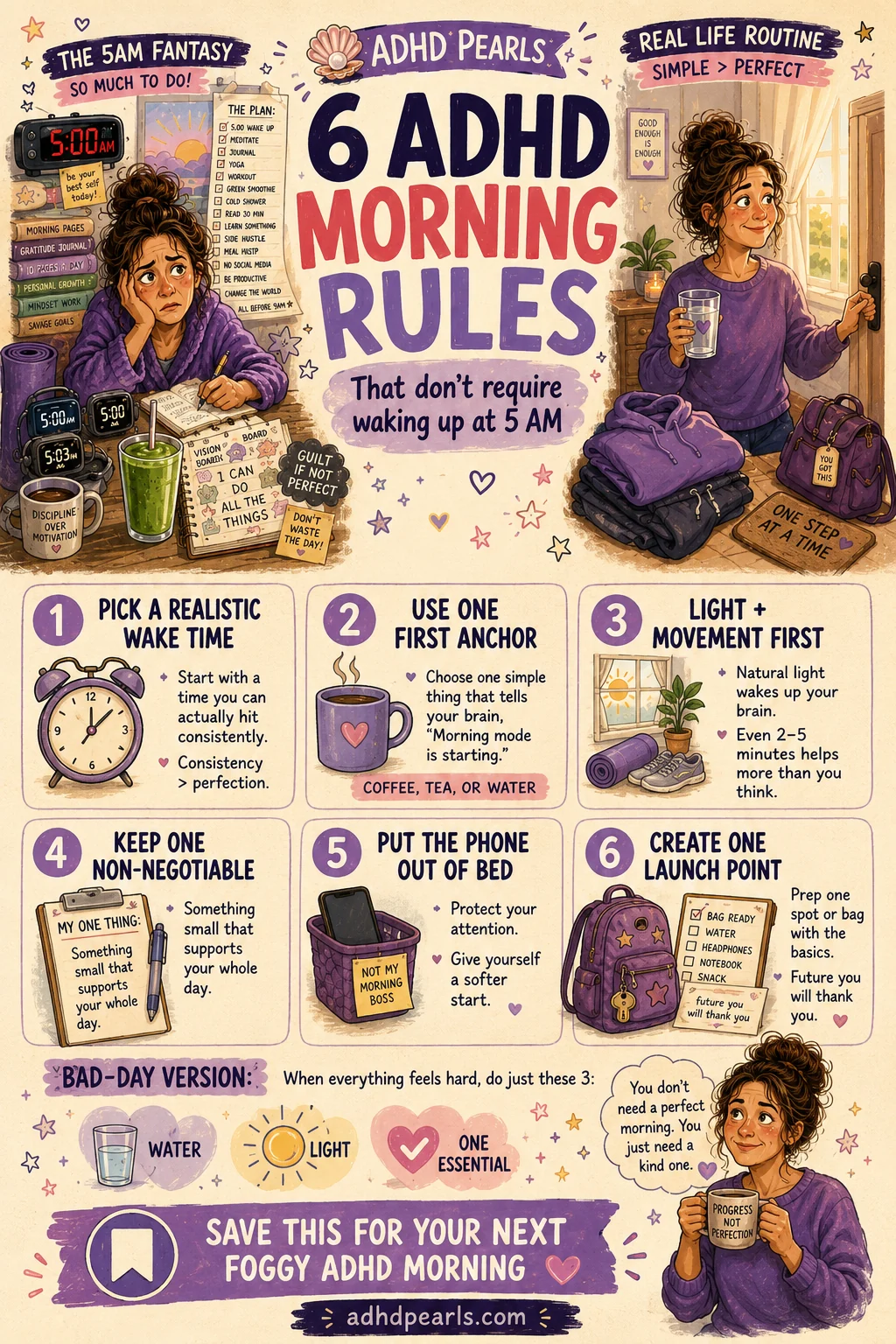
Not a 12-step routine. Six rules, each one designed to remove a decision or a battle. Steal the ones that fit and ignore the rest.
1. Pick a wake time you can actually keep - then keep it
Consistency beats earliness. A reliable 7:30 does more for your brain than a heroic 5 AM you hit twice and then resent. Choose a time you can hold most days, including weekends-ish, so your body clock stops getting whiplash.
2. Have one fixed first anchor
One action, the same every single day, no deciding required. Mine is a full glass of water before anything else. It could be opening the curtains, or stepping outside for sixty seconds. The anchor isn't magic - it's just a reliable first domino your foggy brain doesn't have to think about.
3. Use light and movement before willpower
Don't lie there negotiating. Get light on your face and your body slightly moving - curtains open, feet on the floor, a short stretch. Light and motion shift sleep inertia faster than any pep talk you can give yourself at 6:50 AM.
Pick the single thing that makes you feel human - teeth, coffee, ten minutes of quiet, whatever it is. Everything else is a bonus. When you have one non-negotiable instead of ten, a rough morning can't wipe out the whole routine.
5. Put the phone across the room (or at least out of the bed)
I gray-scaled my phone once and felt deeply superior for a day before a friend sent a puppy photo and I caved. But keeping it off the nightstand is the one that stuck - if I have to physically get up to silence the alarm, I'm already vertical, which is most of the battle. The scroll is fake rest, especially first thing.
6. End the morning with a launch point, not a to-do list
Instead of facing the whole day, set up the very first thing you'll do - the laptop open to the right tab, the bag by the door, the one task written on a sticky. A single clear launch point beats a 14-item list your brain reads as one giant wall.
Fewer decisions and gentler anchors make an ADHD morning routine easier to keep.
Bonus, if you take ADHD medication: set an early alarm
Some people set an alarm 30 to 60 minutes before their real wake time, take their stimulant medication, and doze until it kicks in, so the meds are already working when they actually get up. It can take the edge off the worst grogginess. It is not right for everyone, so run it past your prescriber before you try it.
A morning routine isn't a personality test you keep failing. It's a set of ramps you build so the hard part needs less of you.
Low energy mode: a gentle morning ramp, not a 5 AM marathon
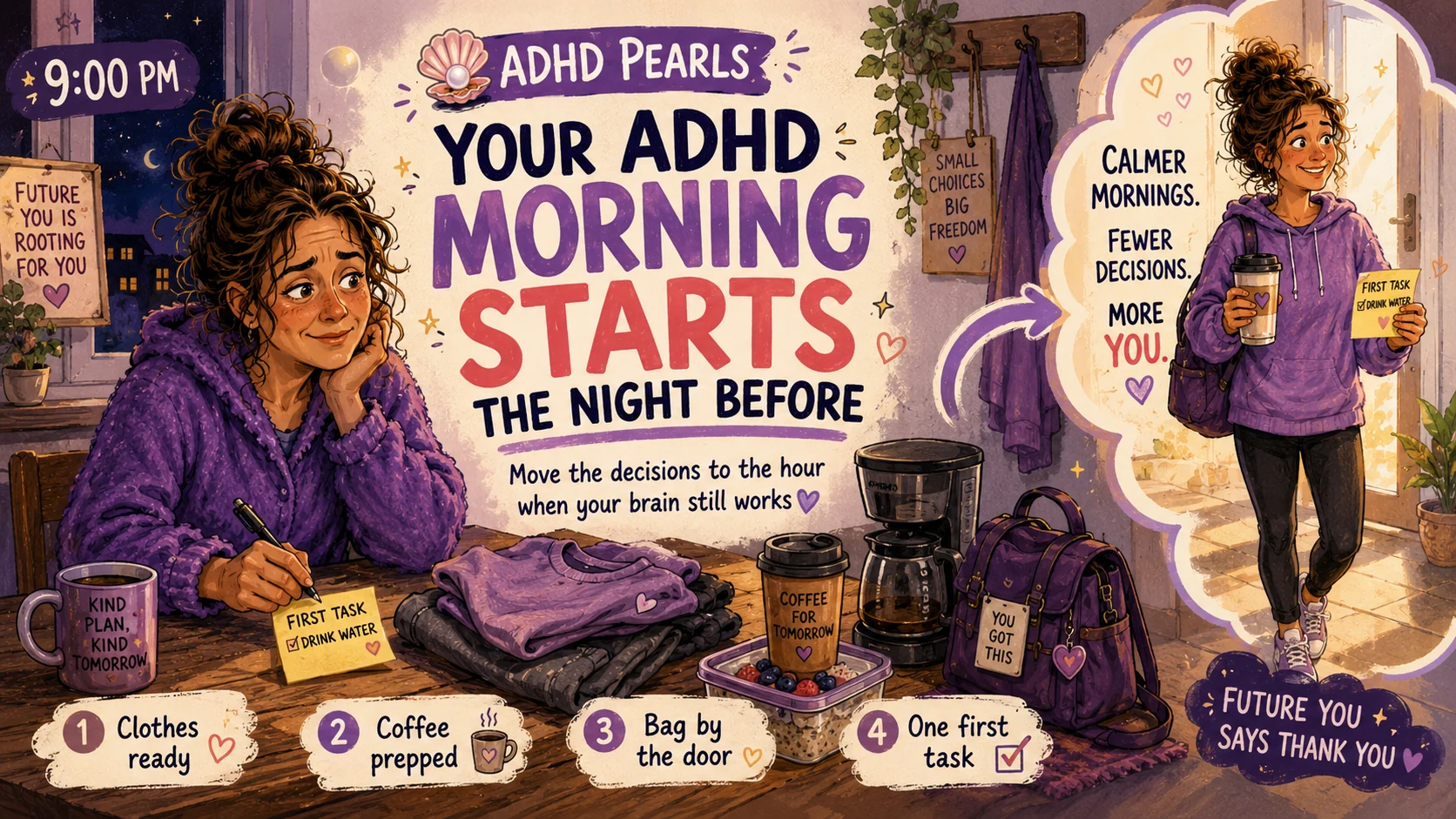
Most of Your Morning Happens the Night Before
Here's the reframe that saved me: morning-me is not a reliable employee. She is foggy, slow, and easily defeated. So I stopped asking her to make decisions.
The version of you who exists at 9 PM is far more capable. Let her do the setup:
Clothes out, including socks - decisions you don't want to make half-asleep.
Coffee or breakfast prepped to the last possible step.
Bag packed and parked by the door.
One sticky note with the single first task for tomorrow.
The 9 PM version of you can remove decisions from the morning before your foggy brain has to make them.
None of this is about being organized. It's about moving the thinking to the hour when your brain still works. A solid ADHD night routine is honestly half of a good morning.
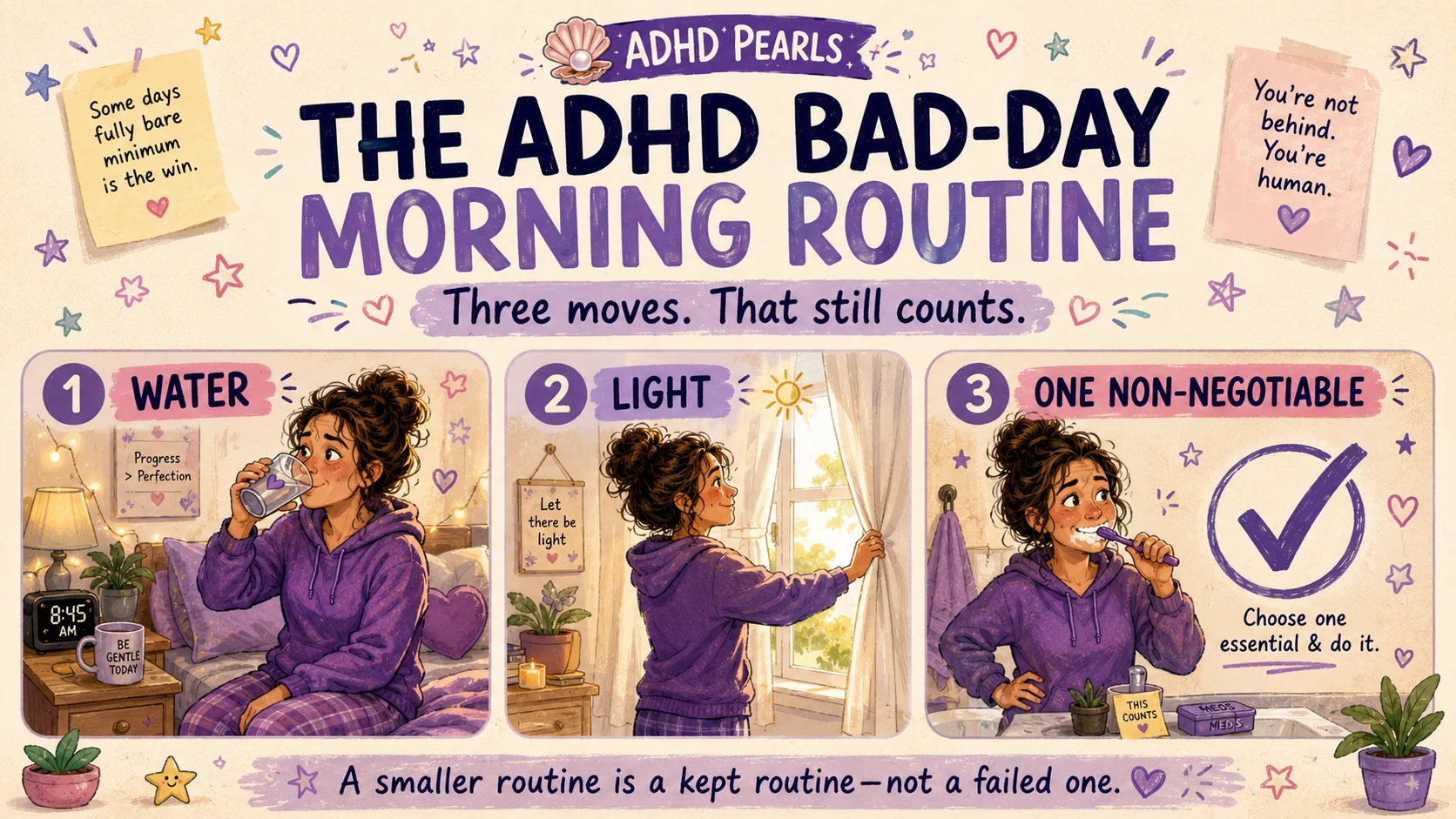
The Low-Energy Version (For Bad Days)
The reason routines die is that they're built for your best self and have no plan for your worst day. So one missed morning becomes a missed week becomes "I'm just bad at this."
Build the bad-day version in advance, on purpose. On a hard morning, the whole routine shrinks to three moves:
Water.
Light on your face.
The one non-negotiable.
Water, light and one essential still count as a kept morning routine.
That's it. That still counts. A morning where you only hit the floor version is a kept routine, not a broken one - and that's the difference between a system that lasts and another fresh start you abandon. The same logic powers energy-based planning: match the plan to the brain you actually have.
On the mornings you can't even start, the free ADHD Stuck Reset is a soft first step.
FAQ: ADHD Morning Routines
What is a good morning routine for ADHD?
A good ADHD morning routine is short, decided in advance, and survives a bad night's sleep. Lean on one fixed first action, set up clothes and coffee the night before, and keep one non-negotiable instead of ten. The aim is fewer decisions, not more discipline.
Do I have to wake up at 5 AM to be productive with ADHD?
No. The 5 AM idea works for some people and quietly shames everyone else. What matters is a consistent-enough wake time that fits your real life and sleep, not the number on the clock. A reliable 7:30 routine beats an aspirational 5 AM one you never keep.
Should I take my ADHD medication before getting out of bed?
Some people set an alarm 30 to 60 minutes before their real wake time, take their stimulant medication, then doze until it kicks in, so the meds are already working when they get up. It can ease morning grogginess for some, but it is not right for everyone, so check with your prescriber before trying it.
What is a good ADHD-friendly breakfast?
Use a formula, not a recipe: pair a protein with a carb and a fat, and keep the same few options so there is nothing to decide. Think peanut-butter toast, eggs and toast, yogurt with nuts, or a smoothie. A protein-forward breakfast can help steady energy and focus for some people.
How do I stop hitting snooze with ADHD?
Make the alarm require a body movement: put the phone across the room, or a glass of water you have to sit up to drink. Getting vertical and adding light breaks sleep inertia faster than willpower does. Snoozing often deepens the grogginess rather than easing it.
How do I make myself get out of bed with ADHD?
Shrink the first move to something tiny and pre-decided: feet on the floor, phone across the room, one glass of water. Then add light and a little movement, which physically speed up waking. Try not to lie there negotiating; that is when the grogginess wins.
How long should an ADHD morning routine be?
Shorter than you think; even three to five anchored minutes is enough to count. Long routines look impressive and collapse fast. A tiny routine you actually keep does more than an elaborate one you abandon.
Why do my ADHD morning routines always fall apart?
Usually because they are too long, too rigid, and built for your best day, so one missed step ends the whole thing. Routines last longer when they are short, flexible, and have a built-in low-energy version, so a hard morning still counts.
Is it bad that I'm not a morning person with ADHD?
Not at all. Many ADHD brains run on a later body clock, and that is biology, not a character flaw. The goal is a consistent-enough rhythm that fits your real life, not forcing yourself into someone else's 5 AM ideal.
You're Not Lazy. You Just Needed a Gentler Ramp.
I never became a 5 AM person. I became a person whose clothes are out, whose first move is decided, and whose bad mornings still count. That turned out to be enough.
You don't need a perfect routine. You need a few ramps and a low-energy version. Build those, and mornings stop being a thing you fail at by 7:40.
Save this six-rule ADHD morning guide for your next foggy morning.
Sources I leaned on while writing this
CHADD: Overview of ADHD. chadd.org. Grounding on ADHD as a difference in self-regulation, not effort.
ADDitude: ADHD and sleep. additudemag.com. Background on delayed sleep patterns and morning difficulty in ADHD.
Sleep Foundation: Sleep inertia. sleepfoundation.org. On the grogginess that makes waking up so hard and how light and movement help.
Found this helpful? Share it with someone who gets stuck too.
One tap makes ADHD Pearls a preferred source in your Google account, so our articles surface higher when you search. No signup, and it brings you straight back to this page.
Before you go
ADHD Morning + Night Cards
36 printable micro-step cards for hard ADHD mornings and hard ADHD nights — one clear next step, no full routine required.
For the woman who sets up the perfect system on Sunday and abandons it by Tuesday.
One short letter, every week. Real talk about ADHD, task paralysis, and the tiny wins that actually move the needle for a brain like yours. No shame. No hustle culture.