Three weeks. That is how long the form sat there. I thought about it every single day — while making coffee, in the shower, at 2am. I did not do one thing about it.
Then, on the last evening, I did the whole thing in forty minutes. Forty. After three weeks of carrying it around like a stone in my coat pocket.
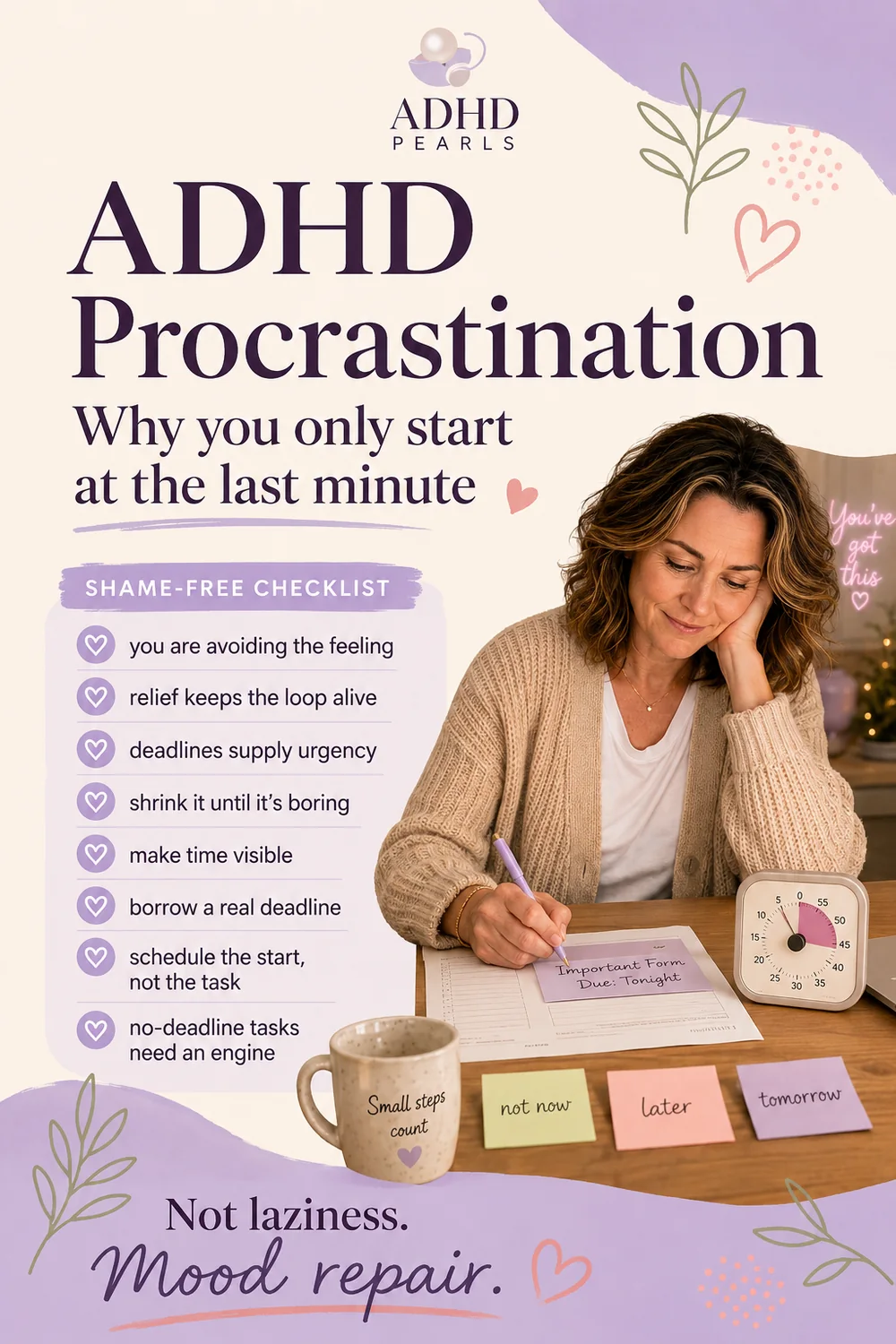
For most of my life I read that as proof that I only respond to pressure, and that I am fundamentally a bit lazy underneath. What is actually going on is duller and far more useful: I was not avoiding the form. I was avoiding how the form made me feel — and my brain had a very efficient way of making that feeling go away for a few hours at a time.
Here is what I understand now about ADHD procrastination, what actually works, and the part almost nobody covers: what to do about the tasks that have no deadline at all.
Quick answer
How do I stop procrastinating with ADHD?
Stop treating it as a time management problem. ADHD procrastination is short-term mood repair — avoiding a bad feeling now at your future self’s expense — so the fix is lowering the emotional cost of starting, not planning harder. Shrink the task until it is boring, do the setup instead of the task, and borrow a deadline from a person.
Key takeaways
📌ADHD procrastination is short-term mood repair, not poor time management.
📌The deadline works because it finally supplies the urgency your brain cannot manufacture on its own.
📌Procrastination involves choosing something easier; task paralysis is wanting to act and being unable to.
📌Lower the emotional cost of starting rather than planning harder. Shrink it until it is boring.
📌Tasks with no deadline need a borrowed one, from a person who is actually expecting it.
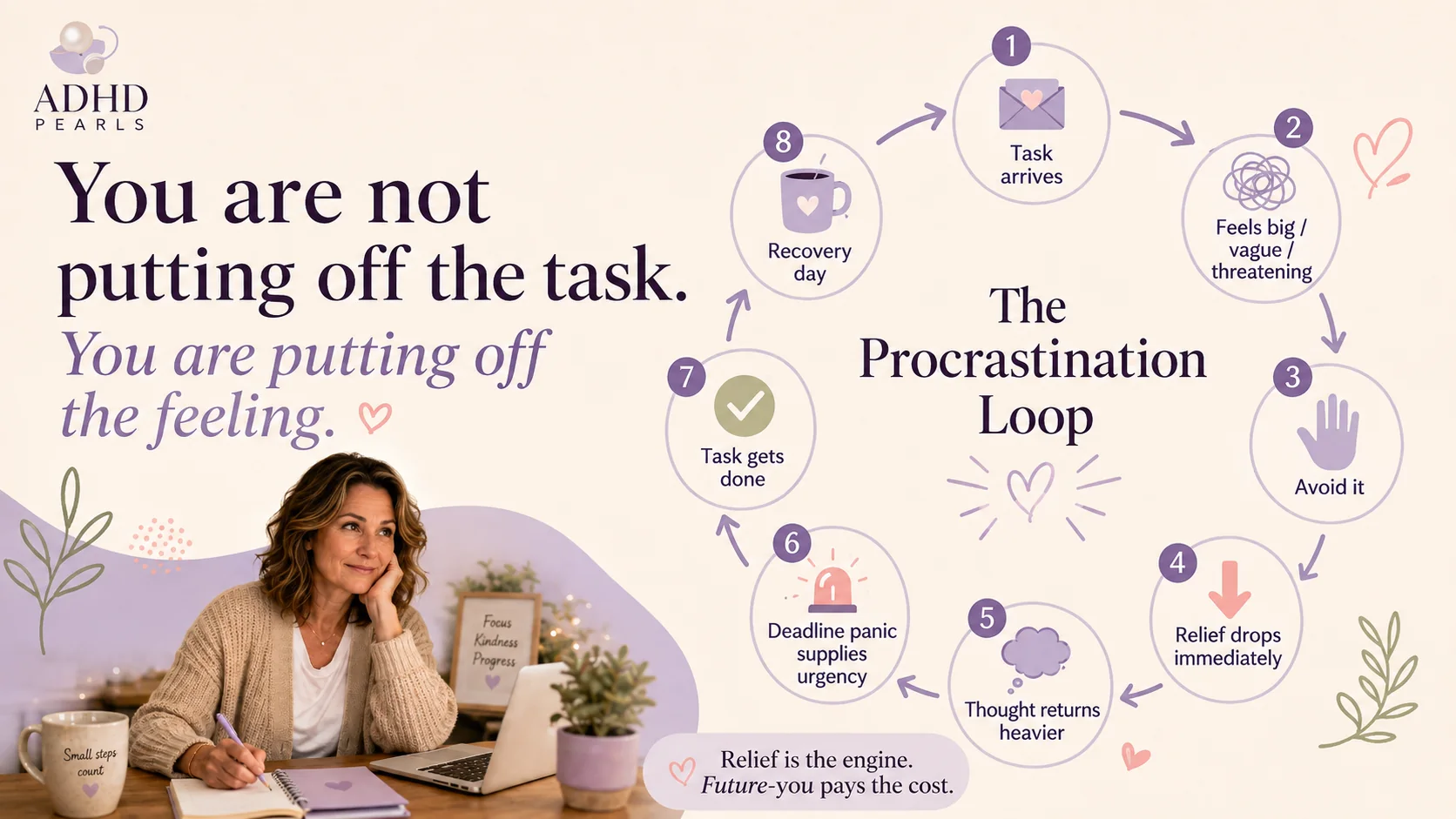
It runs the same way every time, and once you can see it, it stops feeling like a personal failing and starts looking like a mechanism.
A task arrives. It feels big, or vague, or slightly threatening. You do not start it — you do something else, and the discomfort drops immediately. That relief is the whole engine. Later the thought comes back, slightly heavier, and you avoid it again, and the relief is slightly smaller. The deadline gets close, panic arrives, and panic finally supplies enough urgency to move. You do the thing, often well. Then you are wiped out for a day, and you promise yourself that next time will be different.
Next time is not different, because nothing in that loop was about planning.
You are not putting off the task. You are putting off the feeling — and it works, briefly, every time.
This has a name in the research. Sirois and Pychyl described procrastination as prioritising short-term mood repair over long-term goals: when a task feels aversive, avoiding it genuinely improves how you feel right now, and the cost lands on your future self, who is not in the room. Their word for it is a self-regulation failure driven by the wish not to feel bad in this moment.
Which explains the thing that used to confuse me most. I was never lazy about the form. I thought about it constantly. Thinking about it was the tax I paid all three weeks — and it was more tiring than the forty minutes.
Avoidance works briefly. That is why the loop survives, even when the long-term cost is high.
From ADHD Pearls
Free Stuck Reset
One tiny move for the moments you know what to do but still can't start.
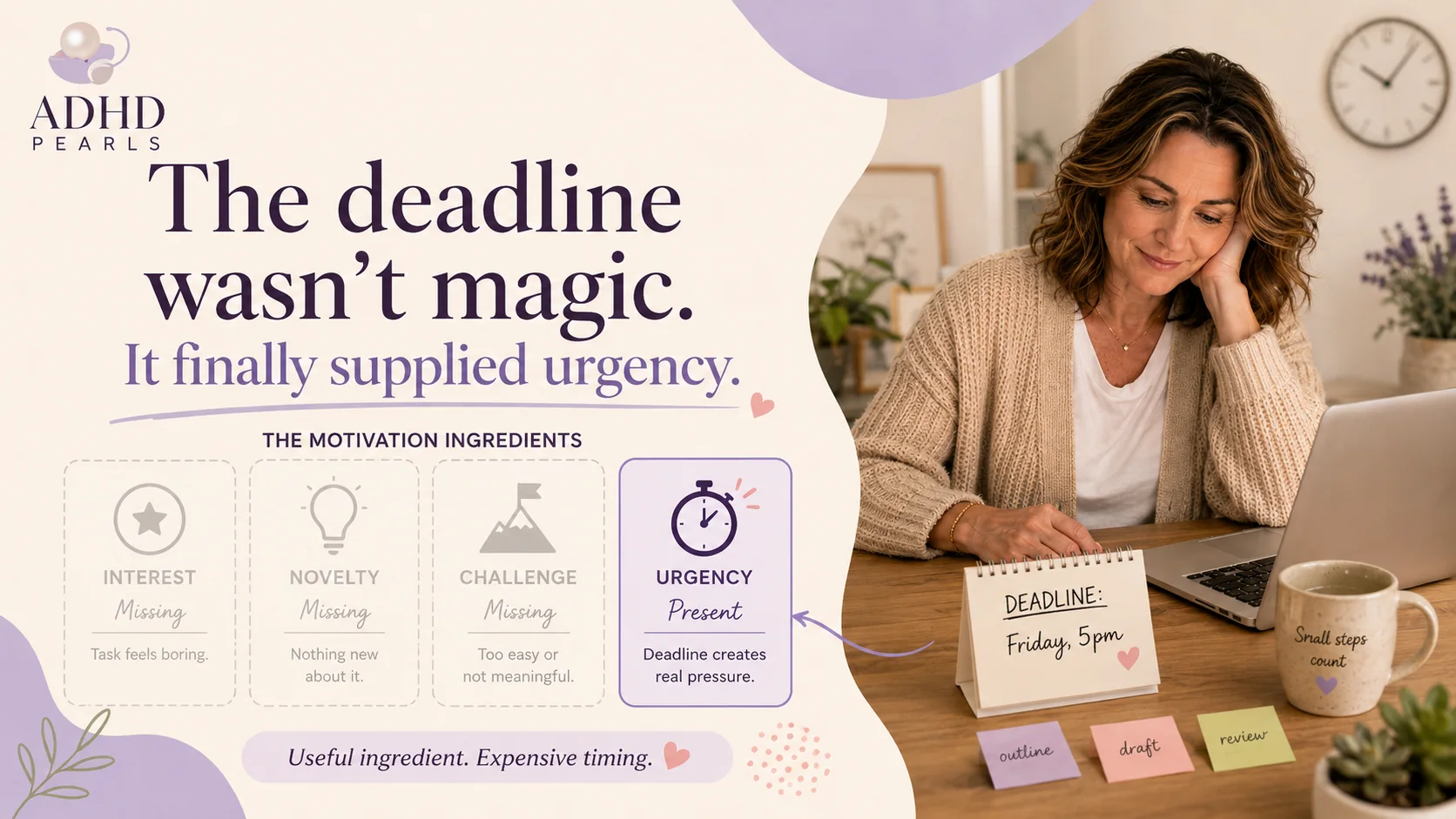
An ADHD brain runs on interest, novelty, challenge and urgency. Take all four away and a task starves, no matter how important it is on paper. A deadline is the only one of the four you can manufacture on demand — which is why the night before is the one time your brain cooperates.
So the last-minute pattern is not evidence that you are broken. It is evidence that the ingredient works. The problem is the price: everything gets done in a state of stress, nothing gets done early, and you spend the recovery day paying it back.
Two things follow from that, and they shape everything below. First, if urgency is what makes you move, the useful question is how to supply it earlier and more cheaply. Second, if avoidance is emotional, then any strategy that adds thinking, planning or deciding before you start is asking you to spend the exact currency you have run out of.
This is educational and personal, not medical advice. Persistent, life-affecting procrastination also appears in depression, anxiety and burnout, and it is worth raising with a professional if it is costing you work, money or relationships rather than just annoying you.
The deadline is not proof that you are lazy. It is proof that urgency works - but it arrives late and costs more.
Procrastination or Task Paralysis?
They get used interchangeably and they are not the same, which matters because the fix differs.
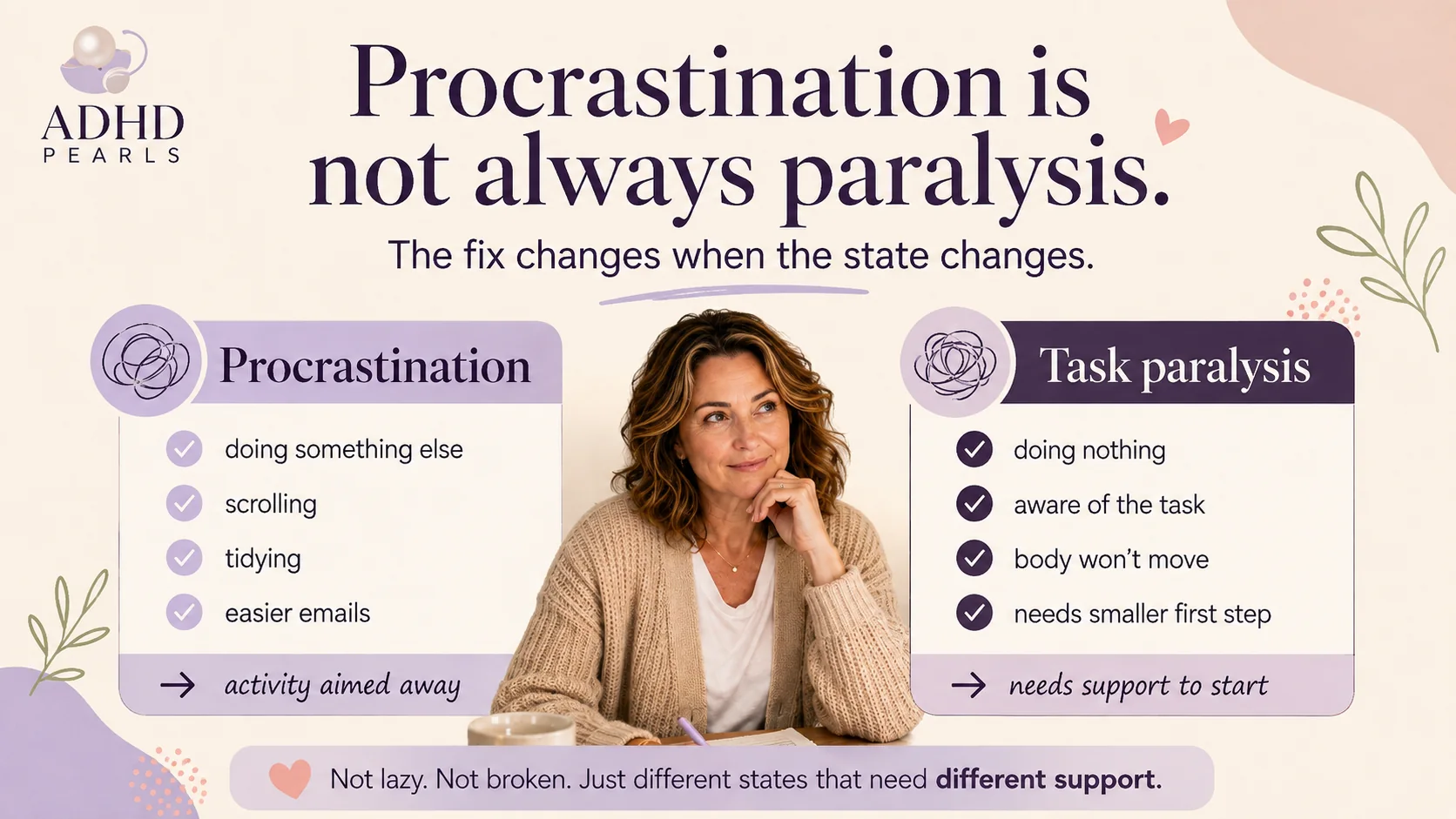
Procrastination means you are doing something else. Scrolling, tidying, answering easier emails, suddenly deeply invested in reorganising a drawer. There is activity — it is just aimed away from the thing.
Task paralysis means you are doing nothing. You are on the sofa, aware of the task, unable to make your body move toward it. If that is the one you recognise, what task paralysis actually looks like is the better read, and it has its own set of moves.
Mine flip within the same afternoon. I procrastinate all morning, feel worse for it, and by three o'clock I am in full paralysis about a task that was mildly annoying at nine. Avoidance makes things heavier — that is most of what it does.
Procrastination and task paralysis can happen in the same afternoon, but they are not the same state.
15 Strategies That Actually Work
Grouped by what they are for, because the reason a strategy fails is usually that it was aimed at the wrong problem.
For lowering the emotional cost of starting
1. Name what you are actually avoiding. Out loud, in one sentence. "I am not avoiding the email, I am avoiding finding out that I have annoyed her." Nine times out of ten the real object is smaller than the dread, and saying it removes some of its size. This is the only one on the list that never stops working for me.
2. Shrink it until it is boring. Not until it is small — until it is dull. "Write the report" is threatening. "Open the document and type the date" is too boring to be frightening, which is the point. Fear is what you are dismantling, not size.
3. Give yourself permission to do it badly. Say it before you start: this will be a rough version and that is the plan. Most of my worst avoidance has been perfectionism wearing a different coat, and a first draft that exists beats a perfect one that does not.
4. Do the setup, not the task. Open the tab. Get the form out of the envelope. Put the folder on the table. You have not agreed to do anything yet — and about two thirds of the time I carry on anyway, because the expensive part was the transition, not the work.
5. Change your body before you change your task. Stand up, walk to the end of the corridor, get a glass of water. Sitting still while trying to force a start is the least effective position I know. Movement is doing something, and something is easier to continue than nothing.
For manufacturing urgency
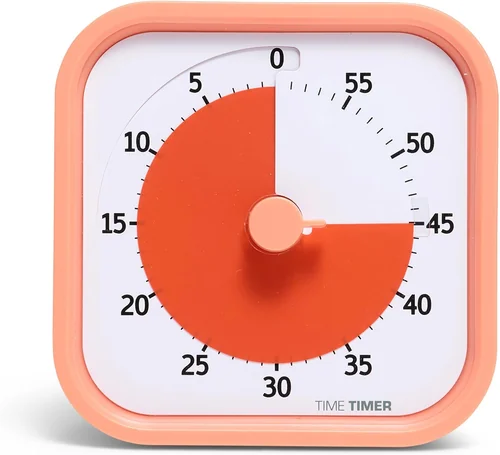
6. Make the time visible. Time blindness means "twenty minutes" and "two hours" feel roughly the same in the abstract, so a countdown you can see supplies information your internal clock does not. This is also why a phone timer is weaker: it lives inside the device that eats the time. A disc that shrinks in front of you needs no reading and no numbers — you glance at it and know.The visual timer on my desk →Affiliate link — as an Amazon Associate we may earn from qualifying purchases.
7. Borrow a real deadline from a person. "I'll send it to you by six." An internal deadline is a suggestion; a deadline someone else is holding behaves like a real one. I use this for anything I have already rescheduled twice.
8. Work in a shorter block than feels reasonable. Fifteen minutes, not an hour. A long block is a commitment you have to be brave to make; a short one is barely a decision. You can always run over, and you usually do. What helps is not having to set anything up: a cube you turn onto the 15 face and it has already started, no buttons, no menu, no extra choice at the exact moment you have none left.The flip cube I keep on the desk →Affiliate link — as an Amazon Associate we may earn from qualifying purchases.
9. Put someone in the room. Presence does something that planning cannot — it converts a private negotiation into a semi-public one, and the internal court closes. There is a whole method to this in how body doubling works, including when nobody is available.
10. Schedule the start, not the task. "Tuesday: do taxes" will not survive Tuesday. "Tuesday 10am: open the tax folder for fifteen minutes" is an appointment with a beginning, and beginnings are the part that needs the scaffolding.
For getting through the day itself
11. Do the two-minute jobs immediately. Anything that takes under two minutes should never enter the list, because the overhead of remembering it costs more than doing it. This is the one rule of mine that has genuinely reduced the size of the pile.
12. Get it out of your head and onto paper. Unwritten tasks do not sit quietly. They circle, they feel bigger than they are, and they consume attention all day. A brain dump does not organise anything — it stops the looping, which is a different and more urgent job.
13. Start with a finished thing, not the hardest thing. Eat the frog is decent advice for brains that have a steady tank of willpower to spend first thing. Mine does not. One small completed task creates a state where the next one is possible, and I have stopped apologising for needing the run-up.
14. Pair the boring task with something you like. A specific coffee, a particular album, the good chair. You are adding stimulation to a task that has none, which is the actual deficit — a dopamine menu is the pre-made version of this so you are not inventing one while depleted.
15. Stop before you are finished. Deliberately leave it mid-sentence, mid-form, mid-anything. Starting a task from a blank page tomorrow is a full transition; picking up something already open is barely one. This is the single highest-return habit I have, and the one that feels most counterintuitive.
Pick two. Not fifteen — two. A list of fifteen strategies is itself a decision, and deciding is the thing you are short of.
And if the problem is less that you avoid things and more that the whole day quietly disappears, that is a different mechanism — why the plan never survives the day deals with the gaps between tasks.
The Tasks With No Deadline
This is the part the productivity advice keeps skipping, and it is where most of the real damage is.
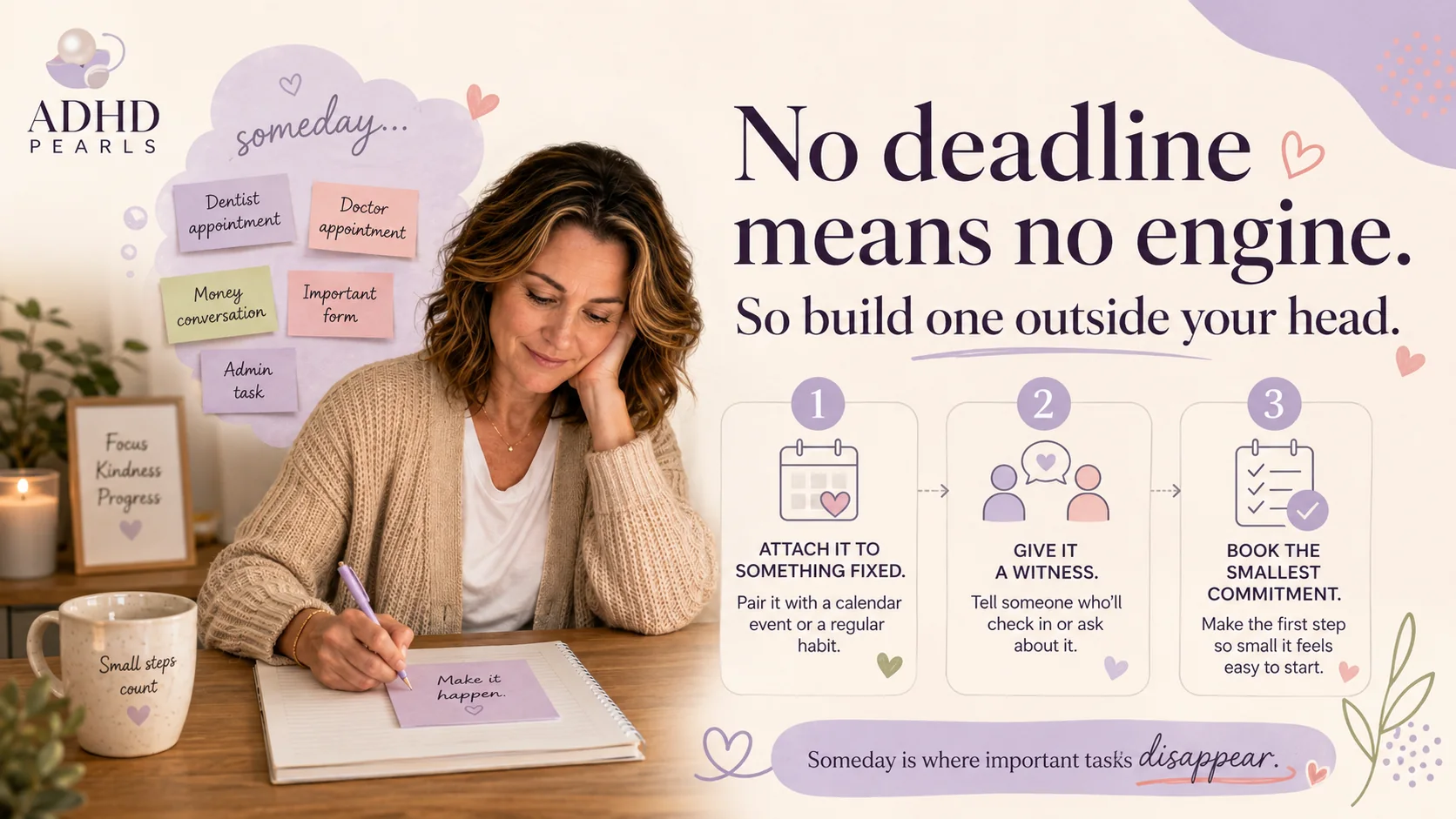
If urgency is what makes you move, then a task with no deadline has no engine at all. Nothing forces it. So it slides — for months, for years — no matter how much it matters. The dentist. The will. The doctor's appointment about the thing you have been ignoring. The money conversation. My own record is a form that went eleven months, and there was never a day it was urgent.
These do not respond to any of the strategies above, because those strategies help you start, and this problem is that starting never gets scheduled.
Three things that work, in order of how well:
Attach it to something already fixed. Anything with an existing slot in your week can carry a passenger. The call gets made in the car park after the school run, every time, because the school run happens whether I planned it or not.
Give it a witness. Tell one person a date. Not a vague intention — an actual day. The deadline is invented, and it works anyway, because what makes a deadline function is that someone else is holding it.
Book the smallest possible commitment. Not "sort out the dentist" but the ninety seconds it takes to make one appointment, which then supplies a real deadline for free. Turning an open-ended task into a dated one is often the entire job.
A task with no deadline can matter deeply and still never start. It needs an external engine.
What Makes It Worse
Four reliable ways to turn an ordinary bit of avoidance into a lost week:
Waiting to feel motivated. Motivation is not the input, it is usually the output. It shows up a few minutes after starting, not before, which is an unfortunate order.
Building a new system instead. A new planner feels like progress and is the most convincing form of avoidance available — the same argument as why a planner will not fix your routines.
Adding shame. Self-criticism raises the emotional cost of the task, and the emotional cost is the actual obstacle. You are not motivating yourself; you are making the thing harder to approach.
Keeping it all in your head. An unwritten list is heavier than a written one and less accurate. It also grows overnight, which written lists do not.
If your version of this is less "I am avoiding it" and more "I genuinely cannot make myself move", the maths is different and matching the tool to your level of overwhelm is the better starting point.
One Tiny Move
Pick the thing you have been carrying longest. Do not do it.
Write one sentence: what am I actually avoiding here? Not the task — the feeling. Being told off. Finding out it is worse than I thought. Doing it badly. Having to admit how long it has been.
That sentence takes fifteen seconds and it is the only step on this page you cannot get from anywhere else, because nobody but you can write it. Most of the time it also makes the task noticeably smaller.
Save this for the next time you think you are just being lazy, when the real problem may be that the task feels too expensive to approach.
Pin this ADHD procrastination guide for the next time “later” keeps turning into the last minute.
FAQ: ADHD and Procrastination
How do I stop procrastinating with ADHD?
Stop treating it as a time management problem. Procrastination is short-term mood repair — your brain avoiding a bad feeling now, at the expense of your future self. So the fix is to lower the emotional cost of starting rather than to plan harder: shrink the task until it is boring rather than threatening, make time visible, borrow urgency from an external source, and give tasks with no deadline an artificial one.
Why can I only do things at the last minute with ADHD?
Because a deadline supplies urgency, and urgency is one of the few things that reliably switches on an under-stimulated ADHD brain. It is not a character flaw — it is your nervous system finally getting the input it needs to engage. The problem is not that last-minute work happens; it is that it only happens then, and the cost is paid in stress and recovery.
Is procrastination a symptom of ADHD?
Procrastination is not a diagnostic criterion for ADHD, but it is extremely common in it, because the things that drive it — difficulty starting tasks, time blindness and emotional regulation — are all core ADHD difficulties. Plenty of people without ADHD procrastinate too. What tends to differ with ADHD is how consistent it is and how little willpower changes it.
What is the difference between ADHD procrastination and task paralysis?
Procrastination usually means you are doing something else — scrolling, tidying, a different task entirely. Task paralysis means you are doing nothing at all and cannot make your body start. They can happen in the same afternoon and often overlap, but the fix is different: procrastination needs urgency or a lower emotional cost, and paralysis needs a much smaller first step.
Why do I procrastinate on things I actually want to do?
Because wanting something does not lower the cost of starting it. In fact, things you care about often carry more emotional weight — more fear of doing it badly — which makes them more aversive to begin, not less. This is one of the clearest signs that procrastination is about feelings rather than motivation.
How do I do a task that has no deadline?
Give it one, and make it external. A task with no deadline has no urgency, so an ADHD brain will keep deprioritising it forever, no matter how important it is. Book the appointment, tell someone you will send it by Friday, or attach it to something already fixed in your week. The deadline does not have to be real to work.
Does a timer really help ADHD procrastination?
For many people, yes — because it makes time visible and shrinks the commitment. Time blindness means an hour and ten minutes feel similar in the abstract, so a visual countdown gives you information your internal clock does not supply. It works best for starting, not for enforcing a long stretch of work.
Why does nothing help my procrastination?
Usually because the advice you tried was aimed at planning, and your problem is emotional. If a strategy asks you to organise, schedule or decide before you start, it costs the exact resource you are short of. The strategies that tend to survive contact with a real ADHD day are the ones that reduce a decision rather than adding one.
Is ADHD procrastination laziness?
No. Laziness would mean not caring about the outcome. Most people who procrastinate with ADHD care intensely, think about the task constantly, and lose hours to the discomfort of not doing it. That is the opposite of indifference — and it is exhausting in a way that doing the task usually is not.
One tap makes ADHD Pearls a preferred source in your Google account, so our articles surface higher when you search. No signup, and it brings you straight back to this page.
Before you go
Free Stuck Reset
One tiny move for the moments you know what to do but still can't start.
For the woman who sets up the perfect system on Sunday and abandons it by Tuesday.
One short letter, every week. Real talk about ADHD, task paralysis, and the tiny wins that actually move the needle for a brain like yours. No shame. No hustle culture.