The drive home after the assessment was one of the strangest hours any of us can remember. Something enormous had just been handed over, and the main feeling was not joy. It was a kind of quiet vertigo. So that was it. That was the whole thing.
The relief was real. For about a fortnight it genuinely rearranged the furniture. Then, on an ordinary Tuesday, a message went unanswered for four days and the voice came back word for word: you are so bad at this. Not a new thought. The exact old one, in the exact old tone, as though the last month had not happened.
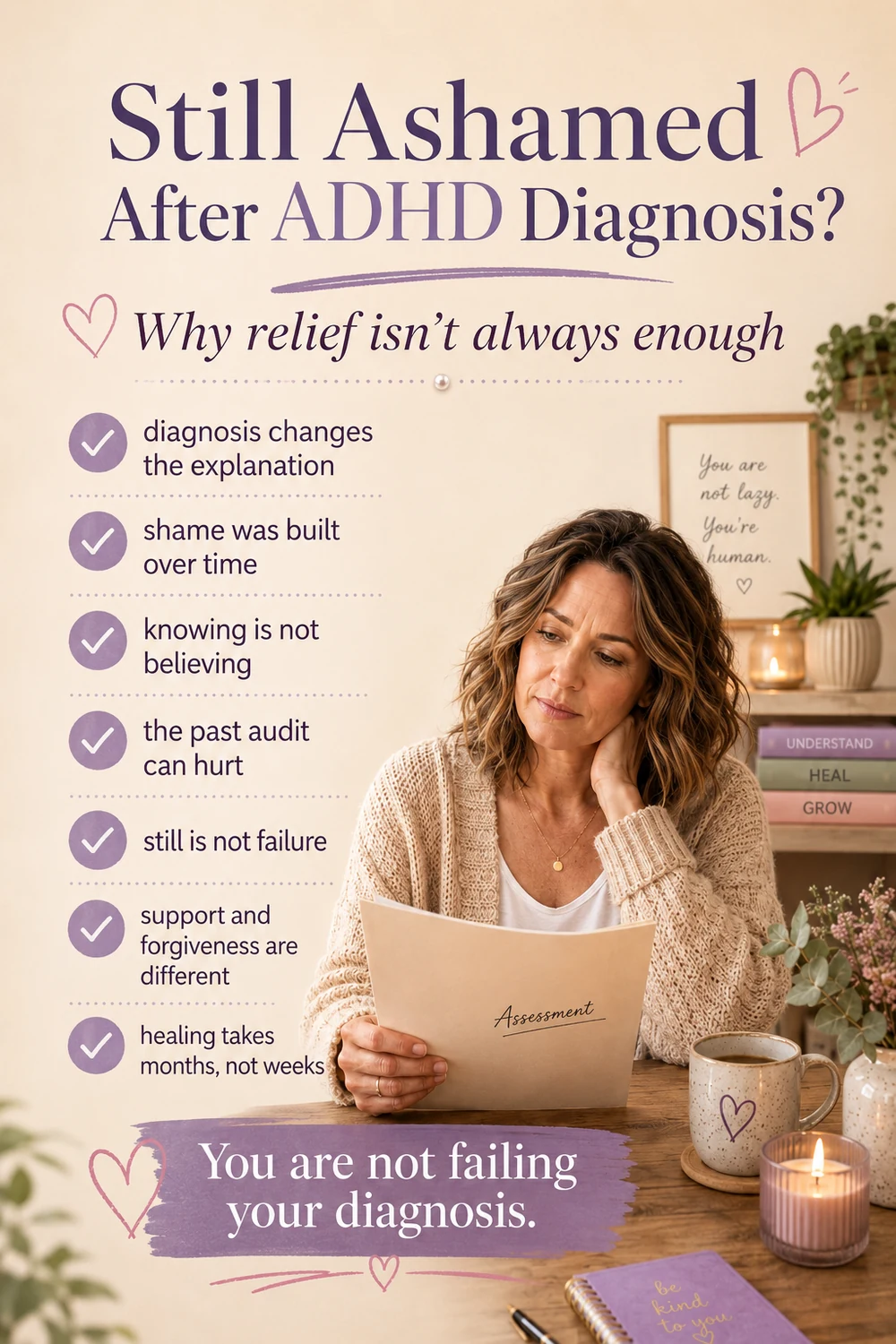
That is the part almost nobody prepares you for. The diagnosis changes the explanation. It does not automatically change the feeling. And when the feeling stays, most of us make it mean something terrible: that we are ungrateful, or that we were making it up, or that we are so broken even the answer does not work on us.
You are not any of those. There is a reason the explanation did not reach the place the shame lives, and it is a boringly mechanical one.
Quick answer
Why do I still feel ashamed after my ADHD diagnosis?
Because the diagnosis is one fact learned in an afternoon, while the shame was built from thousands of separate moments, each carrying its own emotional charge. A single new sentence cannot re-label them. Relief usually comes first, then a stretch of anger and grief. Belief trails knowledge by months, and that lag is normal.
Key takeaways
📌The diagnosis is one fact. The shame was built from thousands of separate moments, each with its own charge.
📌Relief usually comes first, then anger and grief. That second stage is the process, not a complication.
📌Internalised stigma is measurable: of 104 adults with ADHD, 88.5% expected to be judged in everyday life.
📌Watch for the word “still” — it turns an ongoing condition into a failure to improve on schedule.
📌Belief trails knowledge by months. If the low mood is constant rather than passing, that is worth a professional conversation.
Most write-ups of adult diagnosis stop at relief, which makes the next part feel like a personal malfunction. It is not. Clinicians who work with newly diagnosed adults describe a fairly consistent pattern: an initial reaction — often relief, sometimes flat disbelief — followed by a stretch of confusion and turmoil in which anger and sadness turn up uninvited.
That second stage is not a complication. It is the process. A diagnosis does more than explain behaviour; it destabilises the story you had been using about yourself, and a story that has been load-bearing for four decades does not come down quietly.
The diagnosis gives you a new explanation. It does not delete the forty years of evidence you already filed under a different one.
We wrote about why it took so long to be spotted in why your ADHD got missed until now. This article is about the bit that comes after that one — the specific, disorienting gap between knowing and believing.
From ADHD Pearls
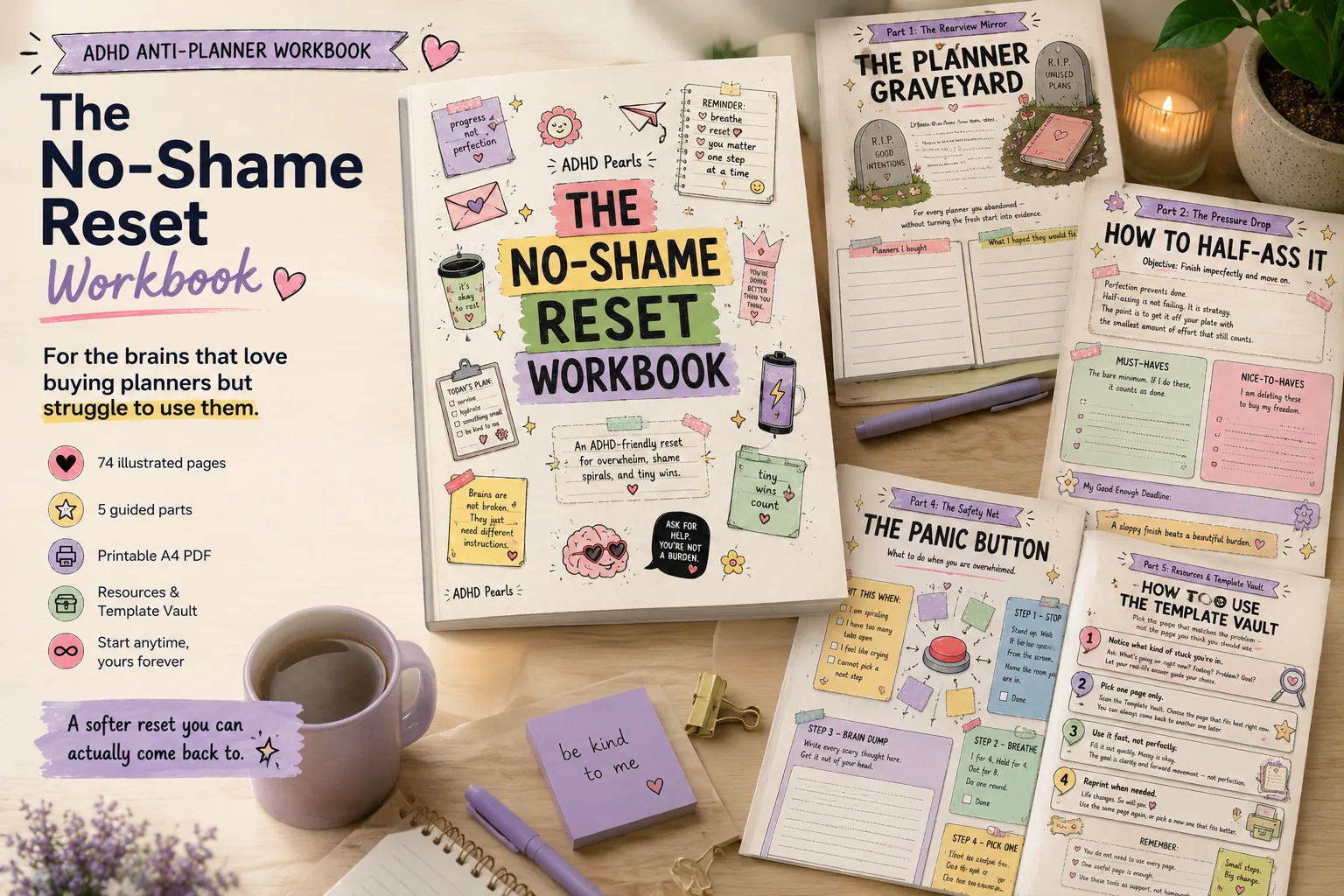
The No-Shame Reset Workbook
74 pages to reflect without shame, release what isn't working, and build a softer reset you can actually return to.
Why an Explanation Doesn’t Reach Where the Shame Lives
Here is the mechanism, and once it clicks the whole thing stops feeling like a moral failure.
The diagnosis arrives as a fact. One sentence, learned in one afternoon: the reason I could not do those things is ADHD. Your brain files it the way it files any other new fact.
The shame was not built that way. It was built out of thousands of separate episodes, each one small, each one carrying its own little charge of feeling — the report card, the sighing colleague, the friend who stopped inviting you, the school shoes nobody could find, the fourth planner. None of those were arguments. They were experiences, and each one deposited a bit of emotional evidence.
One new sentence does not go back and re-label four thousand memories. It cannot. That is not how the filing works.
So you end up in a genuinely odd position: you can explain your ADHD accurately to somebody else, with real conviction, and still feel exactly as much of a fraud as you did in March. Both of those are running at once, and neither one is lying.
Knowing is a fact you learn. Believing is a pattern you wear down. They run on completely different timescales, and expecting the second to arrive at the speed of the first is the thing that makes people feel they have failed at their own diagnosis.
A diagnosis is one new sentence. Shame is a pattern built from thousands of moments.
What Was Actually Happening for Forty Years
Worth naming plainly, because most of us have never had a word for it: what accumulated was not simply low self-esteem. It has a name in the research — internalised stigma. Not the stigma other people aim at you, but the version you absorbed and started running yourself, without needing anyone else in the room.
It has been measured. In a study of 104 adults with ADHD, 23.3% reported high internalised stigma, 88.5% anticipated being discriminated against in everyday life, and 69.3% perceived public stereotypes about ADHD. Those levels tracked with psychological distress, self-esteem, functional impairment and quality of life. A 2026 systematic review of stigma in adults with ADHD reaches broadly similar conclusions.
Read that again, because it reframes the whole thing. The shame is not a side effect of your personality. It is a documented feature of living undiagnosed inside a world that had opinions about you. Roughly nine in ten of those adults expected to be judged. That is not a group of unusually fragile people. That is what decades of correction does.
And a diagnosis, however good, is a single event landing on top of all of that. It is one piece of counter-evidence against a pile that took forty years to build.
Internalised stigma is not a personality flaw. It is emotional evidence absorbed over time.
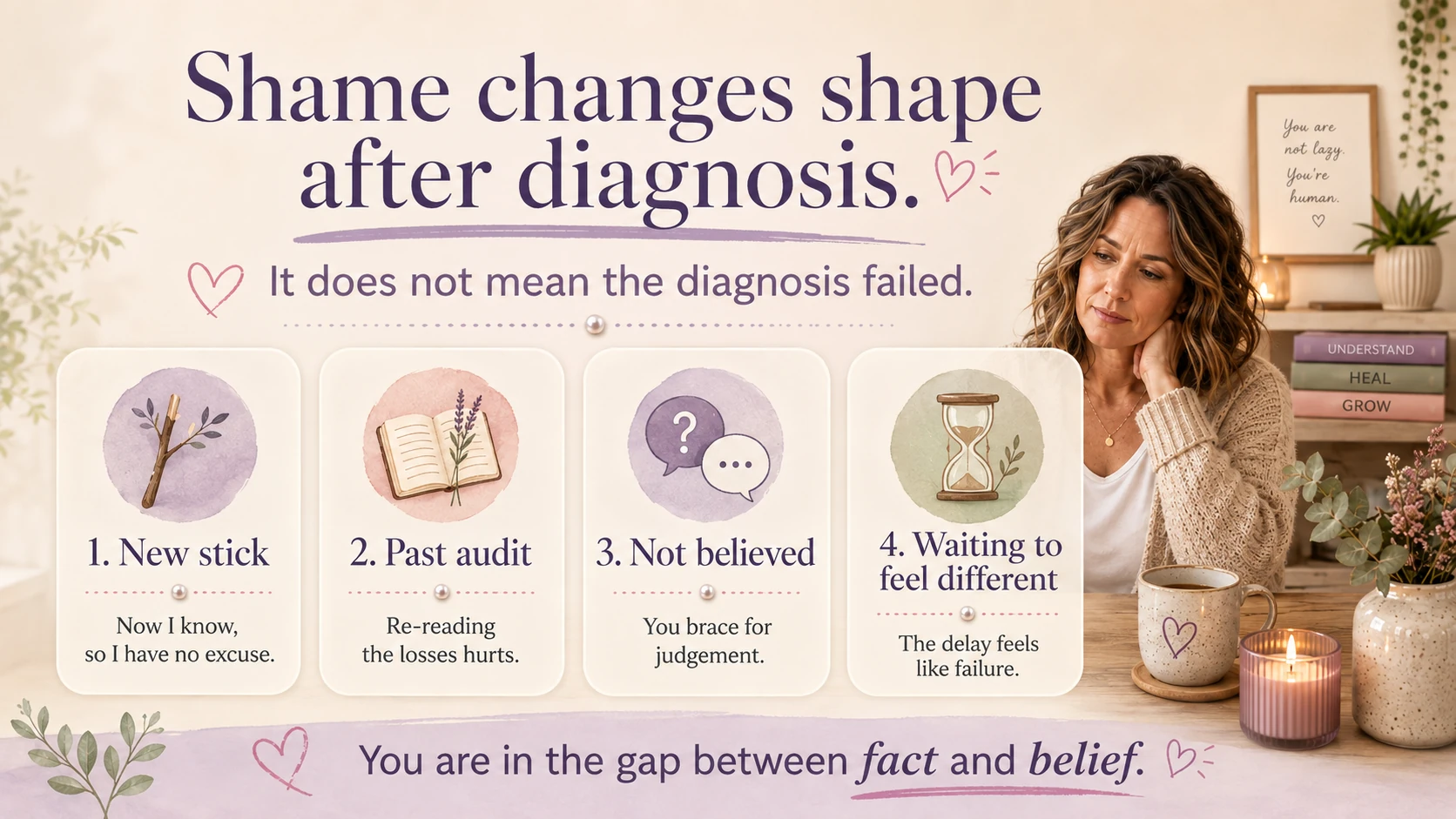
The Four Shapes It Takes After Diagnosis
The residue does not usually announce itself. It shows up wearing ordinary clothes.
1. The diagnosis becomes a new stick to hit yourself with
This is the cruellest one and it is extremely common. The old sentence was I should have managed that. The new one is I know exactly why I struggle now, so I have no excuse for still struggling.
Knowledge gets converted into obligation. Every strategy you read becomes something you are failing to implement. The explanation, which was supposed to let you off, quietly becomes the prosecution's best exhibit.
2. You audit the past, and it hurts more than you expected
Almost everyone does this, usually around week three. You go back through the degree you dropped, the job you lost, the friendship that cooled, the version of you at fourteen who was trying so hard, and you re-read all of it with the new information.
Some of that re-reading is genuinely healing. Some of it is grief, and grief is the right word — researchers have used grief theory specifically to make sense of how adults rebuild their own story after a late diagnosis. You are mourning a real thing: the support that existed and never reached you.
3. You brace for not being believed
You tell someone, and part of you is already flinching. Everyone has ADHD these days.But you did well at school.Isn't that a bit trendy? Sometimes people really do say it. Often they do not, and the flinch happens anyway, because after 88.5% of a lifetime spent anticipating judgement, the anticipation runs whether or not it is warranted. If that flinch is very loud for you, rejection sensitivity is probably part of it.
4. You wait to feel different, and read the delay as failure
This is the one that sends people looking for an article like this. You expected a threshold. You got a Tuesday. And because nothing announced itself, you conclude the diagnosis did not take — or worse, that you do not really have it.
Nothing has gone wrong. You are simply in the gap between the fact and the belief, which is exactly where you are supposed to be at this point.
Shame can change shape after diagnosis. That does not mean the diagnosis failed.
What the New Research Actually Says
A study published in 2026 in the Journal of Attention Disorders interviewed twelve women aged 45 to 58 who were diagnosed in adulthood. The themes will be uncomfortably familiar: years of misdiagnosis and hidden struggle, internalised stigma, hard-to-manage emotions, and hormonal fluctuations that participants felt changed both their symptoms and how well their medication worked. Alongside all of that, the diagnosis itself was described as profoundly validating, and several women had come to see their hyperfocus as a real functional strength.
Two honest caveats, because we would rather you trust us than be impressed.
Twelve people is twelve people. These are retrospective, self-reported accounts from a small group, which is exactly the right method for understanding what an experience is like — and the wrong basis for any claim about cause. In particular, the hormone-and-medication link is what those women perceived. It is a lead worth taking to a clinician, not a finding. If that thread is live for you, we go into it properly in ADHD and perimenopause.
The paper's own title calls it a “personal superpower,” and we would not repeat that. There is a meaningful difference between what those women actually did — reclaiming one specific capacity, hyperfocus, after being believed — and the tidier internet version where ADHD is a gift. The first is adaptation, and it is hard-won. The second quietly implies that if you are not thriving you are doing your neurodivergence wrong, and it papers over a disability that costs people jobs, money and marriages.
You do not owe anybody a silver lining. Reclaiming something is allowed to come later, or not at all.
What Helps, and How Long It Honestly Takes
Not a detox plan — we have a whole article on the shame practice itself, and it is the better place to start if the pattern is old and general. These are the things that specifically help with the post-diagnosis gap.
Expect the lag, out loud. Simply knowing that belief trails knowledge by months removes the second layer of shame — the shame about still being ashamed. That layer is often heavier than the original.
Re-read one memory, not your whole life. The full audit is overwhelming and tends to end in a bad evening. Take one specific incident. Ask what was actually being asked of you, and what your brain had available at that moment. One at a time is how a pile of four thousand gets smaller.
Watch for the word “still.”I still can't keep a routine. I still forget birthdays. That word is doing something: it is treating an ongoing disability as a personal failure to improve on schedule. A condition you have does not become a character flaw because you have now been told its name.
Separate what needs support from what needs forgiving. The unpaid bill needs a system. The version of you who could not pay it for two years needs something else entirely, and no system will do that job.
Tell one safe person properly. Not a broadcast — one person who will take it seriously. Being believed out loud does something that reading cannot. It is also, notably, the thing the women in that study described as the turning point.
On the timeline: most people describe months, not weeks, and it is not a straight line. A good stretch followed by a week that feels like April is normal, and is not evidence of backsliding.
Some things need a system. Some parts of you need compassion for surviving without one.
When It Is More Than Shame
This part matters, so we are saying it plainly rather than burying it.
For some people, the flatness after diagnosis is not residual shame working itself through. If, weeks or months on, most days feel heavy, things you used to enjoy have gone grey, sleep and appetite have shifted, or you find yourself thinking the world would tick along fine without you — that is worth taking to a professional. Depression is common alongside ADHD, and a late diagnosis with all its re-reading of the past can be exactly the thing that surfaces it.
Asking about that is not being dramatic and it does not undo your diagnosis. It is the same practical move as any other: getting the right support for the right problem. If you are in real distress right now, please talk to your doctor or a local crisis line rather than waiting it out alone.
One Tiny Move
Not a reframe, and definitely not a gratitude exercise.
Catch one sentence today, and put a date on it. When the voice says you're so bad at this, ask one question: how old is that sentence? Not whether it is true — that argument goes nowhere. Just how old.
Most of them turn out to be about thirty years old, in somebody else's voice, formed before anyone had the information you have now. That does not make the sentence disappear. It does put it in the past tense, which is where it belongs, and it is a much smaller job than trying to feel differently on command.
One sentence. One date. That is the whole thing.
Once the old sentences have dates on them, a quieter question tends to follow: which parts of you were the coping strategy, and which were you all along? We wrote about sorting that out in is it my personality or my ADHD?
FAQ: Shame After an ADHD Diagnosis
Why do I still feel ashamed after my ADHD diagnosis? Because the diagnosis is a single fact and the shame was built from thousands of separate experiences, each with its own emotional weight. Learning something new does not automatically re-label decades of memories filed under a different explanation. The knowledge arrives in an afternoon; the feeling shifts over months.
Is it normal to feel worse after being diagnosed with ADHD? It is very common. Clinicians describe an initial reaction — often relief — followed by a period of confusion and turmoil in which anger and sadness surface. Feeling worse for a while does not mean the diagnosis was wrong or that you are handling it badly.
What is ADHD diagnosis grief? It is the mourning that follows a late diagnosis: for the support that was available and never reached you, and for the version of yourself who was trying hard without knowing why it was so difficult. Researchers have applied grief theory to how adults rebuild their personal narrative after diagnosis, which is why the word fits better than most alternatives.
How long does it take to accept an ADHD diagnosis? Most people describe months rather than weeks, and it tends to move unevenly rather than in a straight line. A good stretch followed by a bad week is normal. If the low mood is constant and lasting, that is worth discussing with a professional rather than waiting out.
Why do I feel like a fraud even though I have a formal diagnosis? Partly because self-doubt was a well-practised habit long before the assessment, and partly because ADHD is inconsistent by nature — a good day can feel like proof you invented the whole thing. A good day is not evidence against ADHD. Variability is one of its defining features.
What is internalised stigma in ADHD? It is when negative beliefs about ADHD get absorbed and turned inward, so you apply them to yourself without anyone else needing to be present. In one study of 104 adults with ADHD, 23.3% reported high internalised stigma and 88.5% anticipated discrimination in everyday life. It is associated with psychological distress, lower self-esteem and reduced quality of life.
Should I tell people about my ADHD diagnosis? There is no obligation to. Many people find that telling one person who takes it seriously helps considerably more than telling many people casually. It is reasonable to be selective, and it is reasonable to change your mind later.
Is ADHD a superpower? Some people reclaim specific capacities, such as hyperfocus, and experience them as genuine strengths — usually after being believed and properly supported. That is different from the claim that ADHD is a gift, which can quietly invalidate a disability that has real costs. Both can be true for different people on different days, and you are not required to find an upside.
Does medication help with ADHD shame? Medication targets core ADHD symptoms rather than shame directly, though some people find that when tasks get easier, there is less new evidence being added to the pile. The older beliefs usually need something else — time, being believed, and often therapy. Any medication questions belong with the clinician who prescribes for you.
Save this for the next time you wonder why relief after diagnosis did not erase the old shame overnight.
Pin this reminder: still feeling ashamed does not mean you are failing your diagnosis.
This article describes lived experience and published research on how adults respond to a late ADHD diagnosis. It is not medical advice and it is not a substitute for assessment or treatment. If your mood has been persistently low, or you are struggling to get through the days, please speak to your doctor or another qualified professional.
Found this helpful? Share it with someone who gets stuck too.
One tap makes ADHD Pearls a preferred source in your Google account, so our articles surface higher when you search. No signup, and it brings you straight back to this page.
ADHD anti-planner workbook
The No-Shame Reset Workbook
A 74-page printable reset for overwhelm, shame spirals, and the planners you couldn't keep using. Reflect without shame, release what isn't working, and build a softer reset you can actually return to.
For the woman who sets up the perfect system on Sunday and abandons it by Tuesday.
One short letter, every week. Real talk about ADHD, task paralysis, and the tiny wins that actually move the needle for a brain like yours. No shame. No hustle culture.