Six weeks after my diagnosis, I turned up twenty minutes late to a friend's birthday dinner carrying a three-layer cake I had been decorating until two in the morning. She hugged me, looked at the cake, looked at the clock, and laughed. “That is so you.”
I laughed too. Then I spent the whole drive home taking the sentence apart. Which bit was me? The lateness? The cake? The two a.m.? A month earlier I would have said all of it, proudly or apologetically depending on the day. Now every trait I owned had a small question mark stuck to it.
If you have been diagnosed late, you probably know this stage. The relief has landed, the grief has had its turn, and then a quieter question moves in: if so much of what I called my personality was ADHD, or a workaround for ADHD, who exactly is left?
This is not a crisis you are handling badly. It is the next step, and it can be done gently.
Quick answer
Is it my personality or my ADHD?
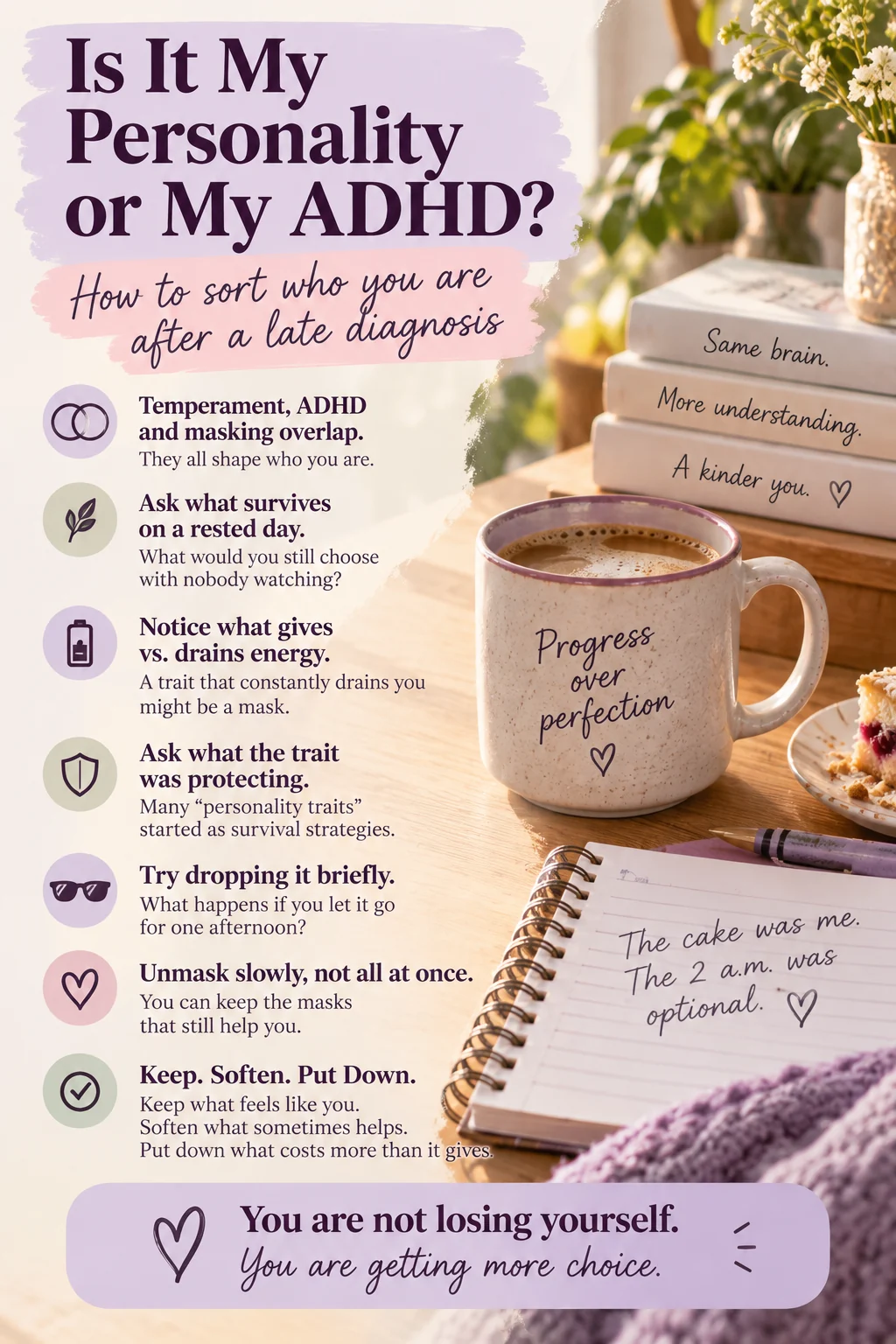
Usually it is both, tangled together. ADHD shapes attention, emotion and energy, so it sits inside your personality rather than next to it. A more useful question is which traits you would choose on a rested day with nobody watching, and which ones you built to survive. Those survival habits are the mask, and they can be loosened slowly.
Key takeaways
📌ADHD and personality overlap by design: research links ADHD traits to measurable differences in how conscientious, agreeable and emotionally reactive people are.
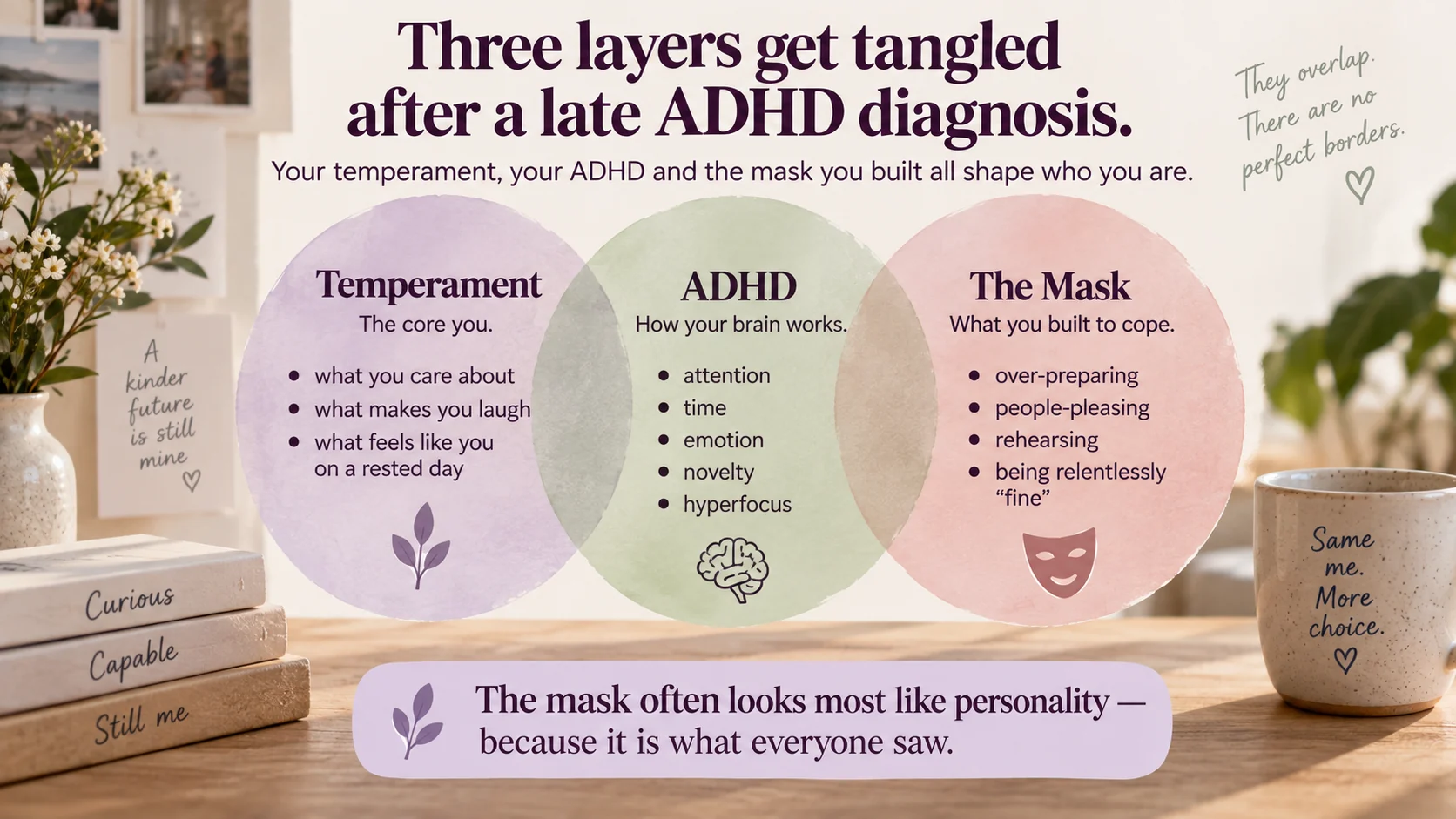
📌Three layers get tangled after a late diagnosis: your temperament, your ADHD, and the mask you built to cope with it.
📌In a 2026 study of 202 adults with ADHD, more than 91% said they hide or compensate for their traits, and many described feeling disconnected from their true selves.
📌A trait that drains you, started as protection, and would vanish on a rested day with no audience is probably part of the mask.
📌Unmasking works best slowly, in low-stakes places, and you are allowed to keep the masks you still choose.
Is It My Personality or My ADHD? Why the Question Gets So Loud
Before the diagnosis, my personality was a fairly settled list. Spontaneous. Chatty. A bit chaotic. Great in a crisis, terrible with paperwork. People had been describing me that way since elementary school, and I had been agreeing.
After the diagnosis, the same list started reading like a symptom checklist. Chatty? Maybe that was impulsivity. Great in a crisis? Possibly just a brain that finally gets enough stimulation when something is on fire. I was not losing my personality. I was rereading it with a new set of subtitles, and some lines no longer meant what I thought they meant.
Researchers who interviewed women diagnosed in adulthood describe exactly this: the past gets rebuilt from the point of view of a new, still-forming identity. That rebuild can open up a kinder future, but while it is happening, the ground moves. It is normal to feel a bit like a stranger in your own kitchen for a while.
Part of the reason the question has no clean answer is that the two things genuinely overlap. A large meta-analysis of ADHD and personality found that ADHD traits go along with lower conscientiousness and agreeableness and higher emotional reactivity, measured with the same tools used for everyone else's personality. In plain English: ADHD is not a passenger sitting next to your personality. It is part of the engine. Asking where one ends and the other begins is a bit like asking which part of a cake is the eggs.
So “personality or ADHD?” is the question everyone asks first. It turns out to be less useful than a second one: which parts of me did I choose, and which parts did I build because I had to?
My first attempt at answering that went badly. I wrote a list titled “Things that might not be me” and it reached three pages before midnight, which mostly made me feel like I was being evicted from my own life. I went looking for something that would help me look back without turning it into a courtroom, and most journals I found opened with “What are your core values?”, which was precisely the question I could not answer that month.
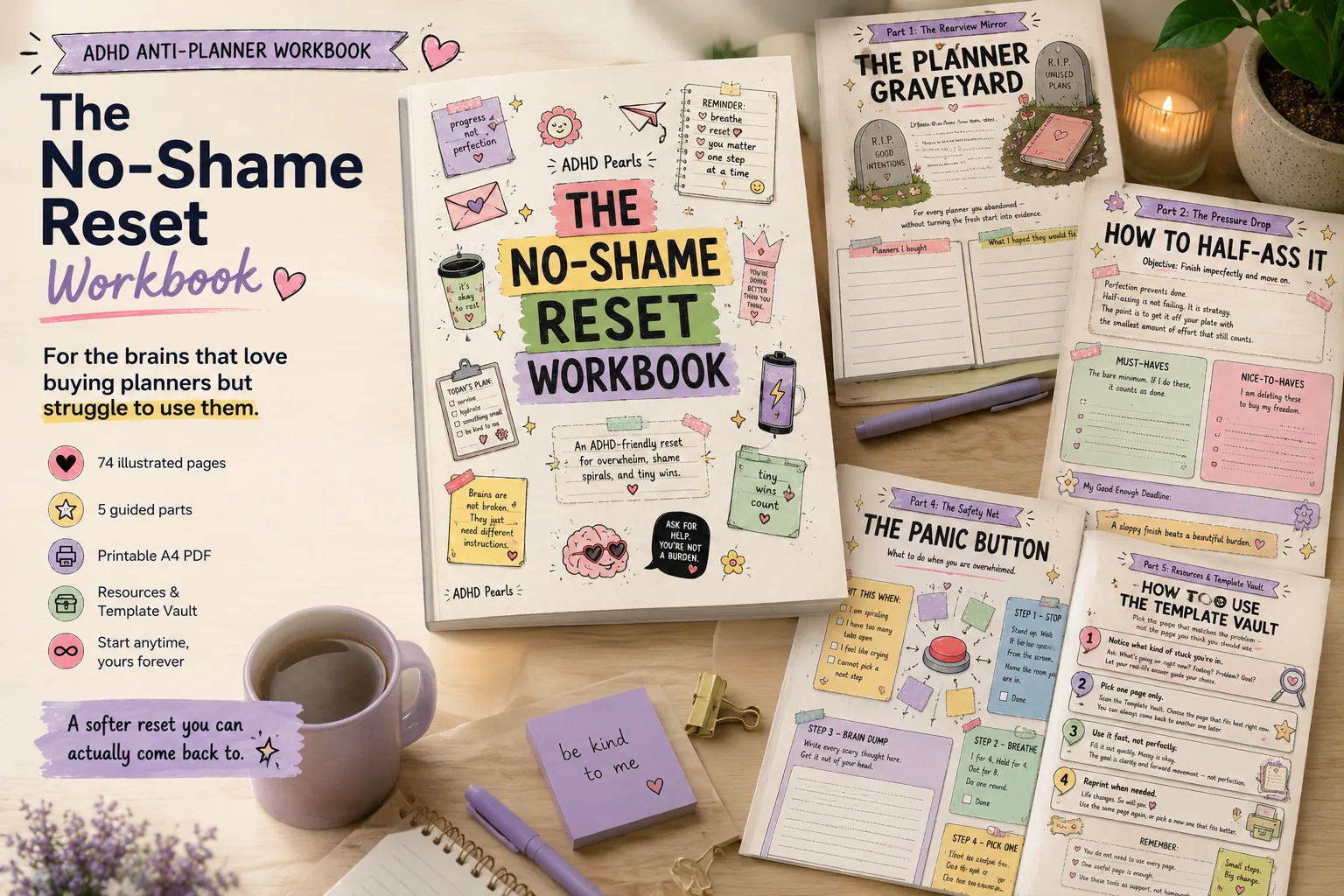
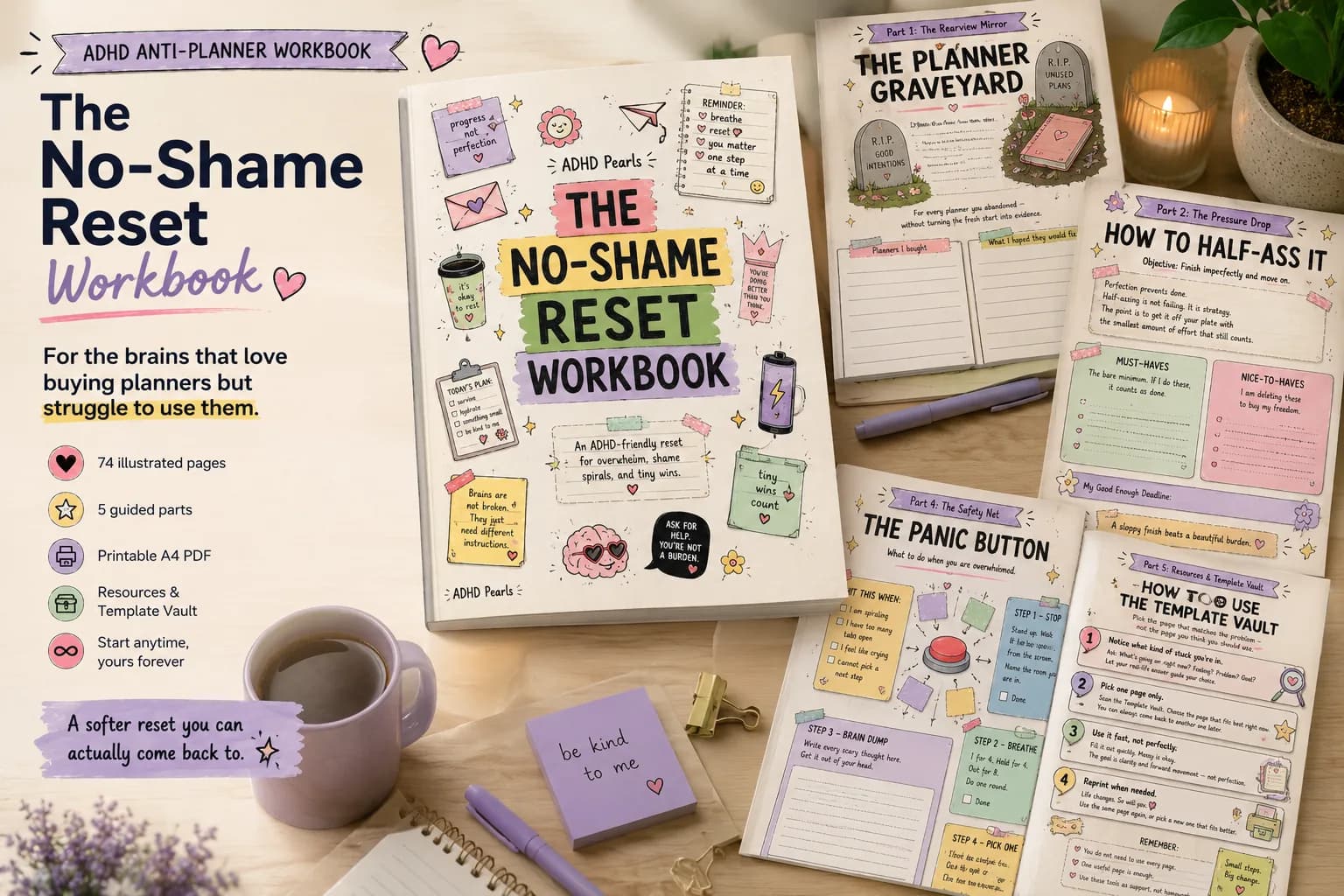
So we built a workbook that starts somewhere softer: one part for looking back without treating the past as proof you failed, and one for dropping the rules that were never built for your brain. It did not tell me who I am. Nothing printable can. It did give the sorting a page to happen on, instead of my head at two a.m.
From ADHD Pearls
The No-Shame Reset Workbook
74 pages to reflect without shame, release what isn't working, and build a softer reset you can actually return to.
Three Layers That Get Tangled: Temperament, ADHD and the Mask 🧠
What finally helped me was splitting one blurry question into three layers. They are not perfectly separate, and nobody can draw the borders for you. But naming them makes the knot loosen.
These layers overlap. The goal is not to draw perfect borders between them, but to understand what each one may be doing.
•Temperament: the stuff you would probably have regardless. Introvert or extrovert, what makes you laugh, what you care about, the things you were curious about at eight and still are.
•ADHD traits: how your brain handles attention, time, emotion and boredom. Hyperfocus, time blindness, big feelings that arrive fast, a strong pull toward novelty.
•The mask: the habits you built to hide or compensate for the second layer. Over-preparing, people-pleasing, rehearsing conversations, being relentlessly “fine.”
The confusing part is that the third layer often looks the most like a personality, because it is the one other people see most. Here is the rough sorting table I wish someone had handed me. It is not a diagnostic tool and it will not label anything for you. It is a way to ask better questions.
Layer
Example
How it tends to feel
Clue
Temperament
Loving long conversations, a dry sense of humor, caring a lot about fairness
Easy. Like breathing out.
Shows up when you are rested, alone, and with safe people alike
ADHD trait
Losing four hours to a project you love, interrupting when an idea arrives, forgetting trash day
Involuntary. Sometimes delightful, sometimes costly.
Changes with sleep, stress, hormones and support, not with effort alone
The mask
Arriving 45 minutes early, saying yes to everything, color-coding a life that is quietly collapsing
Effortful. Often followed by a crash.
Gets stronger when someone is watching and fades when you feel safe
Most traits will not sit neatly in one row. My love of over-the-top birthday cakes is temperament. Starting at 9 p.m. is ADHD. Pretending it took “an hour or so” is pure mask.
The Traits You Built to Survive (and Thought Were You)
For years I described myself as “a very punctual person.” I was always early. Not a bit early. Forty-minutes-in-a-parking-lot early, eating a granola bar and scrolling, because if I left on time something would go wrong and I would be late, and being late felt like proof of everything people had ever said about me.
After the diagnosis I realized I was never a punctual person. I was a person who was terrified of being late. Those look identical from the outside, and feel completely different from the inside.
I was never a punctual person. I was a person terrified of being late. From the outside, nobody could tell the difference.
The behavior was real. The reason underneath it was different from the personality label attached to it.
That is the mask, and almost everyone diagnosed late has one. In a 2026 study from Simon Fraser University, more than 91% of the 202 adults with ADHD said they hide, suppress or compensate for their traits. The cost was consistent: exhaustion, anxiety, low self-esteem, a sense of being an impostor, and, in the lead researcher's words, feeling disconnected from their true selves. Masking also made attention and memory problems worse, because so much effort was going into the performance.
Some common survival traits that often get mistaken for personality:
•“The organized one.” Elaborate systems, labels, three backup calendars. Sometimes a genuine love of order. Often a scaffold holding up a brain that drops things.
•“The easygoing one.” Never asking for anything, never needing anything. Often a way of avoiding the risk of being too much.
•“The funny one.” Real humor, frequently. Also a brilliant way to get ahead of the joke before someone makes it about you.
•“The perfectionist.” Rewriting the email nine times so nobody can spot the gaps you know are in there.
•“The one who always says yes.” Helpful, warm, reliable, and chronically overbooked, because saying no once felt like it could cost you the relationship.
None of these are fake. You really did organize, joke, help and show up early. A mask is not a lie about who you are. It is a strategy that grew so close to your face you forgot it was there. If you want to go further into how those years shaped the way you talk to yourself, we wrote about it in the ADHD shame detox.
How Can I Tell Which Traits Are Really Me? Four Sorting Questions 🔍
I tried sorting my traits by thinking hard about them. That produced a headache and a very long voice note to a friend. What worked better was asking the same four questions of one trait at a time, on paper, on a decent day.
Do not audit your entire personality. Pick one trait that costs you something and get curious about it.
1. Would I choose this on a rested day, with nobody watching?
Picture a slow Sunday, enough sleep, no one to impress. If the trait is still there, it is probably yours. My need to talk ideas through out loud survived this test. My need to have the house look tidy before anyone visited did not. Alone, I am perfectly happy in a gently chaotic living room.
2. Does it give me energy or cost me energy?
Temperament tends to refill you, even when it is intense. Masks tend to drain you, especially afterward. If a trait reliably needs a recovery nap, look at it twice.
3. When did it start, and what was it protecting?
A lot of masks can be traced to a specific moment: a teacher, a report card, a parent's sigh, a boss. My early-to-everything habit started after a school trip that left without me. I was nine. That is a very old bodyguard to still be paying.
4. What happens if I drop it for one afternoon?
Not forever. One afternoon. If dropping it feels like relief, it was probably a mask. If you miss it, it might be yours, or a mask you want to keep, which is allowed.
You do not need to run every trait through this. Pick the two or three that cost you the most. The rest can wait. Identity is not a spreadsheet you have to finish by Friday.
Unmasking Slowly (Without Blowing Up Your Life)
The internet version of unmasking sounds like a dramatic reveal: quit the job, tell everyone, stop pretending overnight. For most women in their thirties, forties and fifties with jobs, kids and mortgages, that is not realistic, and it is not required.
Unmasking works better as a dimmer switch than a light switch. You turn one mask down a few notches in one safe place, see what happens, and adjust.
My first experiment was embarrassingly small. I stopped pretending to remember people's names. For years I had done an elaborate dance to avoid saying a name I had forgotten. One day I just said, “I am so sorry, tell me your name again, my brain drops them.” She told me. She said hers does too. Nobody fainted.
Some low-stakes places to start:
•At home, alone. Let yourself stim, pace, leave the project spread out, eat dinner at 4 p.m. if that is when you are hungry.
•With one safe person. Tell them one thing you usually hide, and what would actually help.
•In writing. Send the email without the fourth rewrite. See whether anyone notices. Usually nobody does.
•In your calendar. Leave a real buffer after social plans instead of pretending you will be fine to go straight to the next thing.
And here is the permission nobody gives you: you can keep some masks. A mask you choose on purpose, for a job interview or a difficult relative, is a tool. The problem was never that you could adapt. It was that you could never take it off. If dropping a mask leaves you feeling exposed or flooded, that is often rejection sensitivity talking, and it is worth reading why it hits ADHD women so hard.
The Parts That Were Never the Problem 🌱
Somewhere in all this sorting, it is easy to start treating every ADHD trait as something to trim. Please do not do that to yourself as well.
Look at the things you were told were “too much.” Too loud, too intense, too curious, asked too many questions, cared too much, got too excited. Very often, the traits that got you in trouble are the ones closest to the real you, because they were the ones you could not fully hide.
I am not going to tell you ADHD is a superpower. It has real costs, and you do not owe anyone an upside. But when I listed the things my closest friends actually love about me, almost none of them were on my mask list. They were the enthusiasm, the weird facts about octopuses, the way I notice when someone has gone quiet. The cake was on the list. The 2 a.m. was not.
This question comes up constantly once people start sorting their traits, often as a fear: what if treatment takes away the parts I like?
Medication is not designed to change who you are. It is meant to make attention and follow-through easier. Some people describe feeling flat, dull or “not themselves” on medication, sometimes called the zombie effect. Clinicians generally treat that as a sign the dose or the medication may need adjusting, not as the price of treatment.
Other people report the opposite: that with less energy going into compensating, more of their personality has room to show up. Both experiences are real, and only you and your prescriber can work out what is happening for you. If you notice yourself feeling emotionally flat, write down when it happens and bring it to your next appointment rather than quietly stopping.
This article is personal and educational. It is not medical or psychological advice. ADHD, anxiety, depression, autism, trauma and other conditions can overlap and affect how you see yourself. Please talk to a qualified clinician about diagnosis, medication or persistent changes in mood.
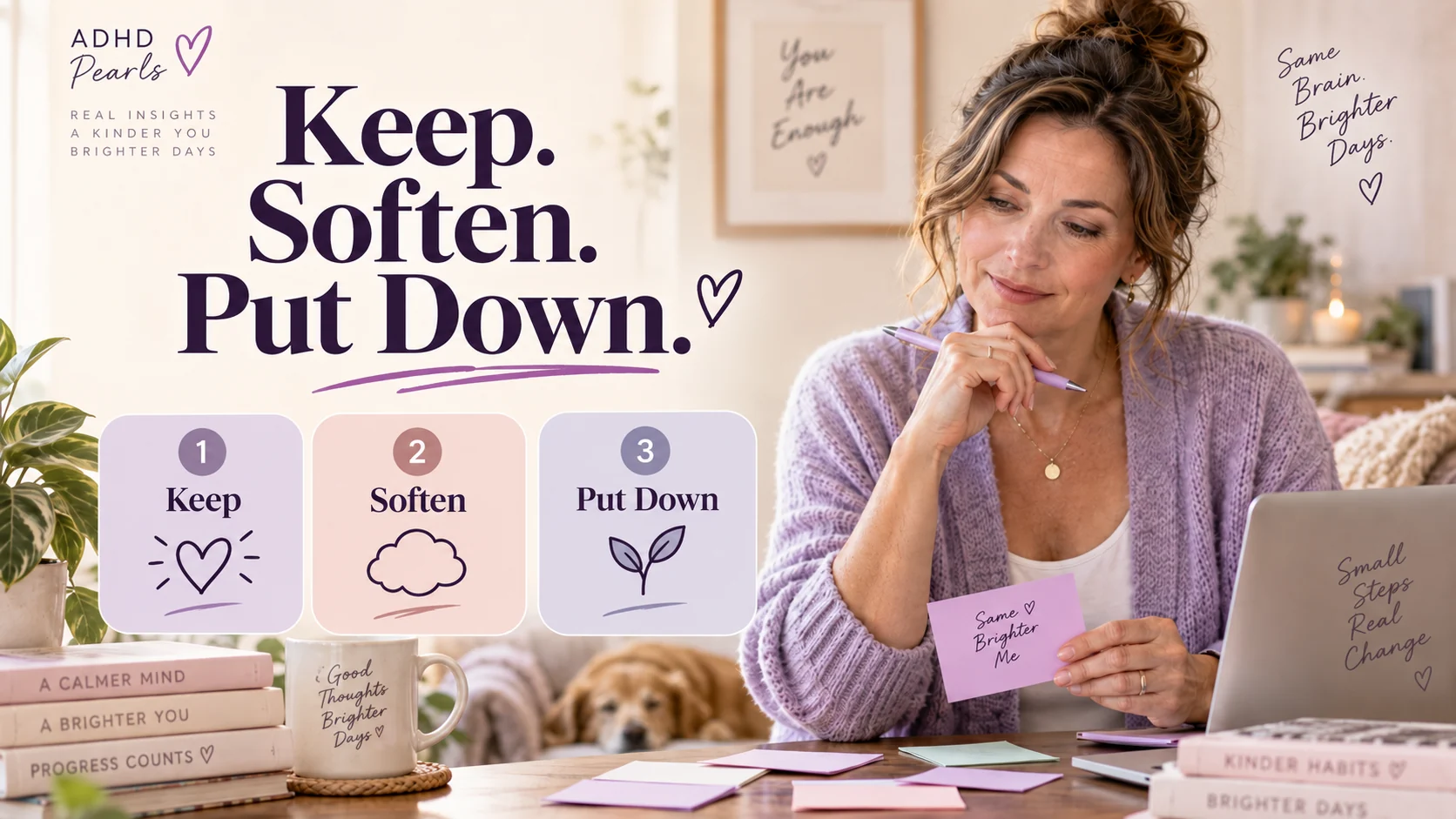
One Tiny Move: Keep, Soften, Put Down 📝
You do not need to answer “who am I?” this week. You only need to make one small sort.
You do not need to remove every mask. The useful shift is having more choice about which ones you still want to use.
Take a piece of paper and draw three columns:
•Keep: traits you would choose on a rested day. The ones that feel like breathing out.
•Soften: masks that still help sometimes, but that you want to use on purpose instead of all the time.
•Put down: survival habits that cost more than they give. Pick just one to experiment with this month.
Write three things in each column, maximum. Then put the paper somewhere you will see it again, which, for me, means stuck to the fridge, because a drawer is where good intentions go to die.
My first page had “talking ideas out loud” under keep, “being the organized friend” under soften, and “arriving 40 minutes early” under put down. I now arrive about ten minutes early, which my granola bar budget appreciates.
If the identity confusion comes with low mood that does not lift for weeks, trouble sleeping, or a feeling that nothing about you is worth keeping, that is more than a normal adjustment. Please bring it to a therapist or doctor, ideally one who understands adult ADHD.
Save this for the next time someone says “that is so you” and you are not sure which part they mean.
FAQ: Personality, Masking and Identity After an ADHD Diagnosis
Is it my personality or my ADHD?
Usually both, because ADHD shapes attention, emotion and energy and is woven into personality rather than separate from it. A more useful question is which traits you would keep on a rested day with nobody watching. Traits that drain you and fade when you feel safe are often part of the mask you built to cope.
Does ADHD change your personality?
ADHD does not replace your personality, but it does influence it. Research links ADHD traits with differences in conscientiousness, agreeableness and emotional reactivity. Many of the coping habits people build around ADHD also become part of how others see them.
Is it normal to have an identity crisis after an ADHD diagnosis?
Yes, it is very common. Research on women diagnosed in adulthood describes them rebuilding their life story around a new, still-forming identity. Feeling unsure who you are for a while is part of that process, not a sign that something is wrong.
What is ADHD masking?
Masking means hiding, suppressing or compensating for ADHD traits so you fit in, such as pretending to pay attention, over-preparing or rehearsing conversations. In one 2026 study, more than 91% of adults with ADHD reported doing it. It can help socially, but it is often linked with exhaustion, anxiety and low self-esteem.
What does unmasking ADHD look like?
Unmasking usually means gradually dropping coping habits that cost you more than they give, starting in safe, low-stakes places. That might be admitting you forgot a name, leaving a buffer after social plans, or sending an email without rewriting it four times. It works better slowly than all at once.
How do I know which traits are the mask?
Ask whether you would keep the trait on a rested day with no audience, whether it gives or drains energy, when it started and what it was protecting, and how it feels to drop it for one afternoon. Traits that drain you, started as protection, and feel like relief to drop are often masks.
Does ADHD medication change your personality?
Medication is meant to make attention and follow-through easier, not to change who you are. Some people feel flat or not themselves, which clinicians often treat as a sign the dose or medication needs adjusting. Talk to your prescriber rather than stopping on your own.
Will I lose the parts of me I like if I treat my ADHD?
Most people do not lose their humor, curiosity or warmth with treatment and support. Some find those traits have more room once less energy goes into masking. If something you value seems to disappear, that is worth raising with your clinician.
How long does it take to feel like yourself after a late diagnosis?
There is no fixed timeline, and most people describe months rather than weeks. It tends to move unevenly, with clear stretches and confusing ones. Sorting a few traits at a time, instead of your whole personality at once, usually makes it feel more manageable.
Sources I leaned on while writing this
Gomez, R., & Corr, P. J. (2014).ADHD and personality: a meta-analytic review.Clinical Psychology Review, 34(5), 376–388. Pooled up to 40 datasets and found ADHD symptoms associated with lower conscientiousness and agreeableness and higher neuroticism.
Stenner, P., O'Dell, L., & Davies, A. (2019).Adult women and ADHD: on the temporal dimensions of ADHD identities.Journal for the Theory of Social Behaviour. Interviews with women diagnosed in adulthood, describing how the past is rebuilt from the point of view of an emerging identity.
Mylett, M., & Iarocci, G. (2026).Adults with ADHD may pay high price to mask traits and fit in. Simon Fraser University summary of a study in Research in Neurodiversity with 202 participants; more than 91% reported masking, with links to exhaustion, anxiety and feeling disconnected from their true selves.
Psych Central (2022).ADHD zombie effect: what it is and what to do. Medically reviewed explainer on feeling flat on stimulant medication and why it is usually treated as a dosing issue.
I still do not have a tidy answer to who I am. What I have is a shorter list of who I no longer have to be: not the woman in the parking lot forty minutes early, not the one who rewrites every message, not the one who has to pretend the cake took an hour.
The workbook we made does not have the answer either, and I would not trust anything printable that claimed to. Its first two parts are just a place to do the looking back and the putting down without it turning into a verdict. That was the bit I needed. The cake person, it turns out, was me all along. The 2 a.m. was optional.
Found this helpful? Share it with someone who gets stuck too.
One tap makes ADHD Pearls a preferred source in your Google account, so our articles surface higher when you search. No signup, and it brings you straight back to this page.
ADHD anti-planner workbook
The No-Shame Reset Workbook
A 74-page printable reset for overwhelm, shame spirals, and the planners you couldn't keep using. Reflect without shame, release what isn't working, and build a softer reset you can actually return to.
For the woman who sets up the perfect system on Sunday and abandons it by Tuesday.
One short letter, every week. Real talk about ADHD, task paralysis, and the tiny wins that actually move the needle for a brain like yours. No shame. No hustle culture.