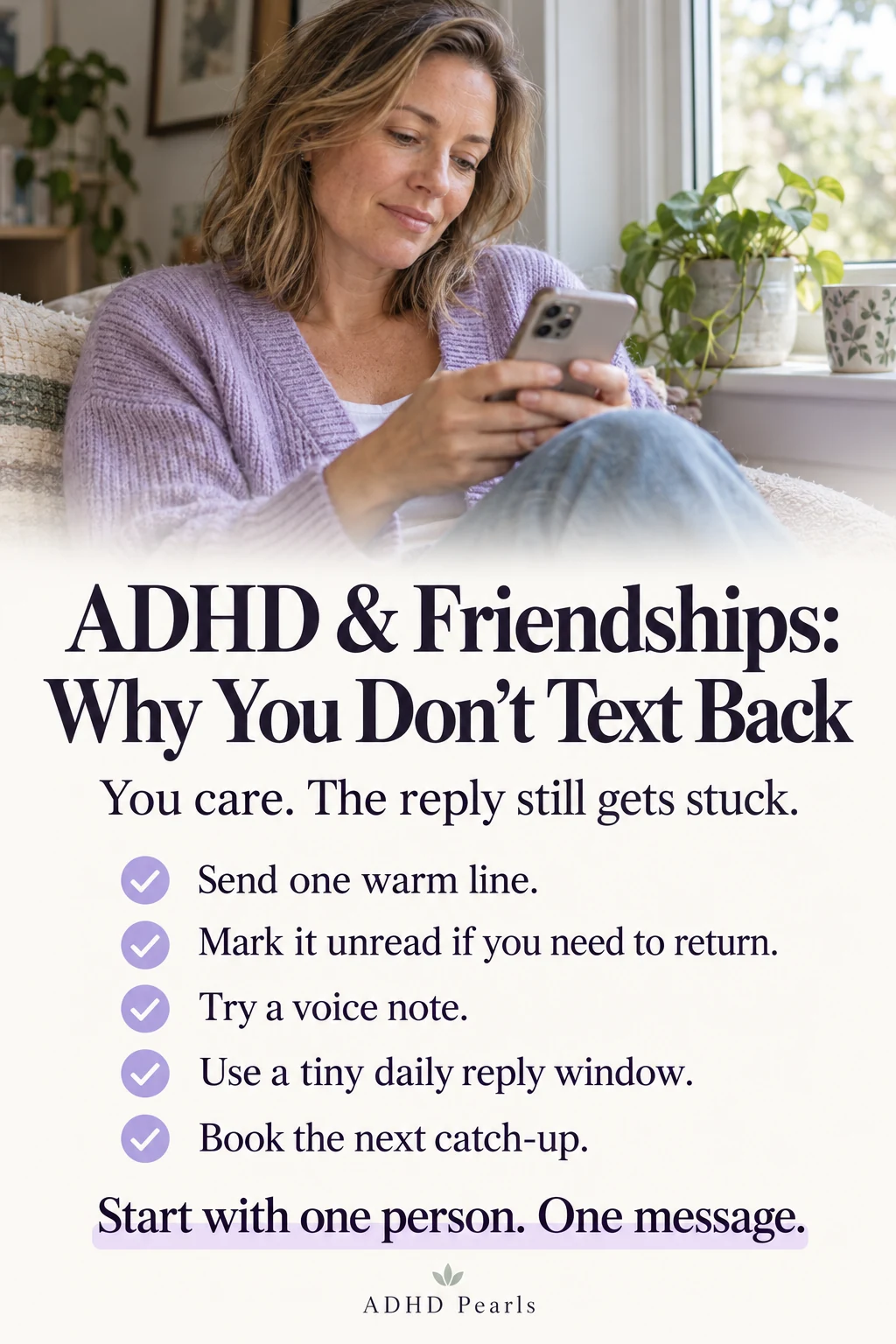
There is a message on my phone from a friend I love. It says, “Thinking of you! How did the new job go?” It arrived on a Tuesday. I opened it on the bus, smiled, and thought, I'll answer properly tonight.
That was 47 days ago.
The thing is, I did answer. In my head. Twice. Once in the shower, with a genuinely funny line about my new manager, and once at 1 a.m., with a long, heartfelt paragraph. Neither version ever reached her phone. She has, as far as she knows, been talking to a wall since early September.
If you have ADHD, you probably have your own version of this. One text, or thirty-eight unread WhatsApps, four voice notes you are “saving for later,” and a birthday message you composed beautifully and never sent. And you have probably told yourself the obvious story: I'm a bad friend.
Not texting back is rarely about not caring. With ADHD, it is usually about memory, timing and guilt, and once you can see the machinery, the wall gets a lot easier to climb.
Quick answer
Why don't I text back when I have ADHD?
With ADHD, unanswered texts usually come from forgetting messages once they are read, saving important replies for a perfect moment that never comes, and guilt that grows every day the reply waits. It is rarely a lack of care. Replying fast and short, putting the reminder back, and skipping the long apology can help.
Key takeaways
📌Opening a message deletes its reminder, and an ADHD brain often has no backup copy of “reply to her later.”
📌The texts you leave longest are often from the people you care about most, because they feel like they deserve a proper reply.
📌A late reply does not get harder to write. It gets heavier to feel, and that weight is what keeps you frozen.
📌Research suggests people underestimate how much others appreciate being contacted out of the blue, so your friend is likely gladder than you fear.
📌A late reply only needs one light sentence about the delay. Everything after it can just be warmth.
When I finally sat down and looked at my unanswered messages like a scientist instead of a defendant, a pattern showed up. It was never one reason. It was usually four or five small ones, stacked.
1. Once you've read it, it disappears
A notification is a reminder. Opening the message deletes the reminder. That works fine for a brain that quietly holds “reply to Ana” in the background. An ADHD brain often doesn't.
Working memory is the mental sticky note where you keep things you mean to do soon. A large review of research found it is one of the areas where people with ADHD differ most from people without it. So the reply doesn't feel postponed. It simply leaves the room. It is the same out-of-sight, out-of-mind pattern we wrote about in why you forget everything you can't see, just wearing a little blue tick.
A visible reminder can help bring an unfinished reply back into view.
2. You replied in your head
This one is sneaky, because it feels like doing the task. You compose the reply while walking the dog. You even edit it. Your brain files it under “done,” and the feeling of having answered arrives without any of the actual answering.
I once told a friend, with total confidence, “I already said that in my message.” I had not sent a message. I had thought one, very warmly, in a supermarket.
3. You're waiting to write the proper reply
A text from the dentist gets answered in four seconds. A long message from an old friend about her divorce deserves a real answer, so you wait for a moment when you will have time, energy and the right words all at once.
That moment almost never comes. The quick, low-stakes texts get answered instantly, and the meaningful ones pile up. From the outside, it looks like you care least about the people you care about most. It is the opposite.
4. “How are you?” is secretly a hard question
“How are you?” sounds tiny. But to answer it honestly, you have to scan your whole life, decide what to share, pick a tone and avoid sounding either fake-cheerful or like a weather warning. That is a lot of sorting for a brain that already finds deciding expensive.
Open questions, long messages with three questions in them, and invitations you are not sure about all land in the same “later” pile.
5. Not opening it feels better, for now
Every time you see the chat and swipe past it, you get a small hit of relief. Your brain learns: not opening that equals feeling better. That is avoidance doing its job a little too well, and it is the same loop we unpack in why you avoid the things you actually care about.
The worst part for me was never the forgetting. It was the moment I finally opened the thread, and my brain had already written the whole story for me: she's hurt, she's done with me, it's too late to fix. I went looking for something that would help me in that exact minute, and everything I found was either generic breathing advice or long articles I was in no state to read.
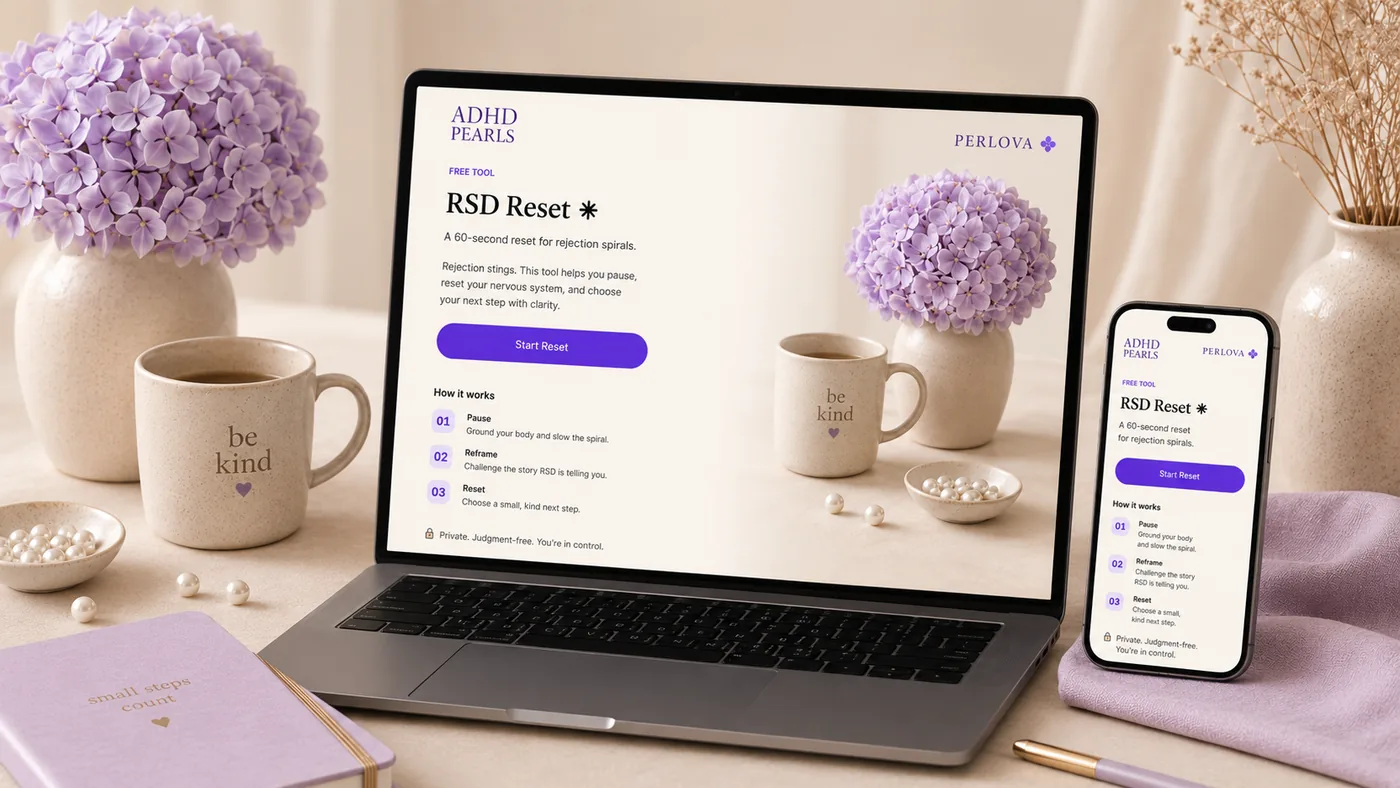
So we built a small reset for it. It walks you through separating what actually happened from what your brain added, and at the end it offers a few calm draft messages so you are not writing from inside the spiral. It has not made me a fast texter. It did get a 47-day-old message sent on a Sunday morning, which, frankly, is the most I have asked of anything.
From ADHD Pearls
Free RSD Reset
When one message or moment sends your nervous system sideways.
On day one, the reply is, “Aw, thank you! It went well, tell you more soon.”
On day ten, the reply seems to need an apology. On day forty, it seems to need an apology, an explanation, a full catch-up, and possibly proof that you still love her.
The task didn't get bigger. The feeling around it did. Research on adults with more ADHD symptoms has found they report noticeably more procrastination, and that procrastination travels with higher anxiety. In texting, that looks like a reply that grows a little scarier every morning you don't send it.
I needed something less vague than “just reply,” so I wrote down what my brain thought each late reply required, next to what it actually required. The gap was embarrassing, in a useful way.
The worry around a late reply can make starting feel harder.
How late
What my brain says the reply needs
What it actually needs
Same day
A thoughtful, complete answer to every question
One line and an emoji
A week
An apology and an explanation of my week
“Sorry, slow week!” plus the answer
A month
A long apology, a full life update, and reassurance that I care
One light sentence about the delay, then a warm question back
Months
It's too late; she has moved on; leave it
“Thought of you today and realized it's been way too long.”
Notice that the right-hand column barely changes. The late reply is almost always the same size as the early one. Only the dread grew.
I wasn't ignoring her. I was avoiding a feeling that got a little bigger every morning the reply waited.
Do Friends Actually Mind? 💬
Here is the good news first. In a series of experiments with more than 5,900 participants, researchers found that people consistently underestimate how much others appreciate being contacted, and the gap was biggest when the message was a surprise. A text out of the blue, after a long quiet stretch, tends to land better than the sender predicts.
That matches my experience embarrassingly well. The friend from the 47-day text replied within four minutes with three hearts and “OMG I was literally about to message you.” She was also behind. Most of us are.
Now the less comfortable part. A large UK survey of more than 7,000 adults found that people with more ADHD symptoms had about two and a half times the odds of reporting loneliness. Texting is not the only reason, of course. But keeping in touch is the small, daily maintenance friendships run on, and when that stalls, people drift even when the love is still there.
So it is worth fixing. Not because you are a bad friend, but because you are a good one with a leaky system. If the “bad friend” voice is loud right now, the ADHD shame detox is a kind place to start. And if your worry is more about how their short replies land on you, that is the receiving side, which we cover in why one short text can trigger rejection sensitivity.
How to Text Back With ADHD: 8 Things That Help 📱
None of these will turn you into someone who replies in four minutes. They are here to shrink the gap from six weeks to a few days, and to make the late replies hurt less.
1. Reply in the first 60 seconds, even badly
The cheapest moment to answer is the moment you open the message. After that, the cost goes up daily. So I lowered the bar: answer something right away, even if it is not the real answer.
“Love this, proper reply coming this weekend” counts. A heart plus one line counts. You are not closing the conversation. You are keeping the door from turning into a wall.
2. Mark it unread on purpose
If you can't reply now, put the reminder back. In WhatsApp, Messenger, Gmail and iPhone Messages you can mark a chat as unread, and the dot comes back. I do this so often my thumb does it before I have finished reading. For more small phone fixes like this, see the ADHD phone hacks that save me hours.
3. Kill the “proper reply” myth
A short reply today is kinder than a perfect reply in March. If a message really does deserve more, say so in the short reply and move it somewhere easier: “This deserves more than a text. Can I call you Thursday?”
4. Send a voice note instead
Typing a careful message feels like homework. Talking for ninety seconds while walking to the shop does not. Voice notes skip the editing stage, which is exactly where so many of my replies used to die. I start them with “this is a ramble, sorry,” and nobody has ever minded.
5. Give replies a tiny daily slot
Pick a moment that already exists: the kettle boiling, the school pickup queue, the first five minutes on the sofa after dinner. That is the reply window. Answer the oldest two or three messages, then stop. Mine is the kettle. It turns out a kettle takes almost exactly two texts.
Use an existing pause in your day to send one short reply.
6. Keep a “people I'm thinking about” list
When a friend pops into your head in the shower or the car, you probably can't text right then. Put their name in a notes app instead. Later, in your reply window, the list tells you who to reach out to. It turns kind thoughts that evaporate into messages that actually get sent.
7. Turn off read receipts if they freeze you
If the little “seen” label makes it worse, because now they know you read it, switch it off. In WhatsApp it lives under Settings, Privacy, Read receipts. On an iPhone, it is the Send Read Receipts switch in the Messages settings. Less audience, less dread.
8. Body double the scary ones
Some messages are just hard: a friend's bad news, an apology you owe, an invitation you need to decline. I answer those next to someone, on a call, or with a friend sitting across the table doing her own admin. Another person in the room lowers the dread enough to start. Here is why body doubling works.
What to Say When You Reply Weeks Late 📩
When a message is weeks old, the hardest part is the first line. You don't need a long apology or a full explanation. One light sentence about the delay, then straight to the warm part.
Copy, tweak, send:
•For a close friend: “I read this weeks ago, loved it, and then my brain filed it somewhere I couldn't find. How ARE you? Did the new job settle in?”
•For a message that needed a real answer: “I've been wanting to reply to this properly, which is exactly why I didn't. So here's the improper version: I'm so glad you told me. Call this week?”
•For someone you haven't spoken to in months: “No reason, just thought of you today and realized it's been way too long. What's new with you?”
•For a missed birthday: “Happy very belated birthday! I hope it was lovely. Let me buy you a coffee to make up for my terrible timing.”
•For a group chat you've gone quiet in: “Back from the void! Catching up now. Did I miss anything big?”
What to leave out: paragraphs of self-criticism, “I'm the worst friend ever,” and long lists of reasons. They make the other person comfort you, and they make the next late reply feel even bigger. I learned this by sending a 300-word apology to a friend who replied, “babe it's fine, what was the question again?”
Keeping Friends When You Are Bad at Keeping in Touch 💜
Texting is only one strand of friendship, and some of the most useful fixes happen away from the phone.
•Book the next meetup before you leave this one. Put it in the calendar while you are still at the table. It removes the whole “we should catch up soon” limbo where friendships quietly fade.
•Put birthdays in your calendar, with a reminder the day before. A reminder on the day is too late for anything but panic.
•Keep a tiny note per friend with what is going on in their life: the job interview, the sick dog, the house move. Glance at it before you message, so “how did the interview go?” replaces another vague “how are you?”
•Prefer friendships with a built-in rhythm. A weekly walk, a standing call, a class you both attend. Rhythm does the remembering for you.
Make the next plan while you are still together.
And consider telling your close people how your brain works. One honest message can take years of pressure off: “I have ADHD and I'm bad at replying. If I go quiet, it's never about you. Feel free to poke me.”
You don't owe anyone a diagnosis, so share only what feels right. But most people take this well, some will say they are exactly the same, and it gives your friends permission to nudge you instead of quietly wondering what they did.
One Tiny Move
Don't try to clear your whole inbox today. That is how the overwhelm wins.
Scroll to the one message that makes your stomach drop a little. Send one of the lines above, or just: “Thinking of you. Sorry I went quiet. Catch-up soon?” Then put the phone face down.
That's it. One message. The rest can wait until the kettle.
FAQ: ADHD and Not Texting Back
Why don't I text back even when I care about the person?
With ADHD, not texting back is usually about memory and emotion, not about how much you care. Opening a message removes the reminder, important replies get saved for a perfect moment that never comes, and the guilt of replying late makes each day harder than the one before. The people you care about most often wait longest, because their messages feel like they deserve more.
Is not texting back an ADHD thing?
Not on its own, because plenty of people without ADHD are slow repliers. But forgetting messages once they are read, replying in your head, and growing dread about a late answer all fit common ADHD patterns, especially working memory difficulties and avoidance. Only a qualified clinician can assess ADHD.
Why do I reply to texts in my head and forget to send them?
Composing a reply in your head can give your brain the feeling of having finished the task, so it gets filed as done. Without a visible reminder, nothing brings it back. Marking the message as unread or sending a quick holding reply right away can stop the imaginary reply from replacing the real one.
Why is it harder to reply the longer I wait?
The reply itself usually stays the same size, but the guilt and worry attached to it grow each day. Your brain starts to believe a late reply needs an apology, an explanation and a full catch-up, which makes starting feel heavier. In practice, one light sentence about the delay and a warm question back is almost always enough.
How do I apologize for not texting back?
Keep the apology to one light sentence, then move on to the warm part. For example: “I read this ages ago and my brain lost it. How are you?” Long apologies and self-criticism tend to make the other person comfort you, and they make the next late reply feel even bigger.
Is ADHD ghosting the same as ghosting?
Not really. Ghosting usually means choosing to end contact. With ADHD, the person typically wants to stay in touch and feels bad about the silence. The effect on the friend can look similar, which is why a short, honest explanation can help.
Should I tell my friends I have ADHD?
Only if you want to, because you don't owe anyone a diagnosis. Many women find that one honest message, such as “I'm bad at replying, it's never about you,” lifts a lot of pressure. It also gives friends permission to nudge you instead of feeling hurt.
How do I keep friends when I'm bad at keeping in touch?
Lean on rhythm instead of memory. Book the next meetup before you part, put birthdays in your calendar with a reminder the day before, keep a short note of what is happening in each friend's life, and favor regular plans like a weekly walk or call. Small, repeated contact matters more than perfect replies.
Liu, P. J., Rim, S., Min, L., & Min, K. E. (2022).The surprise of reaching out: appreciated more than we think (APA summary). Journal of Personality and Social Psychology. More than 5,900 participants; people underestimated how much others valued being contacted, especially when it was a surprise. Not an ADHD study.
I still have unread messages. Right now there are nine, and one of them is a voice note from my aunt that I suspect is a recipe.
What changed is the landing. When I open an old thread and my brain starts narrating how much she must hate me, I run the little reset we built, check what actually happened against what I added, and send one of its calmer drafts instead of the 300-word apology. It has not made me prompt. It has made me reachable, which turns out to be what my friends wanted all along.
Found this helpful? Share it with someone who gets stuck too.
One tap makes ADHD Pearls a preferred source in your Google account, so our articles surface higher when you search. No signup, and it brings you straight back to this page.
Before you go
Free RSD Reset
When one message or moment sends your nervous system sideways.
For the woman who sets up the perfect system on Sunday and abandons it by Tuesday.
One short letter, every week. Real talk about ADHD, task paralysis, and the tiny wins that actually move the needle for a brain like yours. No shame. No hustle culture.