Maybe it says “ok.” Maybe it says “sure.” Maybe it says nothing, and a few hours pass.
Nothing objectively terrible happened.
But my body reacts before my brain gets a vote. My stomach drops. My chest tightens. I reread the last message like I’m investigating a crime scene. And then the story starts:
They’re mad. I annoyed them. I was too much. They’re pulling away. I need to fix this right now.
The text was small. The reaction was not.
This is what ADHD rejection sensitivity and text messages can do together. And if you’ve ever spent an hour rewriting a reply to a two-word response, you probably already know exactly what I mean.
Quick answer
Why does a short text make me think someone is angry with me?
Because a short message strips out tone and context, and an ADHD brain fills that gap fast — often with a rejection story — before any real evidence arrives. The emotional response lands before reasoning catches up. That is why “ok.” can ruin an afternoon and still turn out to have meant nothing at all.
Key takeaways
📌A short message strips out tone and context, and an ADHD brain fills that gap fast.
📌The feeling arrives before the reasoning, which is why “ok.” can take an entire afternoon.
📌The spiral is the problem, not the text. Rereading, drafting and pre-apologising all extend it.
📌Do not send the panic text. Wait for the spike to pass before you reply at all.
📌Most of the time, the story your brain wrote turns out to have been about nothing.
A note before we start: This article is personal and educational, not a substitute for care from a qualified mental health professional. RSD is not a formal DSM diagnosis — it is a term many ADHD people use to describe a very real pattern. If this is severely affecting your life or relationships, please speak with someone who can actually help.
Text messages strip out almost everything that makes communication readable: tone of voice, facial expression, timing, body language, context. What’s left is a few words. Sometimes just one.
For a brain with strong ADHD rejection sensitivity, that stripped-down message creates a problem. There is a blank space where the tone should be. And the brain tries to fill that blank space.
The blank space becomes the problem. My brain fills it in before I can stop it.
ADHD brains can have difficulty with emotional regulation — not just attention. The prefrontal cortex, which helps moderate emotional responses, may be slower to apply the brakes. So when a short reply lands, the emotional reaction can arrive instantly, at full volume, before rational thought has had a chance to weigh in.
A one-word reply is not just a one-word reply. It is a canvas. And a nervous system primed for rejection will paint something very specific on it.
The body responds before reasoning catches up. The drop is real, even when the danger isn’t.
From ADHD Pearls
Free RSD Reset
When one message or moment sends your nervous system sideways.
It’s Not Just the Text. It’s the Story Your Brain Adds.
Here is what I have learned to separate, even though it is genuinely hard to do in the moment:
What happened: They replied “ok.”
What my brain added: They’re mad. I ruined it. I was too much. They’re pulling away. I need to apologise before they disappear entirely.
The text is a fact. The story is a construction. A fast, automatic, very convincing construction — but a construction nonetheless.
Construction has patterns, which is the mildly hopeful part. Mind reading, catastrophizing, one mistake becoming an identity — the nine thought traps are the shapes this one keeps getting built in, and each has a question that interrupts it.
The goal is not to shame yourself for building the story. Your brain is doing what it does. The goal is to notice, eventually, that what you are reacting to is not the text. It is the story your brain added on top of it.
That distinction — between what happened and what my brain added — is the small gap where something useful can happen. Not immediately. Not in the first wave. But a few minutes later, if you can get there.
One message. A hundred interpretations. The text is the smallest part of what happened.
The RSD Spiral After a Message
The spiral tends to move in a particular direction:
A short reply arrives. Something feels off — not logically, but physically. The stomach drops. The chest tightens. The brain scans for what went wrong.
Then the story builds. They’re angry. You annoyed them. You said the wrong thing three exchanges ago. You were too needy, too much, not enough. You need to do something about this right now.
So you write a repair message. Maybe you send it. Maybe you send three. Or maybe you go the other direction — you pull back entirely, go quiet, get unavailable, and let the distance grow before the rejection can arrive on their terms.
Either way: emotional crash. Exhaustion. Shame. And then, often, the realisation that the original message meant nothing at all.
This pattern — intense, fast, disproportionate emotional pain around perceived rejection, criticism, or disapproval — is what many ADHD people describe when they talk about rejection sensitive dysphoria, or RSD. As the Cleveland Clinic notes, RSD is not a formal diagnosis, but it describes a very real experience that many people with ADHD recognise immediately.
Why Text Messages Can Hit ADHD Women Especially Hard
I did not get diagnosed with ADHD until late in adulthood. For most of my adult life, I had a different set of explanations for why I was the way I was: too sensitive, too intense, too emotional, too needy. The kind of person who makes things harder than they need to be.
None of those explanations helped. They just added a layer of shame on top of the reaction.
Many women with ADHD spend years — sometimes decades — being told their emotional responses are disproportionate. Late diagnosis can mean a long time without language for what is actually happening. In that gap, masking develops: you learn to scan constantly for tiny shifts in tone, for signs that someone is pulling away, for evidence that you are too much. You get very good at reading small signals. And when your nervous system has been trained to treat disapproval as social danger, one flat text can feel like an alarm going off.
People-pleasing, which many ADHD women develop as a survival strategy, makes a tone shift feel urgent. If keeping people happy is how you stay safe, a short reply is not just a short reply. It is a warning.
There is also the weight of what a systematic review on ADHD in adult women found: women with ADHD are frequently under-identified and under-supported, often presenting with more internalised symptoms, more emotional dysregulation, and more accumulated shame than their male counterparts. By the time diagnosis happens — if it happens — the nervous system has often been running in high-alert mode for a very long time.
These are real scenarios. Not unusual ones. Not extreme ones.
A friend replies “ok.” I reread the last five messages like I’m investigating a crime scene. What helps: I write only the fact. “They replied ok.” Not what I think it means. Just what happened.
Someone leaves me on read. I decide I have annoyed them beyond repair. What helps: I put the phone across the room for ten minutes before doing anything at all.
A work message says “Can we talk later?” My body hears “you’re in trouble.” What helps: I wait before drafting the apology essay I was about to send.
A delayed reply makes me want to send a second message to fix a problem that may not exist. What helps: I ask myself, “What else could be true?” They could be busy. In a meeting. Asleep. Having a bad day that has nothing to do with me.
I act completely normal on the outside while internally preparing for abandonment. What helps: I name it. “This is a rejection story, not a verdict.”
I withdraw before the rejection can arrive. I go quiet. I get unavailable. I disappear first because at least that way I have some control over how it ends. This one is connected to what happens in ADHD task paralysis — the same avoidance mechanism, just applied to people instead of tasks.
What helps: I do one boring next step before disappearing completely. Reply to one message. Make one cup of tea. One thing that is not the spiral.
What to Do Before You Send the Panic Text
This section is not a list of things you should be doing. It is a list of things that have actually helped me, offered without any suggestion that you should have already figured this out.
1. Do not reply from the first wave. The first wave is the spiral. It is not the truth. Wait until it passes, even a little.
2. Put the phone physically across the room. Not on the table. Across the room. This creates just enough friction.
3. Write what happened. Just the fact. “They replied ok.” Two words. That is what happened.
4. Write what your brain added. All of it. Let it exist on the page instead of in your chest.
5. Ask: what else could be true? Not what is definitely true. Just: what else is possible. Busy. Tired. Distracted. Having a hard day. Moving through their own thing.
6. Wait before sending the repair text. If the urge to fix is very strong, that is usually a signal to wait longer, not shorter.
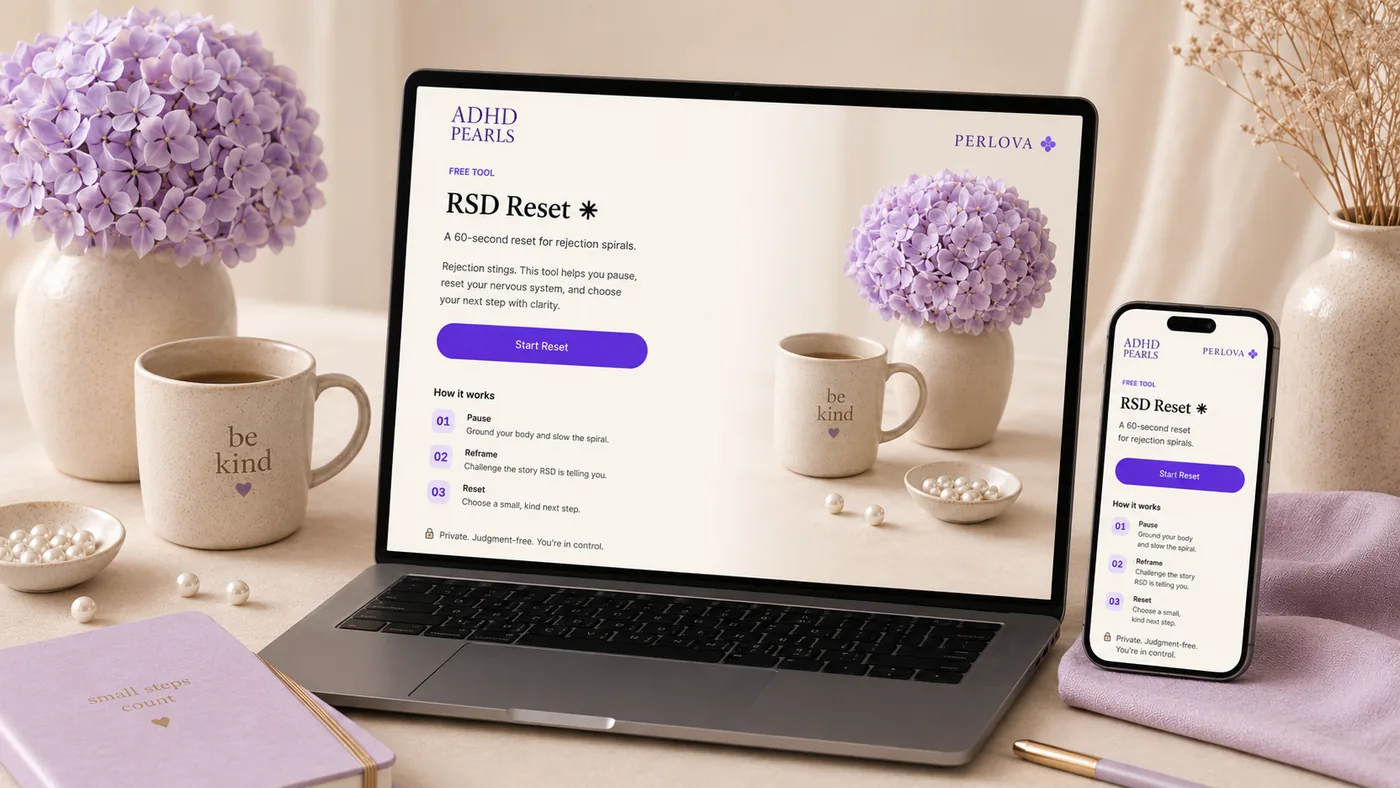
7. Use RSD Reset. It is built for this specific moment. Not therapy. Not a cure. A structured pause before the spiral runs too far.
8. Do one body-based thing first. Walk to the kitchen. Drink something cold. Go outside for ninety seconds. Your nervous system is running the show right now, and it needs a physical signal before reason has any chance.
9. If this is frequent, severe, or affecting your relationships in lasting ways, please speak with a qualified mental health professional. Not because you are broken. Because you deserve actual support, not just coping strategies from a blog.
This is a story, not a verdict.
Before Your Brain Writes the Whole Rejection Story, Pause Here.
Is This RSD, Anxiety, or Just Being Too Sensitive?
Probably some combination of all three, and also: the label matters less than what you do with the information.
Anxiety and ADHD frequently coexist. RSD is not a formal diagnosis — it describes a pattern, not a condition. Many people experience intense emotional reactions to short replies or delayed responses without having ADHD at all. And many people with ADHD experience it intensely precisely because their emotional regulation is already under strain.
The honest answer is: you do not need to prove the perfect label in order to take the pain seriously. If one text message can reliably send you into a spiral that affects your whole day, your relationships, or your ability to function, that is worth paying attention to. Not because something is wrong with you. Because you deserve to understand your own patterns.
If it is severe — if the pain is intense, frequent, and making close relationships feel unsafe — that is worth bringing to a therapist or psychiatrist, particularly one who understands ADHD and emotional dysregulation.
What the Research Says
Briefly, because this is not a medical essay:
Emotional dysregulation is increasingly discussed as a central feature of ADHD, not just a side effect. The American Psychological Association has published work on managing emotional dysregulation in ADHD, noting how significant and under-addressed this dimension of the condition tends to be.
RSD itself is not formally recognised as a diagnosis. It is not in the DSM. It is a term that emerged from clinical observation and community experience — a way of naming something that many people with ADHD recognise immediately but that standard diagnostic language does not yet fully capture.
What we do know is that adult women with ADHD are often diagnosed late, often masked, and often carry a long history of being told their emotional responses are wrong. A systematic review on ADHD in adult women found that internalised symptoms, emotional sensitivity, and social difficulties are common — and commonly missed. That history shapes how rejection sensitivity feels and how much weight one small text can carry.
This article is personal. It draws on research but is not a substitute for professional support.
The Goal Is Not to Stop Caring
I want to be clear about something, because I have read enough advice that implies the goal is to become unbothered, to detach, to care less.
That is not the goal.
The goal is not to become cold. The goal is not to punish yourself for reacting. The goal is to stop letting one tiny message become the whole truth about a relationship, about yourself, about your place in someone’s life.
You cared about that person. You cared about that conversation. That is not a flaw. That is a human thing. The ADHD part is the speed and the intensity — the way the reaction arrived before you could get a word in edgewise with your own nervous system.
Before I was diagnosed, I did not have language for this. I just thought I was broken, needy, or impossible to reassure. What I have slowly learned is that the reaction is not the problem. The reaction makes sense, given the history. The work is to pause long enough to let the story and the fact separate — to sit with the “ok” as just an “ok” before the rest of it builds.
You were not weak because one small text hurt. You were reacting from a nervous system that learned to read danger in tiny signals. The work is not to stop caring. The work is to pause before the story becomes the verdict.
— The ADHD Pearls team
And on the days when the pause feels impossible — when the free free ADHD Dopamine Menu or a walk around the block is the only thing available — that is also enough. One tiny thing before the spiral finishes is enough.
FAQ
Why do short texts trigger rejection sensitivity in ADHD?
Because short texts often leave out tone and context. For many ADHD people, emotional reactions can arrive fast — the body responds before the brain catches up. Without tone or context, the brain may fill in the blanks with a rejection story before there is real evidence of rejection.
Is feeling hurt by an “ok” text an ADHD thing?
Not only ADHD people experience this. But many ADHD people describe intense reactions to short replies, delayed responses, or perceived tone shifts — especially when rejection sensitivity is part of their lived experience. If this pattern is frequent and disruptive, it may be worth exploring with a professional.
Is RSD an official diagnosis?
No. Rejection Sensitive Dysphoria is not a formal DSM diagnosis. It is a term many ADHD people use to describe intense emotional pain around rejection, criticism, disapproval, or perceived abandonment. Many clinicians use the term informally because it names something patients recognise immediately.
Why do delayed replies feel like abandonment?
A delayed reply creates an empty space your brain tries to explain. If your nervous system is already sensitive to rejection, that empty space can quickly become a story about being ignored, disliked, or left. The ADHD short text anxiety around delayed replies is not about logic — it is about what the nervous system does with uncertainty.
What should I do before sending a panic apology text?
Pause before replying. Put the phone down physically. Write what actually happened in one sentence. Write what your brain added on top. Ask what else could be true. Wait until the first emotional wave passes before deciding whether to respond at all.
Can RSD Reset help with text-message spirals?
RSD Reset can help you pause and separate the facts from the story your brain is building. It is not therapy, but it is a structured tool for the moment just before you would otherwise react. That pause can make a real difference.
Why does it feel worse over text than in person?
Because text strips out tone, facial expression and timing, which are the cues your brain normally uses to check whether everything is fine. With those missing, the gap gets filled by prediction, and an anxious brain predicts badly. In person, the same message usually lands as nothing at all.
How do I ask for reassurance without feeling needy?
Ask something small and specific rather than something open. "Are we good?" is easier for both people than a long explanation of the spiral. Most people answer a short question quickly, which is exactly what the nervous system needs.
Should I tell people how I read their messages?
With people who are close to you, it usually helps. A single sentence in advance - short replies land oddly for me, it is not about you - saves a lot of repair work later. You do not owe this explanation to everyone.
Found this helpful? Share it with someone who gets stuck too.
One tap makes ADHD Pearls a preferred source in your Google account, so our articles surface higher when you search. No signup, and it brings you straight back to this page.
Before you go
Free RSD Reset
When one message or moment sends your nervous system sideways.
For the woman who sets up the perfect system on Sunday and abandons it by Tuesday.
One short letter, every week. Real talk about ADHD, task paralysis, and the tiny wins that actually move the needle for a brain like yours. No shame. No hustle culture.