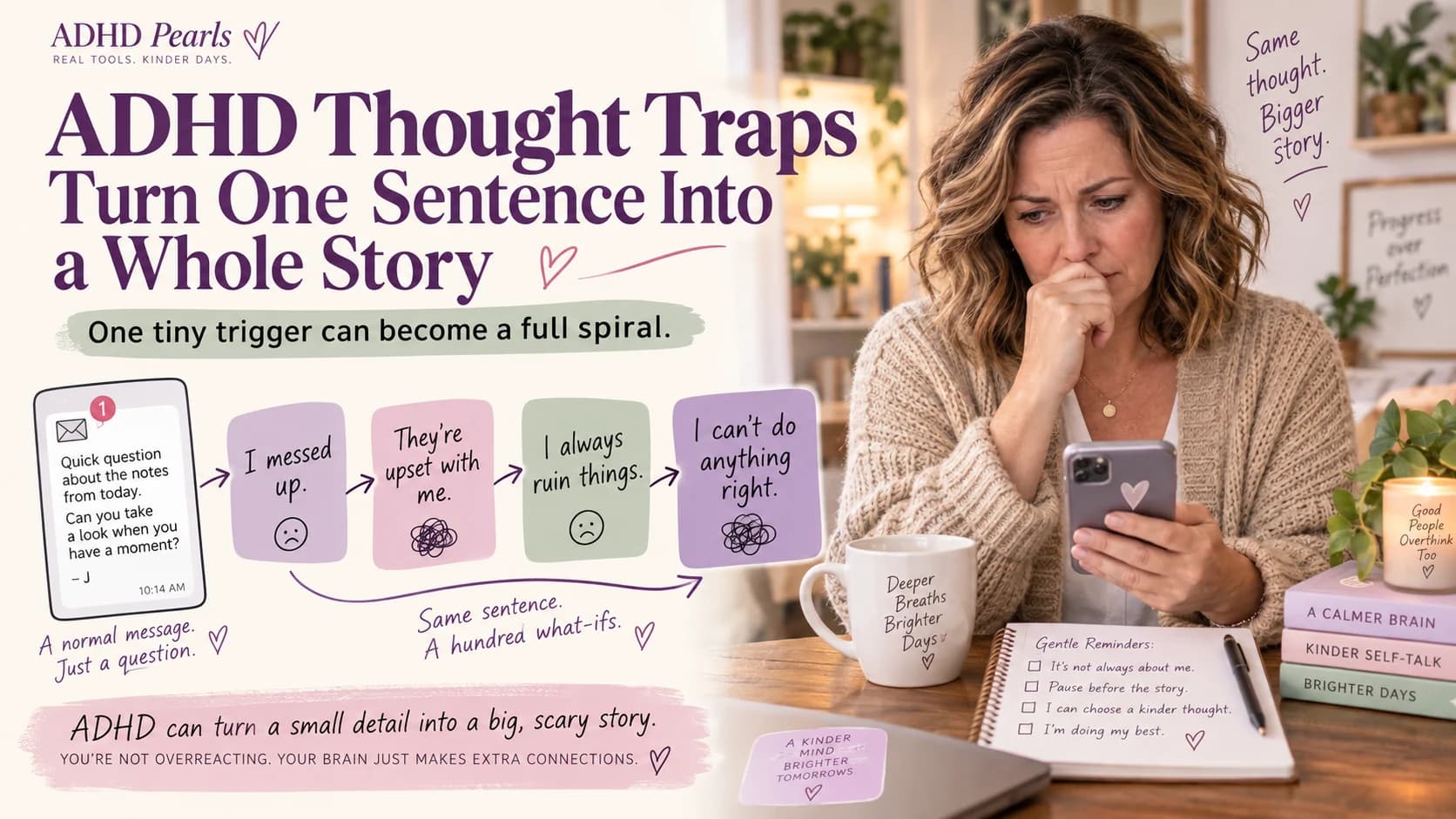
Three words. Possibly four. I was not counting, I was busy.
By the time the dishwasher was loaded I had assembled a full case file: he thinks I am unreliable, he has probably thought so for years, he has definitely mentioned it to his sister, and I should apologize preemptively. In writing.
He had gone back to watching a video about lawn edging.
The event was three words. Everything after that, I built myself.
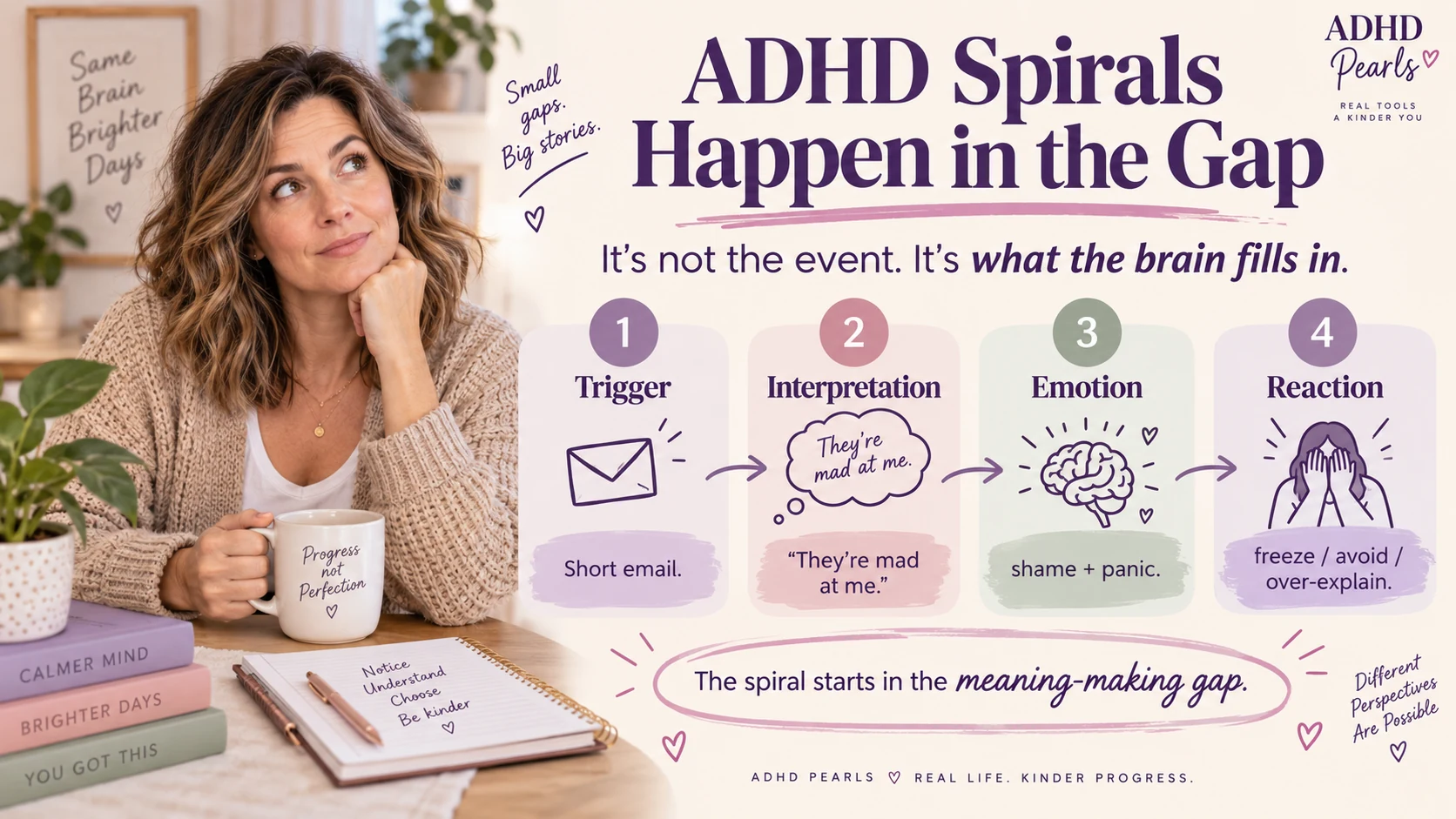
That is what an ADHD thought trap does: it is never the event, it is the meaning your brain bolts onto the event in the first three seconds.
The gap between the two is where the whole afternoon gets decided. And once you can see the traps, they get considerably less convincing.
Quick answer
What are ADHD thought traps?
Thought traps — clinically, cognitive distortions — are the fast, automatic interpretations your brain adds to an event: they think I am unreliable, I always mess this up. They feel like facts and they land like verdicts. They are not unique to ADHD, but research has found adults with ADHD report more of these negative automatic thoughts, and ADHD emotional dysregulation means the reaction often arrives before reasoning does. You cannot delete them. You can learn to check them before they become your whole afternoon.
Key takeaways
📌A thought trap is an interpretation, not an event. The event is usually one sentence long.
📌Adults with ADHD report more negative automatic thoughts than adults without ADHD, even with depression accounted for.
📌The reaction is fast because emotion dysregulation is a core part of adult ADHD — not because you are dramatic.
📌The goal is not to stop having the thought. It is to stop automatically believing it.
📌Self-attack makes every trap worse. Compassion is not an excuse — it is what stops the problem doubling.
Quick note: This article is lived experience plus published research. It is not medical advice. Thought traps overlap with anxiety, depression and trauma responses, and they can look identical from the outside. If these spirals are affecting your work, your relationships or your safety, please talk to a qualified professional.
The Three Seconds Between the Comment and the Spiral
Here is the chain, and it is always the same one.
Something happens → your brain interprets it → an emotion arrives → you react → there are consequences.
Most of us experience that as one smooth motion. It is not one motion. It is five separate things, and the second one is where all the trouble is.
The interpretation is the hinge point — it feels like part of the event, but it is something the brain added. (The card version stops at the reaction; the consequences are the fifth link.)
Thought traps, cognitive distortions — are they the same thing?
Same thing, two registers. Cognitive distortion is the clinical term, borrowed from cognitive behavioral therapy: a habitual, inaccurate way of interpreting an event. Thought trap is what it feels like from inside — something you walk into without seeing it, which then holds you there. The clinical name is the one in the research below; the other is the one you will actually use at 11pm.
With ADHD, the chain runs fast. A 2020 meta-analysis found emotion dysregulation is a distinct feature of adult ADHD, and the gap was not subtle: a large effect, Hedges’ g = 1.17 against people without ADHD, with emotional lability the biggest single piece of it at g = 1.20. So the emotion is often already at full volume before the part of you that would say hang on, that is a guess has arrived at the desk.
There is research on the thoughts themselves, too. In a study of 81 adults with ADHD and 43 without, the ADHD group reported significantly more negative automatic thoughts — and that held even for the participants who had no depression alongside it. Interestingly, it was the inattentive symptoms that tracked with those thoughts, not the hyperactive ones.
In a separate clinic sample of 30 adults, self-reported cognitive distortions correlated with ADHD, and one pattern was endorsed more than any other: perfectionism. Which will not surprise anyone who has ever abandoned a twenty-minute task because it could not be done in the full hour.
Worth being honest about the research, though. A later study of 112 adults found the link between cognitive distortions and ADHD severity weakened once depression, anxiety and personality traits were controlled for. So this is not ADHD causes distorted thinking. It is closer to: these thoughts are common in the pile-up that ADHD tends to arrive with — years of missed deadlines, real criticism, shame that outlived the diagnosis, and a nervous system that reacts first and checks later.
Which is reason enough to learn their shape. If you want the wider picture first — why the emotional side of ADHD hits this fast at all — that is the guide to emotional ADHD and RSD. This article is the thinking half of it.
I do not have a discipline problem in the ninety seconds after a comment lands. I have a speed problem. I went looking for something that would slow those ninety seconds down, and found either breathing apps designed for people already calm enough to open a breathing app, or journals asking me to describe my feelings while my hands were still shaking.
🔍What just happened? The event, in the fewest possible words.
🧠What is your brain saying about it? The story, written down where you can see it.
🛑How loud is this in your body right now? Because the volume is information too.
✅One tiny next step. Usually not the reply you were about to send.
It has not stopped my brain jumping to he told his sister. It has stopped a decent number of those sentences from getting sent, which is a smaller claim and a truer one.
From ADHD Pearls
Free RSD Reset
When one message or moment sends your nervous system sideways.
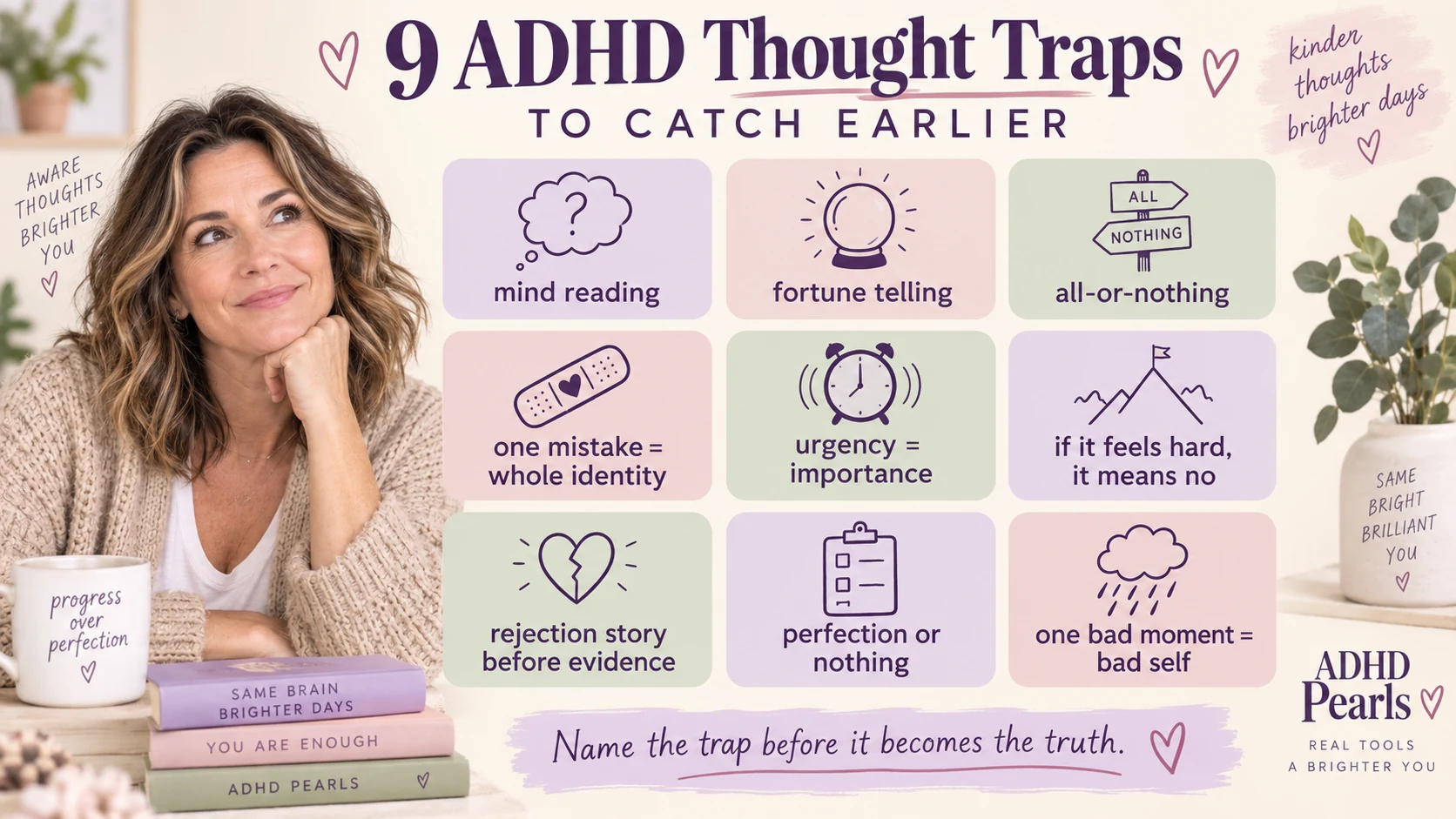
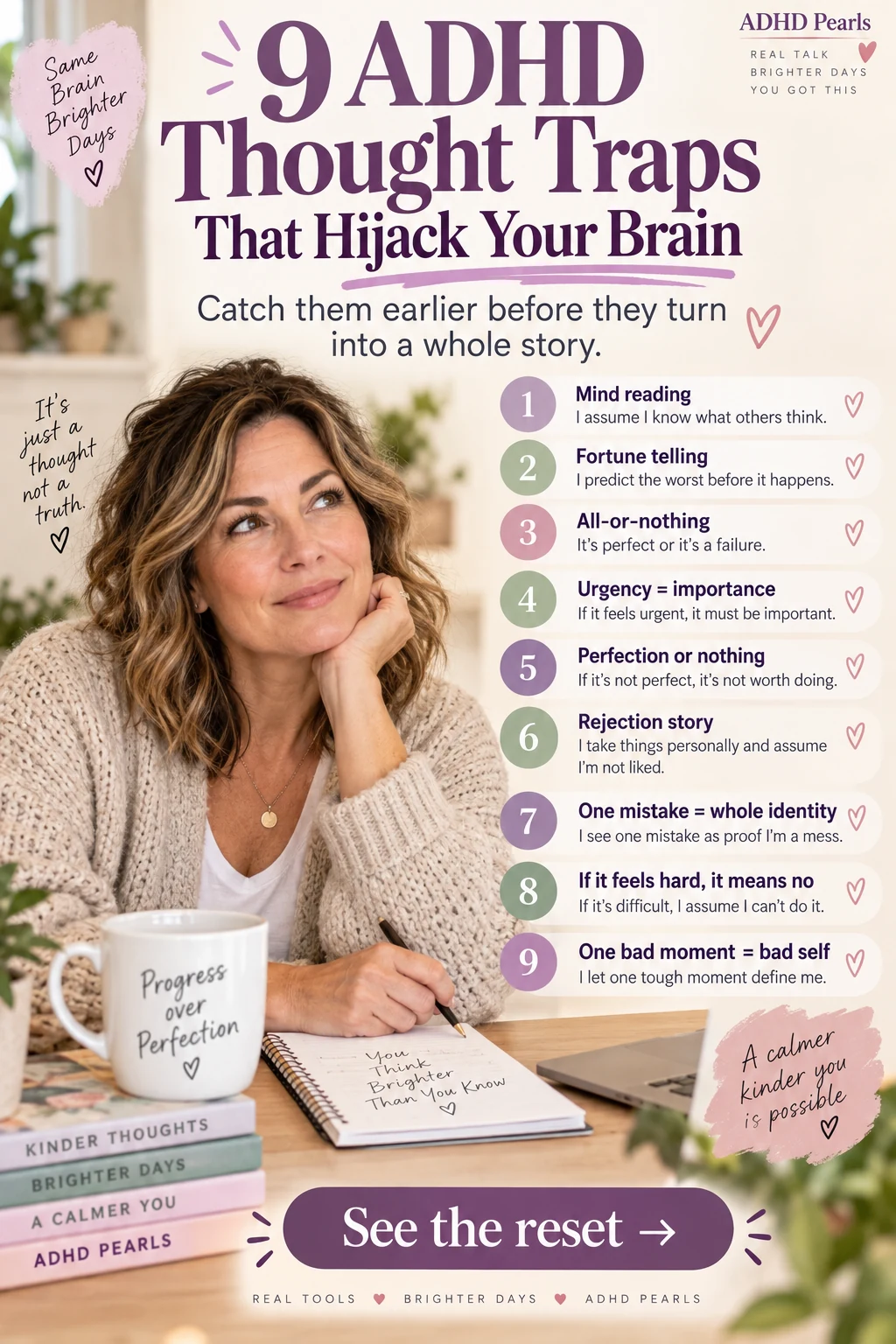
Each one below has the same four parts: the thought as it actually arrives, the question that interrupts it, what tends to land instead, and the line worth keeping.
Shorthand for the patterns, in the words they actually arrive in. The nine sections below are the full versions, under their clinical names.
1. Catastrophizing — “This is going to be a disaster”
One small problem becomes the beginning of the end. You miss a deadline and within four seconds your brain has arrived at: my boss no longer trusts me, this will come up in the review, I should quietly update my resume.
🛑 The thought: “This is going to be a disaster.”
🔍 Challenge it: “What is actually happening right now?”
✅ What lands instead: “I missed a deadline. I need to deal with that. That is the whole size of it.”
💡 Remember: a problem is not a prophecy.
2. All-or-Nothing Thinking — “If I can’t do it properly, there’s no point”
With ADHD the distance between perfect and pointless is remarkably short. I once skipped a workout because I had twenty minutes instead of an hour, then spent those twenty minutes reading about workouts.
🛑 The thought: “If I can’t do this properly, why bother?”
🔍 Challenge it: “Does this actually have to be perfect?”
✅ What lands instead: “Twenty minutes is more than zero minutes.”
💡 Remember: done imperfectly beats perfect in your head.
3. Mind Reading — “I know what they’re thinking”
A short reply. A face that did something. Four hours of silence. Your brain fills the gap, and it never fills it with anything flattering.
🛑 The thought: “They’re annoyed with me.”
🔍 Challenge it: “Do I know that, or am I guessing?”
✅ What lands instead: “I don’t know what they’re thinking. There are several extremely boring explanations.”
💡 Remember: a guess is not a fact.
One mistake gets promoted to an identity. You forget something, and instead of I forgot, your brain files I’m unreliable — permanent, characterological, case closed.
🛑 The thought: “I forgot again. I’m so unreliable.”
🔍 Challenge it: “Am I describing what happened, or who I am?”
✅ What lands instead: “I forgot a thing. I need a better system for remembering that kind of thing.”
💡 Remember: you made a mistake. You are not the mistake.
5. Overgeneralization — “This always happens”
One late arrival becomes a life sentence. I was fifteen minutes late to a dentist appointment and concluded, in the waiting room, that I had never once been on time for anything — which was demonstrably untrue, since I had been on time for the previous appointment, which is why they still had me on file.
🛑 The thought: “This always happens.”
🔍 Challenge it: “Always? Genuinely always?”
✅ What lands instead: “This happened today.”
💡 Remember: one bad moment is not a pattern.
6. Emotional Reasoning — “I feel it, so it must be true”
The feeling becomes the evidence. You leave a meeting feeling embarrassed, and the embarrassment gets treated as proof that everyone in the room agreed with it.
🛑 The thought: “I feel like they were disappointed, so they must have been.”
🔍 Challenge it: “What is my actual evidence?”
✅ What lands instead: “The feeling is real. The conclusion might not be.”
💡 Remember: feelings are signals, not verdicts.
Nine good comments and one suggestion, and you will be carrying the suggestion to bed. I have replayed a single line of feedback on a presentation for three days while the other nine sentences evaporated on contact.
🛑 The thought: “They hated my work.”
🔍 Challenge it: “What else was said?”
✅ What lands instead: “There was one criticism, and there was also positive feedback I skipped straight past.”
💡 Remember: don’t let one negative pixel become the whole picture.
8. “Should” Statements — “I should be able to do this”
This one is brutal with ADHD, because should measures you against a brain you do not have. And it never solves anything. It adds shame on top of the original problem, so now there are two problems and one of them is invisible.
🛑 The thought: “I should be able to remember this.”
🔍 Challenge it: “Is should helping me solve this?”
✅ What lands instead: “This is hard for me. What support would make it easier?”
💡 Remember: “should” describes an expectation. “What helps?” solves a problem.
9. Personalization — “It’s all my fault”
You automatically pick up responsibility for everything in the room, including the parts that were never yours: the supplier who was late, the brief that was vague, the colleague who went quiet for two weeks.
🛑 The thought: “The project went badly because I ruined it.”
🔍 Challenge it: “Which part was actually mine?”
✅ What lands instead: “I can own my part without carrying the whole thing.”
💡 Remember: own your part. Don’t carry the whole story.
The Missing Ingredient Nobody Mentions
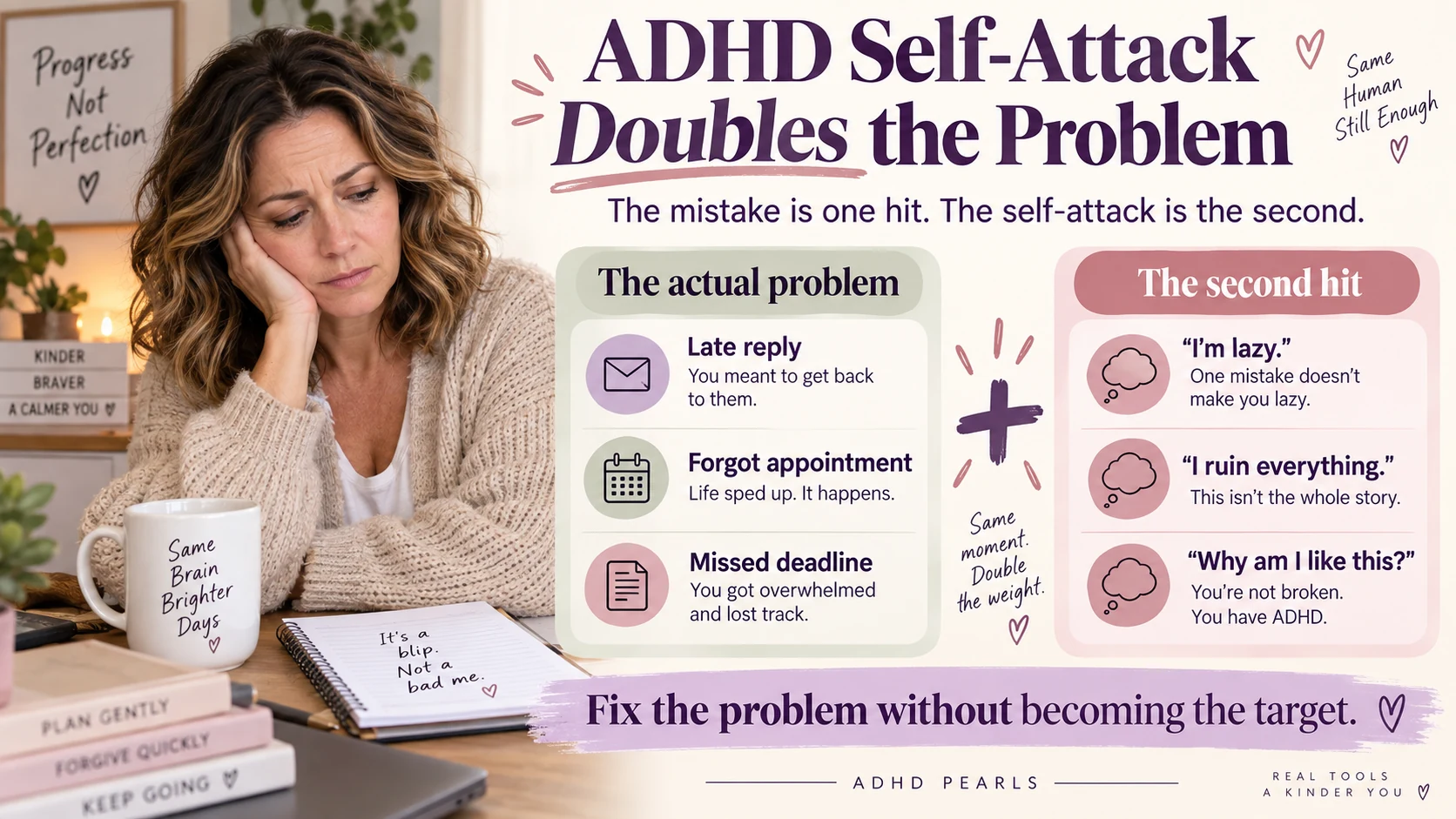
There is one thing that makes every trap on this list worse, and it is not the trap. It is what you do to yourself immediately afterwards.
Self-compassion has a public relations problem — it sounds like letting yourself off. It is not that. A 2022 study of more than 850 adults found people with ADHD reported lower self-compassion than people without, and that lower self-compassion was linked to more depression, anxiety and stress. The self-attack is not a motivator. It is a second injury, arriving while you are still dealing with the first.
What it actually means is separating the event from the identity:
•“I messed up” is not “I’m a mess.”
•“I need to fix this” is not “there’s something wrong with me.”
•Instead of why am I like this, try this is hard for me — what would help?
Fixing what happened and attacking who you are are two different jobs. The second one does not make the first any easier.
That is not letting yourself off the hook. It is refusing to make the problem bigger by attacking the only person currently available to fix it. If the self-attack is the loudest part for you, the ADHD shame detox goes deeper into where that voice came from.
The goal was never a brain that doesn’t spiral. It is two seconds between the thought and the reply.
The 30-Second Reset
One comment. Two completely different afternoons.
Someone says: “You’re late again.”
What happens next
Without the pause
“They think I’m unreliable” → shame → defensiveness → an argument about something else entirely
With the pause
“I feel attacked” → pause → “what actually happened?” → a reply you would still stand behind tomorrow
Same sentence. Different afternoon. The pause is where your choice lives.
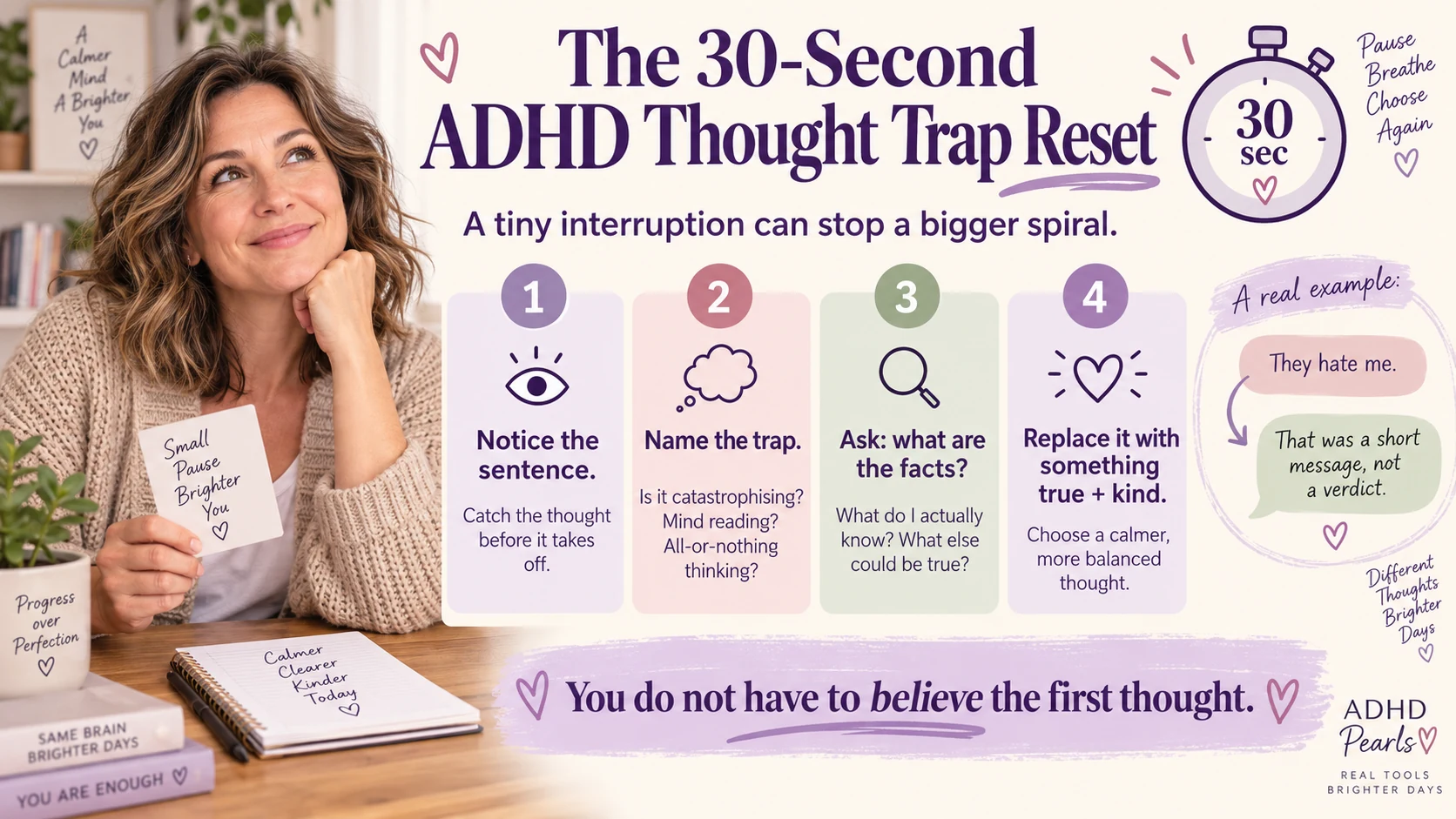
The short version, for when there is no time to read five steps. The pause is not about deciding everything is fine — it is about checking whether the first interpretation gets to run the afternoon.
When you notice the spiral starting:
🛑Stop. Do not reply yet. Nothing needs answering in the next thirty seconds.
🧠Name it. Which trap is this? Mind reading? Labeling? Catastrophizing?
🔍Check it. What evidence do I actually have?
🔄Reframe it. What other explanation fits exactly the same facts?
✅Choose. What response will actually help me here?
You do not need to win the argument with the thought. You just need to stop taking its word for it.
A small thing you can do today: the next time a sentence lands badly, write down the actual event in as few words as possible — “he said I forgot” — with none of the meaning attached. Most of the time the event turns out to be astonishingly small, and seeing it that small does more than any reframe.
FAQ: ADHD and Thought Traps
What are ADHD thought traps? They are automatic negative interpretations — cognitive distortions — that your brain attaches to an event, like assuming a short reply means someone is angry. They are not exclusive to ADHD, but adults with ADHD report more of these automatic negative thoughts, and ADHD emotional dysregulation means they tend to arrive faster and louder.
Are cognitive distortions more common in ADHD? Research suggests adults with ADHD report more negative automatic thoughts than adults without ADHD, even after depression is taken into account. One later study found the association weakened once anxiety, depression and personality traits were controlled for, so the picture is not simple. What is well documented is that these thoughts are common, and that they respond to being questioned.
Why do ADHD spirals happen so fast? Emotion dysregulation is increasingly treated as a core feature of adult ADHD. A 2020 meta-analysis put the difference against people without ADHD at Hedges’ g = 1.17, which is a large effect, with emotional lability the largest component. The emotional response often reaches full intensity before the reasoning part has caught up, which is why advice to think about it logically arrives far too late to be useful.
Is this the same as rejection sensitive dysphoria? They overlap but they are not identical. RSD describes the intense, fast emotional hit after perceived rejection or criticism. Thought traps are the stories the brain builds during and after that hit. Many people experience both at once — first the hit, then the case file. Here is what that looks like from the inside.
Does challenging a thought mean I am gaslighting myself? No, and the difference matters. Challenging a thought is not telling yourself everything is fine. It is asking what you actually know. If the evidence supports the negative interpretation, the answer is to deal with the real problem — not to talk yourself out of it.
Does CBT help with ADHD thought traps? Cognitive behavioral therapy adapted for adult ADHD is one of the better-supported psychological approaches, and modifying negative automatic thoughts has been proposed as one of its mechanisms of change. Standard CBT without ADHD adaptation tends to work less well, because the challenge is often the speed of the reaction rather than the logic of the thought. A clinician familiar with adult ADHD is worth seeking out.
What if the negative thought is actually true? Sometimes it is, and that is fine. Missing a deadline can be an accurate observation. The trap is not the fact — it is the extension: and therefore I am unreliable, and therefore this is the beginning of the end. Keep the fact. Question the extension.
How long does it take to get good at catching these? Most people describe months rather than weeks, and progress is uneven. Early on you tend to catch it afterwards, on the drive home. Later you catch it during. Catching it afterwards still counts — that is the skill arriving late, not failing.
When should I get professional support? If the spirals are constant, if your mood stays low between them, if you are avoiding people or work to prevent them, or if the thoughts turn to harming yourself, please speak to a doctor or a qualified mental health professional. Thought traps can look a lot like depression and anxiety from the outside, and the right support depends on knowing which one you are dealing with.
Save this for the next time one small comment turns into a full case against yourself.
Pause. Check. Reframe. Try again.
One Last Thing
Your brain will keep jumping to the worst available interpretation. Mine still does, usually while I am holding something breakable.
The goal was never to stop having the thoughts. It is to catch a few of them before they turn into an entire afternoon.
💙 And on the days you do not catch one — there will be plenty — the RSD Reset is sixty seconds of somewhere to put it: name the event, name the story, notice the volume, pick one small next step. Free, it opens straight into the steps, and it works on a phone at 11pm, which is when most of this happens anyway. It has not made me a calmer person. It has made the gap between the thought and the reply about two seconds longer, which turns out to be the whole difference.
Pause. Check. Reframe. Try again.
You don’t need a better brain. You need two seconds between the thought and the reply. 🧠💙
Found this helpful? Share it with someone who gets stuck too.
One tap makes ADHD Pearls a preferred source in your Google account, so our articles surface higher when you search. No signup, and it brings you straight back to this page.
Before you go
Free RSD Reset
When one message or moment sends your nervous system sideways.
For the woman who sets up the perfect system on Sunday and abandons it by Tuesday.
One short letter, every week. Real talk about ADHD, task paralysis, and the tiny wins that actually move the needle for a brain like yours. No shame. No hustle culture.